Incidents of a Whaling Voyage

Featured

by

A. C. C. Thompson  (1821-1877)

BEING A TRUE ACCOUNT OF THE VOYAGE AND
SHIPWRECK OF THE AUTHOR.

Written for The Central Georgian, in the year 1859.
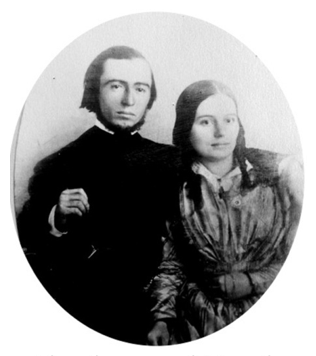
A. C. C. THOMPSON and his wife Sarah Haddaway around the time of their marriage in 1844, the year after he returned from his voyage. He would have been about 33 years old.

INTRODUCTION

“Incidents of a Whaling Voyage”, was written by my great-great-grandfather, Dr A. C. C. Thompson, in a series of articles for a Georgia periodical in 1859, sixteen years after his return to America. It came to me in the form of a pamphlet published with a Forward by his grandson James Wooten McClendon Jr in the mid-20th century, exact date unknown. His forward will serve to introduce the author.

In creating a digital file of my great great grandfather’s story, I have refrained from exercising an editorial hand, with the following exceptions: 

•  Where he has spelled the same word differently in different places, I have settled on one spelling with a preference for current practice. 

•  Frequently the names of geographic locations have changed over the intervening 180 years, and in those cases I have substituted the modern name or spelling.

•  For the sake of clarity I have added or subtracted a word here and there.

•  I will confess to having eliminated a lot of commas and semicolons where they seemed unnecessary. I know I have done the same with my own writings; I think we were trained to sprinkle them everywhere, y’know, back in the day.

• I assume that all the poetry is his; whether composed during the voyage or later I do not know.

Having said all that, this narrative remains a remarkable document of this young man’s wanderlust. Once he set foot on the whaling ship Cadmus and watched the coast of Massachusetts disappear over the horizon, this new medical school graduate, not yet 20 years old, stepped into an entirely different world than the one he grew up in, for the life of a common sailor on a 19th century whaling ship was no picnic. 

One hundred forty years later I myself, with likewise very sketchy credentials as a seaman but apparently a genetically-inherited wanderlust, sailed into the very same harbor of Pape’ete, Tahiti….for that story see my post “The South Pacific”.

Dr A. C. C. Thompson is the character in my family history that I am most invested in exploring and documenting. Another writer — Gary D. Crawford — laid the groundwork for my interest in a series of articles for the Tidewater Times of Chesapeake Bay 2016-2019, one of which, “Global Links”, he was kind enough to allow me to reprint here on my blog before he passed away in 2020.

I hope in the future to flesh out the history that Mr Crawford sketched out, explore and maybe answer some of the perplexing questions he posed to me back in 2019, and address the role that slaveowners played in the midlands between North and South at a time that slavery was perhaps the number one topic of national debate and about to plunge the country into a bloody civil war; and for me personally, the question of how we, the descendants of slaveholders could, should, would or might look back on all this….and move ahead.

Joseph McClendon Stevenson, Astoria, Oregon, July 2025

FORWARD

Dr. A. C. C. Thompson, my maternal grandfather, was born in Talbot County on the Eastern shore of Chesapeake Bay in Maryland. He was the only child of Dr. Absalom Thompson, a prominent physician, who had a large colonial residence on a large tract of land, known as Webbley, or Mary’s Delight, fronting on the bay. There, Dr. Thompson established and operated a hospital, the only institution of that nature in that vicinity. The building is still there and well-preserved with some minor alterations and additions. A history and description of it is published in the March, 1954 edition of the Maryland Historical Magazine. The Bay front of the building is pictured on the front cover.

Grandfather Thompson was born October 12, 1821. He was named Absalom Christopher Columbus Americus Vespucius Thompson. According to family tradition, his father wanted him named for himself and the discoverer of America; and, since at that time, there was a dispute as to which was the real discoverer, he named him for both. Later, the son dropped “Americus Vespucius” from his name.

He was graduated in medicine from a Baltimore college. Shortly thereafter he was sent to Massachusetts on a business mission. After its accomplishment, and at the urge of an innate wanderlust, he apprenticed himself to a whaling schooner for a three year’s voyage to the Pacific. Being under 21 years of age, he registered under the assumed name of “Charles Rochester from Easton, age 22, height 5’ 3¾“, light complexion, sandy hair.”

Dr. Thompson was in the Marquesas Islands when the French took possession in May, 1842 (See Encyclopaedia Britannica, Vol. 14, page 939, 14th edition, 1920). He spent nearly three months in Tahiti, whence he sailed on an English boat bound for Chili or Peru. This must have been about September or October, 1842. According to a statement by my mother, he travelled overland across Brazil to some port on the Atlantic or Caribbean, whence he returned by ship to Maryland, arriving after his father’s death. He claimed his father’s bequests and engaged for a while in a mercantile adventure, which was not very successful, in Wilmington, Delaware. On May 3, 1844, he married Sarah Ann Haddaway, a descendant of two prominent families of Maryland, the Webbs and the Haddaways.

Three girls and a boy were born to them. The oldest, my mother, was born April 1, 1845, in Wilmington, Delaware, as were the two other girls. The son, George Calvert, was born April 23, 1853, after the family moved to Burke County, Georgia. He was ordained by Bishop Pierce, as was his father, as a minister of the Methodist Church, South.

Dr. A. C. C. Thompson served as a surgeon throughout the Civil War in the Third Georgia Regiment. He preferred teaching to practicing medicine, however, and established a number of schools in various parts of Georgia. Among them, one at West Point where my mother was one of the teachers and married my father who was mayor of the town. The school was later transferred to the public school system of West Point. (See West Point in the Chattahouchie, 1920, pages 88-89.)

James W. McClendon

Incidents of a Whaling Voyage

On a clear and cold morning — November 11th, 1841 — the good ship Cadmus weighed anchor and departed from the harbor of Fairhaven, with a free quarter breeze and a flowing sheet, on a whaling voyage to the Pacific.

There is generally a peculiar feeling of mingled anxiety and expectation which impresses those about to start on a long journey; but on leaving our native land to be absent for years, and probably never again to return, there is an indescribable gloom which comes over the soul and burdens the heart with sadness.

As we moved gracefully down the Bay, the houses and spires in the towns of New Bedford and Fairhaven gradually faded in the distance, and in a few hours we were upon the bosom of the Atlantic, leaving the shores of Massachusetts as a faint blue outline on the western horizon.

I bade my native land farewell

And turned on other thoughts to dwell;

But oft’ there would a vision come,

On memory’s view of happy home.

My happy home! when shall I see

The sacred place so dear to me?

Thy imagery shall ne’er depart,

From the fair tablet of my heart.

The first regular business after clearing the Bay and dismissing the pilot, was to choose watches; and as this may not be understood by many of my readers, I beg leave to explain.

The business on board of a ship is conducted with the strictest discipline. The crew is divided into two sections or watches called the starboard and larboard watches. The terms starboard and larboard mean the right and left side of the ship, and as the starboard side of the quarterdeck is appropriated to the commander, the watch which is under his immediate command, or under his chief officer, is called the starboard watch, and that which is under the control of the second officer or mate is called the larboard watch.

Our crew consisted of 38 men all told including the Captain, 4 Mates, 4 Boat Steerers or Harpooners, Carpenter, Cooper, Steward, Cabin-boy, Cook, and 24 men before the mast, i. e., the common sailors, among whom was your humble narrator. According to custom, the men were mustered aft, and the first and second mates selected alternately until the crew were divided into watches as before mentioned, after which the Captain lectured the crew briefly upon the importance of strict discipline. The starboard watch was then called on duty and the larboard watch retired below, some of them to take their first rocking slumber upon the briny ocean.

To give some idea of the strict regularity that is observed in all the business and evolutions of a well regulated ship, I will now state the duties of the watches and the general character of the nautical government. In designating time on ship board, instead of mentioning the hours of the day, we designate them by watches and bells according to the following regulation:

The sea-day of 24 hours is divided into 4 regular watches of 4 hours each, and 3 short watches of two hours each called the dog watches. The time in these watches is divided into bells; that is, there is one tap given to the watch bell for every half hour during the watch, so that 8 bells make a complete watch and 4 bells make a dog watch. Therefore when 8 bells strike, one watch goes off and another watch comes on duty. If a sailor wishes to tell that anything occurred on Thursday at 10 o’clock, a. m. he says “on Thursday at 4 bells in the forenoon watch”. Only one officer exercises command during a watch; for instance the first mate commands the larboard watch and when he is on duty he is said to be the officer of the deck. The same is said of the second mate when he is on duty with the starboard watch. When the officer of the deck gives a command, it is given in a very positive manner, and the sailor must always answer “Aye, aye Sir,” and obey the order immediately, without asking why or questioning its propriety. I will now mention some rules of etiquette on board of a whale ship, which are as rigidly observed as the rules of a monarch’s court.

All that part of a ship’s deck abaft the mainmast is called the quarter-deck. The officers generally occupy this part of the ship, and the sailors never come upon the quarter-deck, unless to perform some duty. When a ship is at moorings or running before the wind, the starboard side of the quarter-deck is reserved for the captain or for the officer in command, and the other officers confine themselves to the larboard side. When the ship is sailing upon the wind, then the Captain or officer in command occupies the weather or windward side and the other officers the lee side. When a sailor goes aft on duty, he must never walk upon the quarter-deck which is appropriated to the commander unless his duty compels him to go upon that side.

When breakfast, dinner, or supper is ready, the Steward always makes the announcement first to the Captain, and then to each officer in regular succession according to rank, allowing nearly a minute to intervene between each announcement.

Spitting upon the deck is strictly forbidden, and when an officer or seaman wishes to spit he must always go to the lee side.

DAWN AND SUNRISE.

Nothing can exceed the beauty of day-dawn and sun-rise at sea when the weather is clear and moderate. On the morning of our second day at sea the sky was cloudless, with a very light breeze from the westward; the ship alternately rose and descended with a slow, graceful motion upon the long rolling waves, which were scarcely ruffled by the gentle breeze. A profound silence brooded o’er the ocean, and the sweet stillness was only broken by the flapping of the sails against the spars, the creaking of the rudder and the measured tread of the watch as they paced upon the deck. A faint grayish streak was seen on the eastern horizon, gradually brightening into a mild silvery light which kissed the tops of the slow rolling waves. The dawn rose higher, spread wider, and grew brighter, until a soft holy light was spread over the visible surface of the ocean. Next a roseate blush was diffused over the eastern horizon, and soon the glorious sun rose majestically from his liquid bed, pouring a flood of sparkling light upon the surface of the ocean, without a single object except the ship to intercept his beams. I have witnessed many lovely dawns and sun-risings at sea, but the first made an indelible impression upon my mind and feelings, and was sufficient to compensate for many unavoidable privations.

The silvery beams of morning light

Come, gently stealing on my sight;

Then, orient blushes light the sky, 

With loveliest hints of roseate dye.

Now rising from his watery bed,

The glorious sun his radiance shed; 

And with a flood of light he laves, 

The ambient sky and rolling waves.

THE FIRST STORM.

As we approached the Gulf-stream on the evening of the second day, the heavens gradually assumed a foreboding aspect. The sun went down behind heavy banks of leaden clouds whilst a thick vapory curtain hung around the eastern horizon. That night during the latter part of the evening watch, the alarm bell rung, and all hands were called in great haste to take in sail. As soon as we waked we heard the roar of the tempest, the loud commands of the officers, and the tumultuous trampling of the watch upon deck; whilst the ship was pitching and plunging as if she were trying to jump from under us. We rushed upon deck and found everything in confusion. A violent gale was blowing from out of the East, the rain descended in liquid sheets, and the mountain waves were rushing and foaming, as if the ocean was angry at being thus disturbed in the solemn hours of the night.

Our noble ship was careering gallantly over the waves with the white sails fluttering in the gale; the yards had been hastily lowered upon the caps, and the sails clewed up, which caused them to flow loosely and soon, the sailors were in the rigging and upon the yards, pulling and hauling; which, with the stern commands of the officers, and loud responses of the seamen heard above the roaring of the tempest, and all mingled with utter darkness, presented a scene of confusion and consternation, unequaled to those who had never witnessed it before. During this confusion a huge foaming wave broke over the larboard quarter, submerging the deck and sweeping off one of our boats from the cranes.

However, the ship was soon put in proper trim; the spanker was closely brailed, the top gallant sails, staysails and jibs were furled, and the ship laid to under double-reefed main and fore topsails.

Our gallant ship bent to the blast,

And felt the shock through hull and mast;

She leaped and plunged like some huge beast, 

That struggles hard to be released.

The howling tempest and the rain, 

Rushed madly o’er the watery main; 

Whilst night’s dark curtains circling ’round, 

Rendered the horror more profound.

The storm began to abate during the morning watch, and soon after day we made all sail and steered South East, intending to touch at the Cape Verde Islands.

Perhaps it will be proper to give some description of our officers and crew, inasmuch as I shall have frequent occasion to introduce them during the voyage. Our commander Captain Mayhew was a man of some piety, and a member of the Baptist church. He was a strict disciplinarian, but very mild in his administration; and not only forbade all profane language among the officers and crew but discountenanced all filthy and vulgar practices. As an example of his manner of reproving the officers or sailors for swearing, I will relate the following incident: On one occasion, the third Mate commenced swearing vehemently at some of the sailors, and Captain called the Steward, and handing him a cup of water and a piece of soap bade him take it to Mr. Crowell, with the request that he would wash his mouth. The third Mate felt the reproof, very sensibly, and was careful that the Captain should not hear him swear again.

Our Mate — Mr. Norton — was an excellent seaman, a good scholar, and a gentleman of considerable refinement. He was a better navigator than the Captain. Our second Mate,—Mr. Fish — was a noble-hearted sailor, and a good officer, but his education and accomplishments were very limited.

The third Mate — Mr. Crowell — was profane and vulgar, and possessed very few good qualities to recommend him. The fourth Mate — Mr. Chase — was an illiterate man, but he possessed good principles and was an enterprising officer. We had 4 Boat-Steerers, or harpooners — a kind of second class officers whose duties were to steer the whale boat, harpoon the whale, and take part in the general exercises of working the ship. Among these we had one low dissipated fellow — a Portuguese — but the other three were clever active young men, who generally conducted themselves very well. Our Cooper was a stern old seaman, possessing great physical powers and ever ready to brave any danger, as will appear in some of my subsequent narratives. The Carpenter of our ship was a tolerably smart man, who had seen much of the world. He would sometimes remark, “Well boys, I served two years on board of a privateer, was taken prisoner and stowed away in a prison ship in England; I served in the Florida war, I have had several narrow chances of being sent to the penitentiary, and now I am on a whaling voyage; what will come next, the Lord only knows.” Among our crew we had only three men who loved rum excessively; the others were temperate or moderately so, and were all active and obedient except one Portuguese, who was passionate and stubborn, and a young man from New York, who was so lazy and entirely worthless, that he was rejected and sent home. Among the common sailors was a very pious young man of the Methodist persuasion — James Hutchens of Fairhaven, Mass. There were ten experienced seamen before the mast and fourteen green hands who had all the nautical operations and whaling business to learn. Besides the regulars, we had on board Dr. Wells, passenger to Tahiti.

Our ship was strong and well equipped, and with such a crew as I have briefly described, we started for the Pacific on a three years whaling cruise. Our chief occupation during the early part of the voyage, was to work the ship, keep the rigging and sails in good order, look out for whales, and occasionally, when the weather was moderate, the boats were lowered, and the men drilled in rowing and the usual whaling tactics. Dr. Wells and six or eight of our green hands suffered considerably for several days from seasickness, but in the course of 10 or 12 days they had all recovered from their sickness, and were able to partake of the rough sea diet and perform their regular duties with alacrity.

After the storm which I have already described, nothing very interesting occurred, until we arrived at the Island of St. Nicholas, one of the Cape Verde group near the coast of Africa. In the afternoon of Dec. 7th, the joyful cry of “Land ho!” sounded from the main lookout. “Where away?” cried the officer of the deck. “Three points off the lee bow!” responded the lookout. The Mate then went aloft with spy glass, and in a short time made it out to be the Isle of St. Nicholas, distant about 35 or 40 miles. We were running down the trade winds on the larboard tack, with a stiff quarter breeze and making about eight knots per hour. Most of the officers and sailors ascended the rigging to get a sight of the desired object, which was seen like a blue cloud upon the southern horizon. Gradually it became more distinct, until the separate peaks of the mountains, and the deep gorges and valleys began to appear, and the blue hazy tint by degrees assumed first a pale and then a deep brown color.

We had been 27 days at sea and had seen no land since we left the shores of Massachusetts; consequently many of us were much rejoiced by the sight of terra firma. When we had approached within three or four miles of the Island, we ran down the eastern side to enter the Port.

This Island presented a novel feature to those of us who had never seen mountainous land. The whole Island appeared to be a mass of mountains presenting in the interior four or five prominent peaks about 6000 feet high, which gradually sloped to the ocean, with many gradations of hills and valleys, to break the regularity of the slope. There are eleven islands belonging to this group extending from 14½ to 17% degrees North Latitude, and situated about 400 miles from the West coast of Africa. They belong to Portugal, are inhabited by a mixed race of Portuguese and Mulattoes, and are of very little commercial importance; being so sterile as barely to yield a scanty subsistence for the inhabitants. Some of these islands carry on a very limited trade in salt, which they procure by evaporating sea water. Our object for stopping at St. Nicholas was to procure a supply of pigs, poultry and vegetables, which we purchased at reasonable prices in exchange for sea bread, soap, calico, etc. Finding that we could not enter before dark, we “lay off and on” during the night and early in the morning stood in for the Port. As we neared the land, we beheld the surf beating violently against the rocky shore; and finding the Port very narrow and incommodious, we did not enter, but sent two boats ashore, whilst the ship laid to in the offing. On landing, we found the beach crowded with a promiscuous throng of men, women and children, most of whom were poorly clad, and appeared to have been but scantily fed. Many of them had come from the interior, bringing with them various articles of produce, which they were anxious to sell to our Steward. There was a small collection of houses; some of them built of rock, and some of sun dried brick, having roofs thatched with plantain leaves. As there was nothing about the Port to interest us, we made up a party of nine to visit the town of St. Nicholas situated seven miles in the interior. Our party consisted of the Captain, second Mate, one Boat- steerer, Carpenter and five sailors; the third Mate and three sailors being left to take care of the boats, whilst the Steward made the purchases. I was placed with those who were to watch the boats, but I succeeded in hiring one of the sailors to remain in my stead, and I obtained permission to accompany the party to the town.

VISIT TO THE TOWN OF ST. NICHOLAS.

By taking a foot path over the mountains, the distance from the Port to the town of St. Nicholas was only four and a half miles; whilst it was seven miles by the road. We determined to take the route over the mountains, that we might enjoy the scenery and therefore hired a Portuguese lad for a guide. For nearly a mile the ascent was gradual, not rising more than 800 feet above the level of the sea. This portion of the Island might properly be called table land; or rather, several belts of table land, with a red silicious soil, considerably intermixed with gravel. We passed a few rude cottages upon this table land surrounded by small barren fields or patches, which were walled in white stone for there is scarcely any wood upon the Island. We saw numerous flocks of goats, and occasionally a few diminutive donkeys, feeding upon the scanty herbage, but there were very few indications of intelligence or industry. It appeared that their agricultural enterprise never exceeded a patch of corn and yams, and occasionally a little sugar cane.

After leaving the table land, our guide led the way over steep and rugged hills; and as several of our party wore sailor’s light pumps, or slippers our feet began to feel the effects of the rough gravel. Nevertheless, we wended our toilsome way up and down the precipitous hills; occasionally crossing small green valleys, where the orange and banana trees afforded us refreshing shade, but very little fruit. It is only in those little valleys where the soil is fertile, springs afford the means of irrigating, that anything of much consequence can be produced for the sustenance of the inhabitants; and the valleys bear such a small proportion to that which is barren, that probably not more than one twentieth part of the whole Island is susceptible to cultivation.

After nearly two hours toiling and occasionally resting we reached the highest part of the mountain over which our path led; probably about 5000 feet above the ocean; but there were several peaks from 800 to 1200 feet higher than the part over which we passed. 

From this elevation we had a magnificent view of the ocean. We swept the horizon with a scope of 70 or 80 miles towards the East and South East, and through several deep gorges we had a view of the ocean on the Western side of the Island. As there was scarcely wind sufficient to ruffle the surface of the ocean, it appeared like a vast expanse of liquid glass, the nearer parts rising and falling with slow glossy undulations, whilst the more remote faded into a misty blue until it appeared to mingle with the sky. The ocean, under all circumstances, possesses a sublimity on account of its vast extent, its profound depth and its ceaseless motion, but its sublimity is greatly increased when, from a great elevation we survey at a glance about 4000 square miles of its surface, and then consider that as vast as may appear the area of our vision, it comprises scarcely a unit of that interminable waste of waters. The houses in the Port which we had left about two hours previous, now appeared as mere dots upon the sea-shore; and our ship in the offing appeared like a diminutive toy boat.

I had never before ascended a mountain, and indeed there was such a wild grandeur in that mountain scenery, that notwithstanding the sterility of the Island, I formed an attachment for it which did not altogether depart, even when I had visited more interesting places.

After we had rested a few moments and enjoyed the fine prospect around, above and beneath us, we commenced our descent on the other side of the mountain, passing over hills and valleys as we had done in our ascent, but we found the valleys more fertile than those on the side next the ocean. Unfortunately, our guide could speak only a few words of English, and none of our party understood the Portuguese language; consequently, we could gain no information from him respecting the Island.

After pursuing our winding path over hills and valleys; sometimes fording little mountain rills, and sometimes passing along steep ledges where the precipitous chasms below us were several hundred feet deep; we at length came to the inner brow of the mountain ridge, and our guide pointed out the town about five or six hundred feet below us in a pleasant valley. As we were anxious to terminate our fatiguing journey and, get some refreshments; we hurried on, and in a short time entered the town of St. Nicholas. It is a small town extending irregularly about half a mile along the valley, and presenting few appearances of comfort or delight. The houses are small and roughly built of stone or sun-dried brick, with small windows generally about one and a half by two feet, and presenting many appearances that indicated the slothful and filthy habits of the occupants. There were not more than six or seven dwellings and a small Catholic Church that looked even tolerably respectable. The situation of the town is very pleasant, serene, well shaded with orange, lime and banana trees; but unfortunately the inhabitants are deficient in the three great elements of improvement: intelligence, enterprise and capital. Three of our party called on the Commandant of the island, a meagerly consequential little man, who appeared to feel the full responsibility and dignity of his office. He treated us to excellent fruit and sweet wine, and made many inquiries about such simple things as we supposed every man of ordinary intelligence ought to know. Nevertheless, notwithstanding his limited means and apparent ignorance, he was as much elated with official honors, as if he had been a genuine Braganza.

A few hours sufficed for us to see all that was interesting in the town of St. Nicholas; and feeling too much fatigued to retrace our steps over the mountains, we hired some donkeys and drivers to return by the road. Donkeys and mules are the only beasts of burden used in these Islands; the roads through the mountains being so rough and precipitous that no other animals used for traveling can pass upon them. The donkeys upon which we rode were not more than one third as large as an ordinary mule; and they were so gentle that they were ridden without bridles, and directed by words and blows on the neck and head with a small paddle. We were unable to talk to the donkeys and manage them like the natives; some of our party therefore proposed that each of us procure a head of cabbage or bundle of hay and hold it before his beast on the end of a pole, presuming that the animal would follow it. As this suggestion appeared more amusing than practicable, we did not put it into execution but trusted to our drivers, who by frequent blows and much hallooing got us down to the Port in a little more than two hours. The valleys along the road were more fertile than those we crossed in our path over the mountains. Besides the usual tropical fruits we saw considerable coffee, and some luxuriant crops of corn and beans, and a very large variety of squashes. We saw on the roadside a large wooden cross, erected over a pile of stones, and on inquiring of one of our drivers who could speak some English; we learned that it was the grave of a man who had been robbed and murdered at that place. I afterwards discovered that it was a common practice among Spaniards and Portuguese in Catholic countries, to erect crosses over the graves of murdered persons.

When we returned to the Port, we found that our Steward had obtained a good supply of pigs and poultry; and having no other business to delay us, we immediately embarked and reached our ship before sunset, hoisted the boats, set all sail, and bore away for the coast of Brazil.

Once more we bid the land adieu,

And spread our canvas to the breeze; 

With buoyant hopes our course pursue, 

To capture whales in Southern Seas.

Our gallant ship with full spread sails, 

Before the gentle trade wind moves;

But higher waves and fresher gales,


Are what a noble sailor loves.

We left the Island of St. Nicholas on the evening of Dec. 8th; and running almost directly before the trade winds we crossed “the line” Dec. 17th. As some of my readers may not understand what is meant by “the line,” I will explain that it is a term used by sailors to designate the Equator, which to every intelligent reader is known to be the imaginary line or circle with which geographers divide the Earth into Northern and Southern Hemispheres. Many years ago it was a very general practice among seamen, to play amusing tricks upon greenhorns, by making them believe that Neptune always came on board and shaved those who had never crossed the line; consequently, when a ship approached the Equator, a sailor was generally disguised to represent Neptune, and the affrighted green ones had their faces smeared with slush-grease and scraped with a piece of hoop iron. However this practice has entirely ceased, and is almost regarded as a nautical legend.

We had now entered the Southern Hemisphere; many of the Northern constellations had disappeared, and new ones had arisen above the Southern horizon. In a few days we approached the Tropic of Capricorn and had the sun directly over our heads at noon, and very soon he declined to the North and cast the shadows to the South. I can scarcely realize the fact that whilst I had midsummer under the blazing sun of the Tropics, my friends in the United States had midwinter.

How wondrous are thy works, O God Most High,

Who ruleth all things in the earth and sky: 

The summer’s scorching sun, and winter’s cold: 

And all the beauties which Thy works unfold.

On land or sea, on mountain or in vale, 

In the soft zephyr, or the rushing gale; 

We see Thy power and wisdom everywhere, 

And all things show Thy providential care.

After leaving St. Nicholas, a constant watch was kept at the three mast heads for whales. We saw none of the right kind until we came to the mouth of the Rio de la Plata. We frequently saw the spouts of whales, and sometimes passed very near them; but they were either the fin-back or hump-back varieties, which were not the kind generally taken by whale ships.

The two varieties of whales that are taken by whale ships are the sperm and right whale. Sometimes the hump-back whale is taken in bays and sounds on the West coast of South America by whaling crews who go out from their fisheries on shore. The sperm whale is most valuable on account of the spermaceti, and the superior quality of the oil; and ships that go in pursuit of the sperm whale do not pursue the right whale and vice versa, because they are found in different latitude; the sperm whale being found from the Equator to 35 degrees North and South; whilst the right whale is generally found in parts of the Atlantic, Pacific and Indian Oceans, ranging from 30 to 60 degrees North and South latitude. The different varieties of whales are recognized by their manner of spouting, and the shape of their backs and heads, when seen on the surface of the ocean. The sperm whale makes a low, bushy spout about five feet high, and projecting considerably forward; whilst the right whale throws a forked perpendicular spout to the height of ten or twelve feet. Whales do not spout pure water as some persons suppose, but what is termed their spout is nothing more than their breath surcharged with watery vapor as we sometimes see from the nostrils of the animals on a frosty morning, and it can be seen under favorable circumstances nearly three miles.

THE FIRST CAPTURE.

Before relating my first adventure with the spouting sea monster, I will briefly describe some parts of a whale ship’s equipment so as to render the adventure more intelligible.

The small boat which is lowered from the ship to pursue and attack the whale is about 24 feet long and five feet wide in the middle, built very light and sharp at both ends. The boat is propelled by five oars and steered by a long oar projecting from the stern, by which she can be turned round very quickly. A little abaft the middle of the boat is placed a tub containing about 150 or 200 fathoms of rope about as thick as a man’s thumb, called the tow-line, which is attached to the harpoon. When the harpoon is darted into a whale, the frightened animal plunges into the depth of the ocean with frightful rapidity, taking out the towline so rapidly, that it is necessary to keep it wet to prevent ignition as it passes through the chocks. Besides the harpoons, which are used to fasten on to the whale, long lances are carried in the boats to kill the annual after he has become worn down by his running and fright, and the boat is pulled up to him. It is the business of the harpooner, who always pulls the forward oar, to dart the harpoon into the whale, and the officer who commands the boat has the honor of killing him with the lance.

On a certain day, when we were nearly in the latitude of the Rio de la Plata, soon after dinner the repeated cry of “There she blows!” resounded from the mizzen look-out and was soon repeated from the main and foremast. “Where away?” hallooed the officer of the deck. “Off the lee beam,” responded the look-out. The ship was running close hauled upon the starboard tack, with a strong topgallant breeze and consequently making pretty rapid headway. The fore topsail was thrown aback so as to stop the headway of the ship, whilst several of the officers went aloft to reconnoiter. They soon decided that it was a school of sperm whales, and the Captain gave the long-desired command, “Prepare for action and lower away the boats.”

A thrill of joy ran through each heart,

From man to man the orders fly;

Each noble sailor acts his part,

As heroes fight to win or die.

Fearless they launched into the deep,

Regardless of the ocean’s rave;

With measured strokes their long oars sweep,

As swift they skim the foaming wave.

In less than three minutes after the order was given, the four boats were manned and darting over the water at a rapid rate in the direction of the whales. Each boat singled out a whale, and gave chase; but as they were running tolerably fast to windward, we could scarcely keep up with them; and in passing near the bows of the ship they became frightened, and increased their speed. After pursuing them for nearly half an hour, we were about giving up the chase, when the Mate espied a whale to the leeward, who had loitered behind the school and appeared not to be frightened. The Mate bore down upon him and in a few moments we saw his harpooner stand up to strike. Presently, we saw him dart two harpoons in quick succession, and the huge animal threw his flecks high into the air, and darted off with lightning speed. After making a short sounding he came to the surface and started to windward, carrying the boat at the rate of fifteen or twenty miles per hour. He did not run more than about four miles, before he became wearied and slacked his pace; and we saw the boat haul up to kill him. In a short time the Mate made signal for help, and each boat pressed vigorously for the scene of action; but the second Mate’s boat, to which I belonged, being the nearest when the signal was made, we arrived first. We found that the Mate had got both lances into the whale and lost them on account of the roughness of the sea; the second Mate therefore laid our boat alongside the monster who was blowing and bellowing at a terrible rate. The officer plunged his lance deep into his vitals, and he soon spouted blood which was a sure indication he was mortally wounded, he then roared terribly, and commenced running around in a large circle, plunging and lashing the sea with his huge fins and tail until the whole circle was covered with bloody foam. This is called the death flurry; and the boats always move off at that crisis so as to be free from danger. After performing those terrible death antics for a few moments, the whale turned upon his back and giving a few frightful groans or roars, he yielded up his mighty ghost. He proved to be a good sized whale, large enough to make sixty-three barrels of oil.

There are few persons, except those who have been engaged in the whaling business, that have any definite ideas of size, appearance and characteristics of these enormous animals; hence I shall endeavor to give a correct description of the sperm and right whale, the two varieties most commonly captured by whale ships.

The full grown sperm whale varies from 60 to 80 feet in length, and from 25 to 40 feet in girth, around the thickest part of the body. In shape it is well proportioned, being much rounder than fishes that are usually found in bays and rivers and having a long slender tail, with flukes from twelve to fifteen feet wide, situated horizontally, or parallel with the surface of the water. I will here remark that all the cetaceous mammals, such as the whale, grampus, black-fish and porpoise, come to the surface to breathe, and have their flukes similarly situated, that is horizontal or flat upon the surface of the water, which is different from all other fishes. The sperm whale has a large, square head, with a comparatively small under jaw. It has teeth only in the under jaw, which are about as thick as a large man’s arm, projecting about four or six inches above the jaw, and being from eight to ten inches long when extracted. I do not recollect the number of teeth in a whale’s jaw, but they appear to be sufficient to masticate a man, or even a small boat in a very short time. The right whale has no teeth, but from the upper jaw is suspended long strips of black bone like feathers on the side of a quill, which is the article commonly known as whalebone. In fact this is not bone, but a substance more analogous to horn; the real bone in the bodies of whales being white like other bone.

The oil is obtained from the blubber, which is a thick adipose tissue, situated between the skin and the muscular fibre, or red flesh, and enveloping the whole body. The blubber on an ordinary whale is about eight inches thick, and of a large whale from fourteen to sixteen inches thick. The blubber stripped from a large sperm whale is sufficient to load ten or twelve four horse wagons and will make eighty or ninety barrels of oil, while twenty to twenty-five barrels of oil and spermaceti is obtained from the head in a fluid state, making one hundred or one hundred and ten barrels of oil from one whale. Sperm whales are sometimes captured that make one hundred and fifty barrels of oil, and right whales sometimes produce two hundred barrels. There is no spermaceti found in the right whale, and hence their oil is not so valuable as the sperm whale.

After the whale was killed, the next business was to get it alongside the ship. For this purpose three boats were hitched on to it by fastening several tow-lines to the flukes, and we soon reached the ship with our first prize, though we were nearly two miles distant when the whale was killed. The whale was secured to the ship by strong hawsers and the business of cutting in or stripping off the blubber was conducted in the following manner. A powerful tackle was suspended from the mainmast, and to the end of this tackle was a very large hook called the blubber hook. One of the seamen went down upon the whale and inserted the hook into the blubber near where the head and body meet, and whilst two men stood over the side of the ship with cutting spades to cut the blubber in strips, the other seamen by the combined power of the windlass and tackle, stripped the blubber from the body. The head was severed from the body, and being too large to hoist on board it was opened alongside, and the fluid oil and spermaceti dipped out. The under jaw was then taken off and hoisted on board for the purpose of extracting the teeth, after which all the carcass was cast off, to be devoured by sharks and sea fowl. The whole process of cutting in did not occupy much more than two hours. When the head is not too large it is always best to hoist it upon the ship’s deck, so that the oil may be dipped out without spilling it into the sea; but when a whale will make even forty- five or fifty barrels of oil the head is generally too heavy to be hoisted on board. I presume that the head of a hundred barrel whale would weigh about three or four tons, or at least as much as eight or ten hogsheads of sugar.

When a dead whale is alongside the ship many sharks and sea birds are attracted to the spot, and when pieces of blubber fall off into the sea they are quickly seized by the sharks and birds. I have known whales to be captured more than five hundred miles from any land, when there was scarcely a single bird to be seen; but in less than an hour after we commenced cutting in the whale, there were probably several hundred birds around the ship, such as the petrel, shearwater, cape-pigeon, man-of-war hawk and albatross which is the largest and most beautiful of all sea birds. The albatross has a body about the size of a swan but its wings are much longer. One was taken on board our ship that measured eleven feet, from the extremities of its wings when expanded. These birds can be caught, when round the ship, by fastening a piece of blubber to a large hook, and allowing it to drift off from the ship; the albatross swallows it voraciously and is then pulled in, and it requires considerable force to manage one of these powerful birds.

The next operation to be described, is the process of trying out the oil. For this business, a large brick furnace called the triworks is built upon the main deck, containing two large caldrons, each containing about one hundred and twenty gallons. The blubber is minced, or finely sliced and thrown into these caldrons where the oil is boiled out; and when the operation commences, it does not cease by night or by day, until all the blubber that may be on board is boiled, and the oil stowed away in casks.

About seventy barrels of oil can thus be rendered in twenty-four hours. Every man belonging to a whale ship has a share of the oil, and hence each individual feels an interest in the success of the voyage. The Captain generally receives the fifteenth part; the four mates the twenty-fifth, thirtieth, thirty-fifth and fortieth according to rank; the harpooners the sixtieth, an able seaman about the eightieth, and a green hand the one hundred and fiftieth. If a sperm whale ship has a successful voyage, she generally returns with a cargo of three or four thousand barrels of oil, which is worth from $100,000 to $140,000. Of a cargo of $100,000 the Captain would receive $6,666, an able seaman $1,250 and a green hand $666, which would be the fruits of three years labor.

We took no more whales in the Atlantic, but whilst running down the coast of Buenos Aires we met a Nantucket ship that had captured two which she was then trying out. When whale ships meet, a part of the officers and crew generally pass visits which is called gamming. If the ships are sailing in the same direction, they will sometimes gam a whole day or even longer.

During the month of February, which is the last summer month in the Southern hemisphere, we arrived off Cape Horn, the most Southern promontory of South America. There we had stormy weather almost without intermission. Sometimes, the gales would lull for a few hours, and then burst forth with renewed violence, often threatening to dismantle our storm worn ship.

Upon this icy, rock-girt shore,

Fierce tempests all their furies pour;

And angry waves successive rise,

Their foaming tops, into the skies.

No balmy zephyrs here prevail,

To lightly fan the fluttering sail;

But ice-bergs, clouds and storms so drear,

That fill the stoutest hearts with fear.

In consequence of repeated and severe storms, we were driven far to the Southward of the Cape; so that we saw no land during the whole time we were doubling the continent of South America. I think we went as far South as 63 degrees, and the weather was so cold, that we were compelled to dress in our thickest woolen clothes to keep comfortable; notwithstanding it was the last month of summer. We met with a number of small bodies of floating ice and one ice-berg so large that we were made sensible of its proximity without seeing it. On one dark and stormy night whilst we were heading slowly to the Southwest under easy sail, it became much colder than usual, and as the intensity of the cold continued to increase, our Captain concluded that we were gradually approaching an ice-berg, and fearing that we might have a collision with the floating ice, ordered the ship to be laid to until daylight. As soon as it began to get light we found that the Captain’s supposition was true; for we perceived a large white bank towards the Southwest, which in the faint light, looked like a heavy irregular cloud. But when it was fully day we found that we were about seven miles distant from a beautiful island of ice, at least five miles long on the side fronting us. We made sail and ran within two miles of the ice-berg to get a better view. The main bulk of the ice above water was at least one hundred and fifty-one feet, but many of the irregular peaks extended more than two hundred feet above the surface of the ocean. We can form a tolerable fair estimate of the vast bulk of this ice-berg by considering that it must have extended at least three hundred feet below the surface of the ocean, because ice floats with only one-third of its bulk above the surface. Nothing could exceed the splendor of this icy island when the sun shone upon it. The eastern side of its peaks were so brilliantly illuminated that they looked like highly burnished silver, so dazzling on account of the reflected light that we could not look upon them steadily for any considerable time. Whilst we were near the ice-berg we heard several loud reports, which we supposed to be the cracking of the ice, and occasionally large masses would break off from the sides, and tumbling into the ocean would make the spray fly high into the air. After stretching along the Northeastern side of the ice-berg and viewing it for several hours, we tacked ship and bore away Northwest on our passage round the Cape.

We had been nearly two weeks almost directly off the end of Cape Horn, and baffled and driven about by adverse storms that we scarcely made any progress during that time; but at length the Westerly gales abated for a few days, and the wind veering more favorably towards the South, we reached the Pacific and steered northward to cruise on the West coast of South America.

Soon after we commenced running along the coast of Patagonia, we were overtaken by a violent gale from the South, which appeared to be the severest one that I had experienced. This gale continued over three days without any perceptible abate, and so violent was it that we were not able to carry any sail but a close reefed main-topsail, and even that would have been blown away had it not been a new sail recently put on. Being wide from land, and having nothing in our way, we squared the ship before the storm, because it was favorable, and though we had scarcely any sail on, I think she ran faster than I ever saw any ship either by sail or steam. The second day of the storm it was dangerous to run, for it was with much difficulty that we prevented the ship from broaching-to. As far as our vision could extend over the ocean, nothing could be seen but the long rolling waves covered with white foam, and in the distance the flying spray appeared to mingle with the trailing clouds. Our frantic ship appeared to leap from wave to wave, and though we had double tackles upon the helm, and two picked seamen at the wheel, it was with great difficulty that she could be kept within three points of her course. After this gale ceased, nothing interesting occurred until we arrived at the Island of Juan Fernandez.

JUAN FERNANDEZ ISLANDS.

On the evening of the 12th of March the Mate informed the Captain that we were near the Island of Juan Fernandez, and if we continued running with the wind favorable we should reach the Island before midnight. Early in the night the ship was laid-to, and when morning came, the beautiful Island was seen about eighteen or twenty miles distant. The prospect was very cheering, because we had seen no land since we left St. Nicholas on the 8th of December, a period of three months and five days, and we had been much of the time exposed to rough seas and chilling tempests.

The art of navigation affords the most indubitable proof of the science of astronomy. When we consider that our ship had been cruising in two oceans for more than three months beyond the sight of land; and during that time we had sailed in various directions over twelve thousand miles, much of the time the weather being cloudy and stormy; and yet, had kept our reckoning so as to know our approach to an island in the ocean before seeing it; all this settles the question of the truth of astronomical investigations beyond doubt, for the calculations of navigation are based upon astronomy.

Our object in touching at the Island of Juan Fernandez was to get peaches. When the Chileans used this island as a place for convicts, they planted many peach-orchards in the valleys and on the plains, which were growing very thriftily when we visited the island; notwithstanding it had been abandoned by the Chileans for several years previous in consequence of a severe earthquake.

This island is celebrated as having been the lonely residence of Alexander Selkirk, a Scotch seaman who was left here in consequence of a disagreement between him and the Captain of an English ship in which he was sailing; which adventure gave rise to the very popular fiction, “Robinson Crusoe.”

Juan Fernandez sounds as if it was the name of but one island; but there are two islands included under that name. Más a Tierra is the name of the island which we visited, and supposed to be the one upon which Selkirk remained for years. This is a beautiful island about twelve or fifteen miles long, presenting broken and picturesque appearance. The shores are rocky and precipitous and the mountains in the interior are elevated three or four hundred feet above the sea. We entered Cumberland Bay in the early part of the forenoon, and not wishing to remain long we sent two boats on shore to gather fruit and then tacked about and ran out to sea, intending to go in for the boats in the afternoon. By the aid of a good spy-glass I perceived that the island was well wooded, and many of the plains and valleys appeared to be rich in pasturage. I saw several herds of horses grazing on the plains, and was told that these were owned by Chileans who suffered them to remain here in a wild state until they wanted them for use. I did not have an opportunity of going on shore with the boats, but I will give an account of the success of our fruit-gathering party and their description of the island.

JUAN FERNANDEZ.

On this lone Isle did Selkirk spend

Four years, in dreary solitude.

No voice was heard of foe, or friend, 

No human rights did here intrude.

He was a Prince, whose lone domain,

Was bounded by the ocean tide:

No liveried court did he maintain,

No serf did on his mandate bide.

Late in the afternoon, our ship re-entered Cumberland Bay and the boats soon came alongside, bringing a good supply of peaches and apples, which was a delicious treat to us who had been confined for several months on salt diet. Two of our officers carried guns on shore with them, and they were quite successful in killing pigeons, which were found to be plentiful. Others of the party caught fish enough to make several messes for the whole crew.

I learned from those who went on shore, that the valleys were very fertile, abounding in fruits and wild oats. There was no volcanic appearances seen about the mountains, but the effects of the late earthquake were visible in the yawing chasms, uprooted trees, broken-down walls, and scattered fragments of the houses once occupied by Chilean officers and convicts.

Whilst sailing around this Island, my fancy pictured many thrilling scenes in connection with Selkirk’s lonely residence here. I imagined what might have been the Scotchman’s feelings, had such an earthquake occurred as that which convulsed the Island a few years before our visit.

In my fancy, I saw him in this isolated home, more than three hundred miles from the continent. He had wandered through the quiet valleys and ascended the mountain summits every day, to look out upon the deep blue ocean, until months, yea, years had passed away. During those years of dreadful solitude no human speech had greeted his ear, save the echo of his own voice from the surrounding hills, and he had almost forgotten vocal language. I fancied a time when an unusual stillness prevailed, not only over his isolated domain, but even the surrounding ocean had ceased its murmurings, as if solemnly impressed with the awful silence that prevailed, and long glassy waves passed noiselessly by like floating specters. Not a zephyr moved the pendent branches, the soft melody of the woodland songsters had ceased, and whilst a profound suspense brooded over the face of nature, his solemn reverie was disturbed by a low rumbling sound proceeding apparently from the inmost recesses of the mountains. The sepulchral rumbling increased, the earth began to tremble with quick and fearful vibrations, the affrighted beasts sprang from their lairs and darted wildly across the plains, and he rushed to the mountains for safety. How suddenly and frightfully was nature transformed! Wild gusts of wind swept through the mountain gorges, and the whole island appeared to move and tremble as if uplifted by some giant force beneath. He looked around and beheld the earth heaving and bursting into chasms, and huge cliffs tumbling over the steep precipices. He looked out upon the ocean and saw it recede as by magic, and returning with redoubled fury, dash high upon the rocky parapet, as if determined to submerged his sea-girt home.

Such thrilling phenomena, I fancied to have occurred during Selkirk’s lonely abode, and I obtained the materials for my imaginary earthquake from the description of the earthquake at Talcuahano, which was given to me by one who witnessed the sad catastrophe and the substance of which I have recapitulated as nearly as I can recollect.

This beautiful Island has many little mountain rills which afford a good supply of fresh water, and the bays and inlets abound in excellent fish. These favorable circumstances, together with the fertility of the valleys, would render this a desirable place of residence if it was not connected with the probability of an earthquake. Several years after my voyage to the Pacific, Juan Fernandez was leased from the Chilean government by a company from the United States; but I do not know what progress they have made in colonization. I presume, it would support a colony of three hundred persons and some trade might be carried on in sandal-wood, which is pretty plentiful in the Island. We did not pass within sight of the other Island of the group, Más Afuera, which is about seventy miles Westward; but steered North, intending to cruise along the coasts of Chili and Peru, and stop at the river Tumbes on the coast of Ecuador to get a supply of water and vegetables.

In my previous “Incidents” I have said nothing of the general character of the sailor; I mean the experienced sailor. Among the many who read of, and even among those who occasionally see something of seafaring life, there is very little definite knowledge concerning the sailor or his business.

It is a well established fact, that certain localities and occupations exert a transforming influence upon the characters and habits of man; and this is especially true in regard to the ocean. No man therefore, can live upon the ocean for a number of years and engage in its arduous duties, without having his character and habits considerably modified.

Among regular seamen, there is less deception than among any other class of men. This is the effect of their absence from the conventional formalities of what is called refined society, and the rivalry most commonly connected with trade and speculation. The regular sailor is frequently guilty of demoralizing practices; but it may be said to his credit, that he rarely ever attempts to cheat or deceive.

Experienced seamen are generally more intelligent than landsmen who have enjoyed no better facilities of education. Whilst many of them are illiterate; they nevertheless, possess considerable knowledge of countries, productions, people and customs, which they necessarily acquire from their intercourse with foreign nations.

The true sailor is always generous. He never meets an object of distress, without making an effort to alleviate its sufferings if the means are at his command. We might naturally expect him to be brave, when we consider the appalling dangers to which he is frequently exposed. The furious tempest which drives the landsman to his sheltered home, summons the sailor to duty. When the storm-spirit is abroad upon the ocean, whistling through the rigging and making wild sport with the enraged elements, then the sailor leaves his rocking hammock, and amidst the howling tempest and thick darkness he ascends the giddy mast whilst his ship is plunging wildly into the forming ocean. The sailor is not only fearless of danger but he is careful never to embroil himself by giving offense or unnecessary provocation. He will fight bravely at the blazing cannon’s mouth, or fearlessly attack the huge monsters of the deep, but he scorns to engage in trifling broils, or to be amused with cur-dog fights. I never knew a thorough sailor to visit a cock-pit, unless he was enticed by some vile associate during his moments of inebriation.

When the sailor arrives in port after a long confinement on board his floating kingdom, where he has endured the most rigid discipline and many privations; his long restrained passions, freed from those checks which his isolated condition necessarily impose, return upon him with irresistible force, and yielding to the overwhelming impulse he indulges in many demoralizing practices. Those who only see him on such occasions are apt to suppose that he is wholly destitute of moral principle or religion. Such conclusion would be premature and erroneous. When we consider how frequently, and for how long he is separated from social and religious privileges, and how many human vampires there are in every sea-port, eagerly watching for opportunities to entrap and draw from him his hard earnings, we cease to wonder at his moral irregularities during the few days or weeks he may spend on shore. But those who have favorable opportunities for studying the character of the sailor know that he possesses many moral and religious sentiments. There is no occupation more calculated to inspire feelings of divine reverence and devotion than the business of the sailor when disconnected from the debasing influences of ports. Far removed from the giddy whirl and excitement of the speculating and fashionable world, his mind inadvertently and frequently turns upon spiritual things. He readily forms an idea of the vastness of creation from the wide expanse and profound depth of that boundless waste of waters over which he travels for weeks and months without a single object to obstruct his view. He acknowledges the illimitable power of God in the resistless storm that sweeps over his ocean-home, and whilst he paces the lone deck during the silent watch, when darkness hovers over the face of the great deep, his mind and feelings are soothed by the soft murmurings of the waves, and all the early associations of home, parents and friends steal softly over his soul like zephyrs from a spirit land. He looks into the dark, deep ocean, and thinks of death and the grave. His steady eye penetrates the vaulted dome of Heaven, and wandering among the silent, twinkling stars he meditates upon a happy place and state of rest far beyond this world of human strife and disappointment.

In all my intercourse with sailors, I never met with one who was an infidel. If many of them are immoral and irreligious, it must be attributed to the very feeble efforts that have been made heretofore to furnish them with religious privileges and appliances. Some Christian denominations are beginning to manifest a more lively interest in the spiritual welfare of the sailor, and we may cherish the hope, that e’er long the thick clouds will be swept from his moral horizon, and his religious atmosphere will be as pure as that which rests upon his own blue sea.

I trust that my readers will pardon this digression, for I have been so deeply absorbed in my reflections upon the life and character of my old ocean-companions, I almost forget that our ship was steadily pursuing her course along the Western shores of South America.

I will now relate an incident which for a short time excited considerable apprehension for the safety of our ship. Whilst cruising off the Northern part of Chili, we experienced several successive days and nights of calm foggy weather. One night whilst we were thus becalmed, I was aroused from my soft slumbers (indeed I enjoyed many soft, rocking slumbers upon the ocean) by an unusual excitement upon deck. I soon heard the blowing of whales very distinctly, although I was ensconced in my close berth in the forecastle. I hastened to the deck and found that we were in the midst of a large school of whales. We heard them blowing and gamboling in every direction around us, but so dense was the fog that we could not see them, though it seemed by the loud sounds that some of them were only a few yards from the ship. They would sometimes leap from the water, making a loud splashing noise as they fell into the sea, and were either unconscious of the proximity of our ship, or cared nothing for us. They remained only a few moments near our ship, and as they moved off slowly in the deep gloom, their blowing and splashing softly melted in the distance, like the receding noise of some huge ghosts of the ocean.

I did not suppose that we had any just cause of dread, though some of our crew thought otherwise. If they had come in contact with our ship in their playful frolic, we would probably have experienced a considerable shock from the accidental collision, but I have no idea that it would have been sufficient to damage our ship to any considerable extent.

About eighteen or twenty years ago, the whale-ship Essex of Nantucket was sunk by a large infuriated sperm-whale. The whale had not been attacked by the crew of the Essex, but was supposed to have escaped from some other pursuers. When first seen by the crew of the Essex, it was approaching the ship at a furious rate, occasionally leaping from the water and lashing the sea violently with its huge tail and fins. The crew were preparing to lower the boats for pursuit but on observing the whale’s intention to attack the ship, the Captain ordered them to await the result. He ran against the ship apparently with all the force he could exert, striking her near the forechains, which is a little forward of the middle. The shock was tremendous, causing the ship to tremble violently from mast-head to keel. The whale retreated for a short distance, and repeated the blow, with equal force; and after vainly attempting to seize the ship with his mouth, he left her, still being much enraged. It was soon discovered that he had broken several planks above and below water, and after laboring hard to keep the ship afloat they were compelled to abandon her, and she soon sank below the waves. A similar fate happened to a ship more recently off the coast of Brazil. These are the only instances I ever heard of ships being attacked and destroyed by whales.

The circumstances connected with the fate of the Essex were related to me by a gentleman who was an officer on board the Essex at the time of the catastrophe.

Whales sometimes attack the boats which are fastened to them, but it is very seldom that any lives are lost in such attacks; for they generally content themselves with mutilating the boat, whilst the men make their escape by swimming, and are picked up by other boats that happen to be in company or near by.

SOUTH AMERICA.

We did not approach near enough to the coast of South America to see the land until we got as far up as the South-western part of Peru. We first saw the Andes when they were more than a hundred miles distant, and a considerable time before we could see the shore that was much nearer us. The Andes first appeared like pale blue clouds, and became more and more distinct until we approached within twelve or fifteen miles of the coast, when they appeared about eighty miles in the background rising in bold relief against the Eastern horizon.

Nearly the whole coast of Peru, along which we sailed for several days, presented a bold and sterile appearance, very little of it near the sea being wooded; and the lofty range of the Andes mountains in the East seemed as an immense wall to shut us out from the Eastern portion of the world.

Early in April, (I do not recollect the exact date) we arrived at the mouth of the river Tumbes. This is the place where the Spaniards under Pizarro, first landed to invade Peru.

When we arrived at the river Tumbes, we moored our ship in the open roadstead about three furlongs from the shore, because the river was too narrow and shallow for our ship to enter. A roadstead is a part of a river or bay, where there is good anchorage or holding bottom. At the season when we visited Tumbes, the weather is generally so mild that ships may safely anchor in any roadstead on the West coast of South America; but in the months of November and December when the periodic storms—called northers—prevail, it is dangerous to anchor anywhere along the coast except in well sheltered harbors.

Tumbes river is on the coast of Ecuador, and it is said to be the place where the avaricious Pizarro first landed when he invaded Peru. At this point the land is lower than any I saw along the coast, and it appeared to be very fertile and heavily wooded. There were a few huts at the mouth of the river, occupied by six or eight families who resided there for the purpose of trading with ships, and among them was a keen one-eyed Yankee. I have no recollection of visiting any inhabited island in the Atlantic or Pacific, or any place in South America, where I did not find one or more of this migratory species of the human race. The town of Tumbes, which I will describe further on in this article, is situated about nine miles up the river.

We obtained our supply of fresh water in the following manner. Twenty-five large water-casks were thrown overboard into the sea, and fastened together so as to form a long raft, which was attached to three whale-boats to be rowed into the river. When we arrived at the mouth of the river with our raft of casks, we encountered a very rapid current pouring through the narrow mouth, and the waters of the river meeting and struggling with the breakers of the ocean, produced such a whirling and foaming of the breakers that we had great difficulty in entering. Having failed in our first attempt to get through the breakers, we fell back a short distance into the smooth sea, and raising a merry boat-song, we started with redoubled efforts and soon swept our boats and raft through the foaming breakers.

When we had got several hundred yards above the mouth of the river, where the water was not impregnated with the salt from the ocean, we anchored our boats and after filling the casks, rowed back to the ship and hoisted them on board. In this manner we filled two rafts per day, and in three days obtained the necessary supply of water,—one hundred and fifty casks.

Our next business, was to get wood, and for this purpose we obtained a privilege to cut in a large forest on the right bank of the river. On the fifth day after our arrival the whole ship’s company, except a few who were left to take care of the ship, started on the wooding expedition. The one-eyed Yankee, whose name I have forgotten, conducted us several miles up the river to a tolerably good road, leading through the dense guava thickets to the forest which was more than half a mile from the banks of the river. The wood was cut by our crew, and hauled to the boats by the natives on little ox-trucks or wagons, which appeared to be the poorest arrangement for hauling that I had ever seen. The wheels of the wagons were round blocks sawed from large logs about two and a half feet in diameter, and the oxen were attached to the vehicles by a pole, or small beam passing across their foreheads and lashed to their horns. Nevertheless, they hauled tolerably good loads, and in this manner we obtained our supply of wood in two days.

The banks of this river are skirted with dense thickets of guava bushes which are fifteen or twenty feet high, and overhang the stream, so that we plucked the fruit from the branches as we passed along in the boats.

The guava bears a pretty yellow fruit about the size of a lemon. The outside pulp is mellow and tolerably good for eating, and within the pulp is a rich core which is very palatable.

Beyond the guava thickets, about half a mile from the banks of the river are extensive forests of Log-wood, Brazil-wood, Spanish-cedar, Cork &c. The Spanish-cedar attains a very large size. Many of those which I saw, were from six to nine feet in diameter. Wild flowers were very abundant in the forest. I saw several beautiful varieties of cactus, five or six feet high and in full bloom. Grouse, parrots and many gay-colored birds were numerous, and occasionally we saw wild monkeys which appeared to dispute our right to the forest by much loud squealing, chattering and grinning. The Captain and Dr. Wells killed a number of fine spotted grouse, which were about the size of common ducks, and some other nice birds for eating which resembled large snipe. The gallinule was very abundant in the guava thickets but they were so wild that our sportsmen did not shoot any.

After we had finished wooding, four boats were sent seven miles up the river to get potatoes, yams and oranges which one of the native planters had engaged to furnish us. When we arrived at the plantation we learned that the vegetables would not be ready for a considerable time, and as it was early in the day, we determined on visiting the town of Tumbes two miles higher up the river. We found nothing very interesting about the town; it was pleasantly situated on a fertile plain, and contained about twelve or fifteen hundred inhabitants. Some of the houses were built of wood, and many of adobes, which are bricks dried in the sun. Those houses that are built of adobes and plastered on the outside look tolerably well, but those that are not plastered, present a dingy and uncomfortable appearance. There is every facility about lumber for making at least tolerably good brick and building neat houses, but the absence of intelligence and enterprise prevent this mongrel race from making any advancement beyond semi-barbarism. Nearly all the inhabitants of Ecuador are Mestizos, a mixed race of Spaniards and Indians. They are ignorant, indolent and bigoted and have very little desire or capacity for improvement. Whatever commercial enterprise exists in the towns is generally conducted by Yankees or Englishmen, for the native inhabitants have very inferior talents for trade or speculation. The agricultural operations of the country were at that time conducted in the rudest manner, and I presume that very little improvement has been made since. The only kind of plow that I saw was made from the limb of a tree, or a root very roughly hewn, having a small piece of iron fixed on the end with which they scratched the ground.

Such a large portion of Ecuador is mountainous that a comparatively small part is susceptible of cultivation, and much of that which would admit of cultivation is covered with dense forests; but the land that is cleared in the valleys and along the rivers is so fertile, that it produces good crops of corn, sugar cane, rice, potatoes, yams, &c. notwithstanding the rudeness of their implements and their obstinate adherence to old customs. I learned from some of the most intelligent inhabitants that excellent wheat was raised upon the elevated table lands, where almost perpetual spring prevails. The collection of Cinchona, or Peruvian Bark from the forests at the foot of the mountains is the most enterprising business of the state, and I observed that considerable quantities of this bark were stored at lumber to be transported to Guayaquil ,the only seaport town of Ecuador.

When our boats’ crews assembled to depart from lumber, two of our men, a Portuguese and a young man from New York, could not be found. After searching for them diligently, the Mate, being satisfied that they had deserted, offered a reward for their arrest. We then proceeded down the river, took on our vegetables and arrived on board the ship just after dark.

Our Captain determined to wait two days for the arrest of the deserters, but the next day after they absconded they were brought to the ship, having been taken in a forest near the town. The young man from New York said that he was induced to desert by the persuasions of the Portuguese, and he was willing to resume his duties and complete the voyage. No punishment was inflicted upon him, but the Portuguese positively refused to return to duty, and being wholly insubordinate, he was handcuffed and put on short allowance until he acknowledge his fault and expressed his willingness to return to duty.

The marine laws of our country are very strict. When a seaman has signed articles of enlistment for a voyage to a foreign port, he cannot leave the ship until she returns to the United States unless he is discharged by an American Consul on account of sickness or some disability. In such a case the Consul is compelled to take charge of the sick or disabled seamen, have him attended to, and send him home if he requests it. If a seaman deserts his ship, the captain or a consul can have him arrested and imprisoned, or inflict corporal punishment so as to make him resume his duties.

Having obtained the necessary supplies, we sailed from Tumbes roadstead intending to cruise along the Equator until we arrived at the Galapagos or Tortoise Islands. As we passed along the coast of Ecuador, we saw the three most remarkable mountains in South America: Pichincha, Chimborazo and Cotopaxi. Chimborazo rises like a huge giant above the surrounding peaks, and was long regarded as the highest mountain in the world; but several mountains in Asia and one or two in South America have been discovered to be higher. Pichincha and Cotopaxi are celebrated volcanoes. The eruptions of Cotopaxi have been heard a hundred and fifty miles like the firing of heavy artillery. When we saw it, large columns of smoke were rising from the crater and hovering over the summit, but it was not in active operation.

Here giant mountains in succession rise,

Whose snow-capped summits kiss the ambient skies;

Volcanoes belching with a thundering sound, 

The flames that kindle far beneath the ground.

A few days after we left Tumbes, we met with a very large school of black-fish! and having taken no whales since we entered the Pacific, our Captain ordered the boats to be lowered for an attack. The black-fish belongs to the Cetacea; it is about the size of the grampus — from twelve to sixteen feet long — and one fish generally yields from three to five barrels of oil, inferior to sperm but of better quality than right-whale oil. We had seen them before, but did not take them in consequence of the weather being stormy. Soon after we lowered, every boat was fastened to a fish, and if my memory is correct I think we captured seven. They are attacked and killed with the harpoon and lance in the same manner that whales are captured; but it does not generally require so much time to kill a black-fish, as it does to kill a whale. During our first adventure with the black-fish a collision occurred which ruined one of our boats and came very near killing a man. A black-fish which was fastened to one of the boats leaped across the third Mate’s boat, cutting her down below the water-line and injuring the bow-oarsman so much that he was disabled for a considerable time. The men were soon taken from the shattered boat, and the fish ran off with the fragments, but was pursued and captured by one of the boats.

We captured several whales before we reached the Galapagos Islands, and there was nothing remarkable in these adventures except in one instance the whale was not killed until after dark, and it had carried the boat so far from the ship, that the officers waifed the whale and left it until morning. The waifing of a whale consists in fixing a long staff in his body with a small flag attached. The ship is kept as near to the waifed whale as possible during the night, and next morning the flag can be seen with a spy-glass if it should be several miles distant. In the particular case which I mention, the whale was found in the morning about three or four miles from the ship, but it was much more distant when it was first killed. When a boat is parted from the ship at night, signal guns are fired and lights are hoisted, so that the crew may find their way back.

THE GALAPAGOS ISLANDS.

These islands are situated under the Equator about seven hundred miles from the coast of Ecuador. The whole group comprises thirteen islands, some of them being from twenty to fifty miles long, whilst others are much smaller. I do not know whether they are claimed by Peru or Ecuador, or by either. At the time I visited them they were not inhabited, but I have learned since that one of them—Charles Island—has been settled. These islands are remarkable for the very large land turtles that are found upon them. I have been told that this variety of turtle is found nowhere else, and I am sure that I never saw them elsewhere. Most whale-ships that visit the Pacific, touch at these islands to get turtle, and it was for this purpose that we visited them. We stopped at Albemarle Island, which is one of the largest, being nearly fifty miles long and fifteen or twenty wide.

A party were sent on shore, who encamped on the island at night and occupied about a day and a half in collecting turtle. All the interior of this island is mountainous, the highest parts being elevated about four or five thousand feet about the ocean-level. Lava was abundant in the mountains, showing that the island had been volcanic, but the mountains were covered to their tops with rich verdure. We saw in different parts of the mountains very large tortoise shells, which I learned were left there by whalemen who we had killed the turtle and cut out the meat, because, they were very large and too far in the mountains to be carried to the shore alive. We obtained more than a hundred turtles, the most of them weighing from forty to eighty lbs. and a few of them over two hundred lbs. They can be kept on board of a ship for a long time, and make an excellent article of fresh diet. We had some of them on board when our ship was wrecked more than two months after we got them. Iguanas,— a large species of chameleon or lizard—were very numerous, and great numbers of penguin and other sea birds were seen upon the rocks and in the water near the shore. We collected more than a half-bushel of penguin-eggs from among the rocks; they were about the size of hen eggs, some of them larger, and were very palatable.

In my next article I will give an account of our visit to the Marquesas Islands, the appearance, character and customs of the natives, and the subsequent wreck of our ship. The journal which I kept from the beginning of my voyage until the time our ship was wrecked was lost on that memorable occasion as I shall relate in this article, and that which I journalized subsequently was loaned out after my return home and never returned to me. I am therefore compelled to write these incidents from memory; and hence shall only give such a general outline as I now distinctly recollect, omitting the particulars which would be uninteresting.

MARQUESAS ISLANDS.

After leaving the Galapagos Islands we cruised in the Southern Tropics, ranging from 3 to 8 degrees of latitude, until we arrived at the Washington or Marquesas Islands, which are situated about 3500 miles from the coast of South America and near the middle of the Pacific Ocean.

When a ship is cruising for whales she does not continue long on one course, but frequently changes her direction, and at night all the light sails are furled and the topsails reefed so as to move slowly under easy sail. In this manner she passes over an extensive area of the ocean, keeping a diligent watch for whales, the great object of pursuit. We captured whales several times during our cruise in the Southern Tropics, but I do not recollect the number. At one time we had not seen the spout of a whale for several weeks, and to excite the vigilance of the crew, our Captain offered a prize of two gold half eagles — $10 —  to the man who should first see the spout of a sperm whale, provided a whale was captured on the occasion. The prize money was tacked to the mainmast where it could be seen by the whole crew, and it was awarded to a youth named Briggs, who was the first to see whales after the prizes was offered.

To one cruising in the Tropics of the Pacific this ocean appears to have received a very appropriate name. The trade-winds blow so regularly and moderately that a ship may sail on one course for many consecutive days without varying the quantity of sail or the position of her yards. Nearly all the time we cruised in the Tropics of the Pacific, there was very little variation in the direction and force of the wind or the temperature of the weather. The nights were generally cloudless and pleasant, and the planets and constellations shone more brilliantly than in the temperate zones. This part of the ocean may be appropriately styled the nautical Elysium.

In June we touched at Nuku Hiva, principal Island in the Washington or Marquesas group. This group comprises 19 islands situated about 10 deg. South latitude and 140 deg. West longitude. Some of them are from 40 to 60 miles in circuit, and are very fertile though they are mountainous. The shores of these islands are so precipitous that they are only accessible at a few points. As we passed through the channel between the islands Nuku Hiva and Tahuata, the steep rocky shores, several hundred feet high, appeared like immense walls on either side, whilst the lofty mountains clad nearly to their summits with rich tropical fruits shut out the greater portion of the heavens from our view.

When we entered Resolution Bay, we found there a French man-of-war which had come to take possession of the Islands and establish a Catholic mission. The French Commander would not allow us to pass into the harbor until we showed our papers and explained our business.

The inhabitants of these islands had not been converted to Christianity at the time of our visit, but they had considerable intercourse with whale-ships and were very friendly to foreigners. They are a fine looking race, being athletic and well proportioned. In physical symmetry they excel the natives of any other Polynesian islands that I visited. Their complexion is light copper, eyes dark and sparkling, and hair glossy black. They wear very little dress, generally a piece of native cloth made of the fibers of bark, tied around the waist and extending nearly to the knee, the rest of the body being naked. Some few of them wear such cast off clothes as they can get from the ships that occasionally visit these islands. One of the King’s officers especially attracted my attention on account of his costume and his official dignity. He was a large muscular man who had squeezed himself into a pair of sailor’s pants that were scarcely large enough for a well grown boy. In one hand he carried an old rusty musket and in the other a boarding-pike. This officer and a Tahitian who acted as interpreter escorted us to the King’s house, which was a commodious wigwam constructed of large bamboo reeds and covered with a neatly thatched roof. The royal dwelling contained several apartments but no windows and no floor but the ground. When we entered, the king was reclining upon a mat, and several chiefs were sitting around him. He rose to receive us, and after taking our Captain kindly by the hand he ordered several mats to be spread, upon which he seated us. His attendants soon brought us fresh cocoa-nut milk to drink, and set before us several varieties of fine fruit. Nearly every kind of tropical fruit grows spontaneously in these islands.

The King was a good looking man, apparently about 55 or 60 years old, he wore nothing more than the usual native cloth fastened around the waist, but when he reclined upon his mat, his attendants spread a covering over him. This covering appeared to be made with more skill than the ordinary bark-cloth, having figures worked into it and some ornaments of coral and shells. The females remained in a separate apartment, but they collected around us after we left the king’s room and were very friendly.

The King appeared to be very uneasy about the usurpation of the French, and he was so much concerned for his personal safety, that he wished our Captain to take him away from the Island. Captain Mayhew informed him that he could not comply with his request without the consent of the French Commander, he endeavored to assure the King that the French would do him no harm if his people would treat the missionaries kindly. The French were very unpopular in all the Polynesian Islands that I visited, in consequence of their coercive measures toward the natives.

The natives of Nuku Hiva were the first that I had seen tattooed, and as this custom prevails among all the natives of Polynesia, I will endeavor to describe its appearance and uses. The tattoo consists of various blue figures upon the body and limbs; some of the shape of plants, other of animals and some apparently of no definite figure. When I subsequently resided among the Tahitians I learned that these figures were emblematic, indicating ranks and tribes, so that the subjects of each chief may be recognized by the tattooing upon their bodies, and the ranks of the different chiefs are designated by the same. The operation of tattooing is performed in the following manner. A black pigment is made by burning the kukui nut unto a soft coal, and mixing it into a paste. The figure to be made is then sketched upon the body with this paste, and pricked in with several sharp bones. After the punctures have healed the figures present a bright blue color indelibly impressed into the skin. The New Zealanders are the only Polynesians that I know of, who tattoo the face.

Having obtained a supply of fruit and some pigs and fowls, we bade adieu to the king and his people, and left the beautiful island of Nuku Hiva. As we had not been very successful in the Tropics, our commander determined to change the scene of action to that part of the ocean known among whale-men as the “off-shore-ground” situation South of the Society Islands. For this purpose, we spread all sail and directed our ship to the South with all possible speed, not having the least suspicion that we should soon be wrecked and cast upon the untenanted rocks of the ocean.

THE WRECK.

I stated above that when a whale-ship is cruising, nearly all her sails are furled at night, but I will now add that when she is making a passage from one whaling ground to another, as much sail is carried as the circumstances will admit so as to make the passage as speedily as possible. Therefore, when we left Nuku Hiva we spread all our canvas to the breeze, and would have arrived on the off-shore-ground in 12 or 15 days had not an unfortunate disaster arrested our progress.

On a clear night, when we were about 360 miles South-West of Pitcairn’s Island and 830 South-East of Tahiti, we were running close hauled of the larboard tack with a fresh topgallant breeze, some of the watch were pacing the deck, others were seated on the windlass listening to a song, whilst the ship was making merry music as she plowed the salt foam. Suddenly, the whole crew was thrown into consternation by loud cries from the look-out — “Breaker! breakers!”  “Where away?” shouted the officer of the deck. “Right ahead Sir,” shouted several voices almost simultaneously. “Call all hands, starboard the helm, stand by to tack ship.” These orders were given in quick succession, and as quickly obeyed. The helm was put to leeward immediately, and the ship came to the wind but the maneuver was performed so quickly, and there was so much confusion, that the ship lost her head-way before the sheets were started and consequently she missed stays. Having failed in the attempt to tack, the Captain gave orders to fill away the sails and wear the ship to starboard. Those who are acquainted with nautical evolutions are aware, that a ship in wearing makes a considerable circuit, and being so near the breakers, before we could bring the ship out on the other tack, she struck on a coral reef. The first breaker that boarded us, tore away the hurricane house, and swept away all our boats but the larboard bow-boat and the starboard quarter-boat. In attempting to lower the bow-boat, it was filled by a breaker and our Cooper, Mr. Churchill, was precipitated into the sea; but being an able swimmer he reached a small rock from which he was taken next morning. By the vigilance of our mate Mr. Norton, we succeeded in lowering the quarter-boat safely with which the Captain and seven men made their escape from the breakers.

Mr. Norton took immediate measures to get the remainder of the crew from the ship. There was no time to be lost, for every breaker that struck the ship lifted her from the reef, and then let her fall with such violence that her timbers broke and spars fell at every collision. We saw the rocks, apparently not more than 60 yards from the bows of our ship, and as they seemed to be tolerably level and only a few feet above the surface of the water, we concluded that we might land safely upon a raft.—This was soon formed by lashing together the hatches, loose spars and such boards as we could knock off from the waist of the ship. There was very little effort to save anything from the ship for the concussion was so violent that the ship bilged and filled with water in a few moments after she first struck; hence, the main object was to save our lives from the impending danger. The raft being formed and launched into the sea, we jumped upon it and committed ourselves to the waves. It was a hazardous adventure, for the waves rolled over us, and there was danger of being killed when the raft struck the rocks, or of being drawn back into the sea by receding waves. Nevertheless, we held on securely, and a few surges threw us upon the dark reef or rocks. Most of us were thrown down when the raft struck, but springing to our feet quickly, we succeeded in clearing the raft before it was drawn back into the sea. When we assembled upon the dry rock, we discovered that one of our men— John Turner, was missing and we concluded that he was either entangled in the raft and drowned, or washed off whilst the raft was passing from the wreck to the rocks. He was not found that night, nor subsequently.

When day-light came, it presented to our view a scene of devastation. We perceived that we were wrecked upon a lagoon of coral rocks, extending several miles in a semicircular form. Our ship was torn in pieces by the violence of the breakers; only a few timbers and spars remained fastened together, and the broken pieces of the wreck, together with the contents of the ship were scattered promiscuously over the rocks. We were soon rejoiced to see the Captain coming to our relief with the boat. After taking the Cooper from the isolated rock to which he had swum as I stated above, he came around on the lee side and landed on the rock where we were assembled. Finding that our place of refuge was so low and small that it might be submerged if a storm should come on, we left it and proceeded to a larger rock that was several hundred feet long, about 60 or 80 feet wide and elevated 12 or 15 feet above the surface of the water. The first day was occupied in constructing a tent and collecting provisions which had been thrown upon the rocks. We succeeded in collecting spars and planks sufficient to build a tolerably good tent which we covered with the torn sails of the ship. We also found several pipes of fresh water and some bread that was still dry in the casks, and a number of barrels of beef and pork. Altogether, we had provisions sufficient to last the crew from 50 to 60 days. Notwithstanding we had erected a shelter and secured provisions, our situation was still very critical. The rocks upon which we were cast, having neither soil nor productions, afforded no means of subsistence after our stock should be exhausted, and the probability of being seen and aided by any passing vessel was very slight. The nearest inhabited land was Pitcairn Island, distant 360 miles, and our boat would not carry more than one third of our crew safely. If we should go to Pitcairn Island no help could be obtained for those left on the rocks.

Mr. Norton, who was fruitful in expedients, proposed that a volunteer crew should be formed to undertake the voyage to Tahiti in the whale boat. There was an American Consul at Tahiti, and if the crew should be so fortunate as to reach there, he would send a vessel and afford every necessary aid to those who might remain at the place of our disaster.

It was truly a hazardous enterprise, and many preferred to take their chances upon the rocks. However, during the second day a volunteer crew of eight was formed, composed of the Captain, Mate and six men. I had the good fortune to be one of the crew.

We spent one more day in making the necessary preparations for our departure. We made sails for our boat from pieces of the light sails of our wrecked ship, higher gunwales were fixed around the sides of the boat, provision taken in for 25 or 30 days and being earnestly requested to commit ourselves in prayer to the mercy of God, we set sail for Tahiti leaving our companions whom we had but feeble hopes of ever seeing again. Many tears were shed by the rough sun-burnt sailors at the parting scene, and many prayed earnestly who had never been accustomed to feel the need of prayer.

+ + +

I trust that my readers will accept my apology for delaying this article when I tell them that for five or six weeks past my attention has been given so exclusively to my school as to preclude all extraneous matters. I might extend these incidents much farther, but in consequence of an engagement to write on another subject, I shall conclude the “Incidents of a Whaling Voyage” with this article. 

In my last number I related the wreck of the good ship Cadmus and the starting of a boat for Tahiti, whilst the remainder of the crew were left upon the rocks. We steered North, intending to run out our latitude and then bear due West for Tahiti. By this plan we expected to reach some of the islands belonging to the Tuamotu Archipelago, and we would then understand our true position and be more certain to reach Tahiti.      

With the ordinary trade wind we could run about 125 miles per day, at which rate we expected to reach our destination in 7 or 8 days, but on the third or fourth day after our departure from the rock the wind veered to South-west and increased to a moderate gale, accompanied with heavy rain. The gale continued two days, and though the weather was warm, we suffered much, because we had no protection from the rain, being compelled to sleep on the seats or in the bottom of the boat with the water three or four inches deep around us. Our bread got wet, and had the rain continued several days longer we would have lost all. In consequence of the westerly bearing of the gale, we were driven easterly from our course, and passed the Tuamotus or Chain Islands without seeing them. Several days after the storm abated, we meet with a Chilean brig laden with flour and bound for the Sandwich Islands.

We found that we had run much further than we expected, for we ascertained from the reckoning of the brig that we were nearly two hundred miles North-east of the Chain Islands. We could not prevail upon the Chilean Captain to take us to Tahiti because it would affect his policy of insurance; but he was kind enough to supply us with some good bread and potatoes, and some fixtures for cooking. He also gave us a quadrant by which we could determine our latitude, and with thankful hearts we parted from our benefactor, and directed our frail bark once more towards Tahiti.

Having been driven so far to the north-east, we had to retrace a part of our journey, and were compelled to labor hard at the oars until we reached the southern part of the Tuamotu Archipelago, which brought us into the latitude of Tahiti.

The Tuamotu Archipelago consists of a chain of small islands of coral formation, extending in a long line about 500 from North-west to Southeast, situated about 200 miles North-east from Tahiti. These islands, unlike most others in the Pacific are low, being elevated not more than 6 or 8 feet above the ocean level, and are surrounded by coral reefs, which renders the approach to them very difficult on account of the breakers. They are well covered with coconut trees and a species of fruit called vi-apple. Only a few of the larger islands of this group are inhabited. The fact that these islands have been formed by the calcareous deposit of zoophytic animalcules, affords indubitable evidence of the great age of our earth. We landed upon one of these islands with some difficulty, obtained a good supply of coconuts and vi-apples, and then steered westward for Tahiti, which we reached on the eleventh day after leaving the wreck.

I never had a greater desire to visit a place, than this Island so justly “the queen of the Pacific.” As we moved slowly up Matavai Bay, wafted by the evening sea breeze, a holy enchantment appeared to surround the island. The mountains were more fantastical than any I had ever seen before; the stillness of the Bay formed a lovely contrast with the wild roar of the breakers on the coral reefs which begirt this gem of the ocean; and the low cottages of the town deeply shaded with breadfruit, orange and lemon trees, appeared to me at that time the very personification of contentment and ease. Probably a part of this enchantment was to be attributed to the fact that our arrival at this island would terminate all our sufferings, consequent upon the wreck of our ship, and afford the means of rescuing our companions whom we had left upon the rocks.

Nevertheless, apart from all these considerations, I do not hesitate to pronounce Tahiti one of the most enchanting spots on earth; and when I have given a particular description of it, I presume that some of my romantic readers will be ready to style it the modern Eden.

When we landed at Pape’ete the principal town of Tahiti, and communicated the circumstances of our shipwreck, there was considerable excitement among the whale-ships lying in the harbor, and among the American residents of the town. Several Captains offered to proceed immediately to the scene of disaster, and take the men from their desolate situation; but the American Consul Mr. Blackler owned a fast sailing schooner which was then in port, and he determined to dispatch her as soon as the necessary preparations could be made. The schooner, commanded by Capt. Hall started the next day after our arrival and as well as I can now remember she returned with the ship-wrecked crew in twelve or thirteen days.

When Capt. Hall arrived at the rocks, he found all the men in good health and condition except two, James Hutchins of Fairhaven, and Peter Stadt of New York. It is probable that the sickness of these men was caused by anxiety; for there were no local causes of disease, and the situation of the men was comfortable and safe so long as their provisions might last.

There can be no doubt, that an inexpressible thrill of joy pervaded the breasts of these men when they saw the schooner steering boldly for their rocks and giving the friendly signal .When they arrived at Tahiti, their necessities were speedily relieved. The Captain, Mate and third Mate returned to the United States in the first homeward-bound vessel, and the other officers and seamen soon found situations on other ships.

American seamen usually carry with them a paper called an “American Protection” which is a certificate of citizenship, and if they are sick in a foreign country, or shipwrecked, they can claim the protection of an American Consul, who is compelled to take care of them and send them home if they require it.

I remained nearly three months in this paradise of islands, and as it is in almost every feature different from what most of my readers have seen, a faithful description of it may not be uninteresting.

DESCRIPTION OF TAHITI.

This island which is commonly called by the natives Tahiti, is the principal of the Society Group, situated in the Pacific Ocean, about 17J/2 degrees South latitude, and 139 degrees West longitude. It is 37 miles long, varying from 12 to 20 miles width, and so deeply indented in the middle as to be nearly divided into two islands.

In approaching the island from the sea, it presents the most picturesque appearance of tall mountain peaks elevated six or nine thousand feet above the sea level, clothed almost to their summits with rich verdure, whilst between the peaks are deep gorges and fertile valleys producing spontaneously almost every kind of tropical fruit in rich profusion. There is a belt of level land which surrounds the island, elevated about 8 or 10 feet above the sea and varying in width from two to four miles, though in some places the mountains send forth spurs which extend to the brink of the ocean. This belt of level land is alluvial and consequently very fertile. The population of the island which is about 9000 is confined chiefly to this level belt of land and here they can enjoy every comfort which the most delightful climate and the richest tropical vegetation can afford. Scattered promiscuously over this plain can be found at all seasons of the year the orange, mango, lemon, plantain, banana, pineapple, vi-apple, bread-fruit, coconut and guava, in addition to abundant crops of corn, sugar cane, coffee, potatoes, yams and many other culinary vegetables raised by ordinary cultivation. The climate is as pleasant and salubrious as can be wished, the thermometer ranging from 65 to 80 degrees throughout the year. This delightful temperature is maintained by the land and sea breezes which prevail here throughout the whole year, and are produced by the following causes.

During the day the calorific rays of the sun penetrate much deeper into the ocean than the land, and hence the surface of the land becomes considerably hotter than the surface of the ocean. This produces during the day a consequent ascension of the atmosphere which is over the land, and the cooler air from the surrounding ocean moves inwards towards the land to take the place of the rarefied air which has ascended into the upper regions of the atmosphere. This process commences about 9 o’clock A. M. and is continued till near the close of the day, at which time the order of things is reversed. When the sun sets the radiation of heat takes place, and the surface of the land being heated only a few inches, whilst the calorific rays have penetrated several feet into the ocean. It is evident that the land cools much more rapidly than the water, and in a short time the surrounding ocean is of a higher temperature than the land, and hence the atmosphere over the ocean becomes more rarefied than that over the land, and as it ascends, the air from the land moves outwards to take the place of that which has ascended. The land breeze commences about one and a half hours after sunset. Every morning and evening before the breezes change, there is nearly two hours of calm, which has a most tranquilizing effect upon the mind and feelings of the student of nature; for at these regular periods nature appears to be resting from her labors. By this beautiful provision of Divine Providence the inhabitants of these ocean isles are fanned by a gentle breeze during the greater part of each day and night, and an agreeable equilibrium is maintained in the temperature of the atmosphere.

I sojourned in Tahiti during the months of July, August and September, which is the winter and spring season in that latitude; at which time, the weather was very pleasant during the day, and at night I frequently slept in the open air without covering by swinging a hammock under an orange or candlenut tree. Besides the picturesque scenery, genial climate and rich tropical productions, there are other things about this island which add greatly to the enjoyment of the residents.

The bays abound in excellent fish, mussels and green turtle, the taking of which not only affords agreeable recreation but also furnishes desirable luxuries for the table. The foreign residents spend a considerable portion of their mornings and evenings in catching fish and turtle; but the natives do most of their fishing at night, which is done in the following manner. A man stands in the bow of a canoe holding in his right hand a barbed spear attached to a long reed, and in his left a rushlight. Thus equipped he is paddled over the bay by another man sitting in the stern; and as the canoe glides swiftly over the water, the fish that are within two or three feet of the surface can be easily seen, and they are very dexterously speared and hauled in.

Nothing is more enchanting than an evening in Tahiti. After a comfortable supper you seat yourself in a veranda facing the Bay, the busy hum among the shipping has ceased, and as the shades of evening begin to deepen, the natives collect in groups upon the green grass in front of their houses, and sing lively chants intermingled with spirited conversation and joyous laughter. Above this festivity the deep roar of the breakers on the coral reefs is heard, presently lights begin to appear upon the Bay as if by enchantment, and soon their number is increased until thirty or forty of these magic lights are seen gliding over the Bay in every direction.

In their features and complexion the natives of Tahiti resemble the Malays, but they are more gentle and amiable in their dispositions and habits, which is to be attributed to the ameliorating influence of Christianity. Their forms are symmetrical and well developed, complexion light brown, or copper colored with large dark eyes and glossy black hair, which the females wear very tastefully. Their personal appearance corresponds in every particular to the description which I gave of the natives of Marquesas, or Washington Islands.

These interesting people have been converted to Christianity by the labors of the English Wesleyan Missionaries, and when we consider the vast difference between their present condition, and the state of heathenism which existed fifty years ago, who will not bless the labors of the humble missionary?

The Bible is printed in their language and freely circulated among them, and nearly every native over 12 years of age can read, and many of them can write. They observe the Sabbath more strictly than any class of people I ever met with. Whilst the seamen and foreign residents spend the Sabbath in idle pleasure and dissipation, the natives may be seen wending their way to church; all who are able to read carrying their Bibles to which they make frequent references during the sermon. When they are not attending church, they scarcely go out of their enclosures on the Sabbath day. They have great respect for the missionaries, and in the formation and administration of their laws they are greatly influenced by these spiritual guides.

Not only in Tahiti, but in all the islands of this group the missionaries have established schools, and the natives have all abandoned their heathenish rites and practices. The natives are very sociable and gentle, they are generally honest and temperate; but unfortunately they have very little regard for chastity. This is to be attributed to the contaminating influence of foreign seamen, several thousand of whom visit this island annually; they also counteract the good influence of the missionaries by their profanity, Sabbath-breaking, intemperance, and other demoralizing practices.

This island is important as a rendezvous for whale-ships, nearly a hundred of which visit the place every year to replenish their stock of water, vegetables and fresh provisions. The United States, English and French governments have each a Consul at Tahiti, and there are twelve or fifteen foreign merchants in Pape’ete, the principal town.

Much might be said about the dwellings, habits &c., of the natives but my present limits will not admit of farther description.

I remained nearly 3 months on this pleasant island, and having accepted the situation of second Mate of the English ship Zenobia bound for Chili and Peru, I left with regret this queen of islands to which my memory has ever since clung with the fondest attachment.

✤ ✤ ✤

Muslim Accountability

charlie hebdo cover   Charlie Hebdo magazine cover — Jan. 15, 2015

[Written and published in 2015 in the weeks following the mass shooting in Paris by Islamic gunmen angry because a humor magazine had published the cartoon above. In 10 years my views have not changed.]

I’m sorry but I’ve finally had enough. I can’t do it anymore, can’t accept the idea that if you call yourself a Muslim you have no accountability for all the butchery and mayhem perpetrated in the name of your religion, no responsibility to condemn, speak out against, or make any effort to deal with the burgeoning population of maniacs operating under your logo.

I have come to believe, as my aged grandmother the daughter of a missionary came to believe, that religion is now the greatest divisive force in humankind, more than race even. Race is generally discernible at some distance, religion not so much, nonetheless I think religion has now become the undisputed #1 reason to hate, kill, torture, and mutilate one another. Go back far enough and it all came down to food and sex I suppose, but today, in 2015, it’s religion. No it’s not the only reason, the only modern excuse to unleash our bloodlust, just the most popular, and becoming more popular by leaps and bounds. And Islam leads the parade by a mile.

I grant you there are mass murderers of other faiths. Take the guy in Norway for example, the right-wing Christian gentleman who slaughtered nearly 80 youngsters in a finely-crafted massacre he planned for months. Hindus do it in India, Jews in Palestine, Buddhists in Myanmar, atheists and agnostics are fully capable of turning ugly, but above all Muslims in ever-increasing numbers are killing other people (and themselves) in an ecstasy of religious fervor.

Today the news reports that a 10-year-old girl in Nigeria blew herself up taking 16 market shoppers with her and wounding dozens more. In Syria fighters are joyously beheading each other, murdering captives, and dropping poison gas on civilians. In Paris cartoonists are gunned down for drawing a picture of the Prophet. In New York knife-wielding worshippers steer an airliner full of innocents into a skyscraper killing thousands. In beautiful Bali the faithful blow up a hotel killing over 200. In Palestine parents willingly send their own children off to die strapped into a suicide vest. Devout Muslims are flocking by the thousands to fight in Syria with a group [ISIS] so insane that even Al-Qaeda can’t stomach them. And everywhere their purpose is the same: to take over a piece of territory, turn it into an “Islamic State”, and impose what they see as the laws of their religion on every last one of the inhabitants. Because? Wait for it…

Because theirs is the One True Faith, the One True God, and the rest of us are going to Hell and they would like to speed that up for us. All we have to do is call God by some other name than Allah, bad-mouth him/her/it, or take 10 seconds to scrawl a likeness, and that’s enough for these folks to pass a death sentence on our infidel heads. This week our friends and allies the Saudis sentenced a blogger to 1000 lashes in public and 10 years in prison for “insulting Islam” because he criticized some conservative clerics online. The first 50 lashes were administered today in public before a large audience of worshippers who had just emerged from the mosque after Friday prayers. If I lived in Saudi, this post would earn me the same fate.

I do not believe in God, and until recently I believed it was not my job to speak out against the absurdities of religion, but with religious fundamentalism on the increase everywhere  — including Christian fundamentalism in my own country — my position has shifted. It is time to call bullshit on beliefs that cause harm. I don’t care if your people have been slicing off the clitoris of adolescent girls for centuries, you need to stop it now. I don’t care if you think your God tells you it’s OK to rape underage children, if you do it you should go to jail. I don’t care if your clerics tell you to kill anyone who draws a picture of Mohammed — that’s not even in the Koran, nor does the Bible forbid abortion. The point is we should not craft our civilization according to the interpreted dictates of old books written by folks who were largely ignorant, often the self-serving prescriptions of men asserting dominion over women. It is time to get over all that.

And now to the final outrage, my original point. If, let’s say, half a dozen members of your large and immediate family had lapsed into psychosis and began arming themselves and planning to blow up City Hall during business hours, should you or should you not contact the authorities and try to abort the carnage? Even if City Hall doubled your garbage and sewer rates in the past 5 years, I would say yes. Yes, the right thing to do would be to intervene even at the risk of looking like a tattletale. At the very least you might try to reason with them, turn their destructive impulses in a less murderous direction, or perhaps pay for a few visits with a counsellor. Yes, I absolutely think you bear some responsibility in a situation like that.

To speak clearly and realistically, I think the community of Muslims — and they are certainly a community these days for many reasons good and bad ranging from racism to distinctive clothing and grooming choices — the Muslim community needs to stand up, speak out, and move aggressively to combat this cancer gnawing at their core. Killing these out of control fundamentalists (the solution most frequently recommended on American television) only creates more of them. What is needed is an all-out effort to make outcasts of these murderers, these butchers, these lunatics who believe that God wants them to burn down buildings full of school children as they are doing today in Nigeria. And this needs to start at home, in the family, in the neighborhood, in the mosque. People need to speak out, clerics need to speak out, political leaders need to speak out, idolized athletes need to speak out — all Muslims need to speak out and stop saying “It wasn’t me, it wasn’t me, it wasn’t me…nothing to do with me. Why do you expect me to denounce somebody I don’t even know?”

Why? Well, because he or she is a member of your family. You swear by the same book, repeat the same prayers, bow in the same direction five times a day. Because he or she says he’s doing it for you! And because maybe if your son or daughter, your father, uncle or neighbor hears your words — whatever you find it in your heart to say — just maybe they won’t travel down that path tomorrow or the next day.

Yes you need more acceptance, you need to be free of the discrimination of racism and xenophobia, and yes you deserve the freedom to follow whatever damn fool religion you like as long as you don’t hurt yourself or others. Yes we need to put an end to the counter-productive and highly illegal drone strikes we use to execute people without a shred of due process. Yes my country needs to loosen its stranglehold on the Middle Eastern oil fields to feed our fossil fuel habit and let those folks have full ownership of the natural resources they have under the sand. Let’s take the hit, pursue the future and lead the way to a less-polluting energy future.

It’s not all up to the Muslim moms and dads, imams and clerics to reverse this tide of catastrophe, but after this week’s events in France, in my view peace-loving Muslims are no longer off the hook. There are billions of you out there. If you put your minds and hearts to the task you can help to turn the tide, and I am no longer satisfied to accept excuses why you have no responsibility to try. The new President of Iran has finally stood up and spoken out against these latest killings in the name of Islam. More Islamic leaders need to do the same, and you can do it too.

Many things need to change if we hope to get a handle on this epidemic of extreme brutality sweeping across the globe. The human race has sometimes done worse in the past — remember burning at the stake? or “drawn and quartered”? Christian customs if I’m not mistaken. Whatever the religion or none at all, let’s not go any further down that road. No religion has clean hands. If you consider yourself religious I believe you have a special responsibility to take a stand against prejudice and violence in your own sect, but for Muslims in 2015 the situation is now clearly out of hand and the need for effective and immediate action to change direction is clear and urgent. For God’s sake do something!

Freedom Rider

I was born in New York City, grew up in LA, and have lived most of my life on the Oregon Coast. When I was 18 years old I joined a Freedom Ride, the only one that ever went to Texas. When we arrived in Houston we joined up with local black students in a sit-in at the Houston train station. Some of these students had already been arrested half a dozen times or more, this was our first arrest. The charge was “Unlawful Assembly”.

At the Harris County jail we were segregated by race and sex into four groups. The white male Freedom Riders were put in a cellblock with over 100 white Texans, and they were not a bit glad to see us. They called us “nigger lovers”. The guards had told these prisoners that they would have a free hand to mistreat us, and that night the guards looked the other way while we were beaten on and off for hours.

Meanwhile in the white women’s cellblock the prisoners already there had gotten the same message from the guards, but were divided on whether to beat the Freedom Riders, or not. There was quite a debate, and in the end a vote was taken and by a slim margin the majority decided not to beat the Freedom Riders. Apparently women believe in Democracy.

In the black men’s cellblock the Freedom Riders were welcomed, but there were a few sociopathic prisoners who were used to taking out their aggressions on any new inmates, however the other black prisoners defended the Freedom Riders from attack.

The black female Freedom Riders were greeted by the prisoners in the women’s cellblock like the heroes they actually were and treated like royalty.

I think this is interesting because in American society, then and now, there is what I call a “totem pole of privilege”. You’ve heard the term “low man on the totem pole”, I think you know what that means. In America the white man enjoys special privilege, he’s at the top of the totem pole. Next comes the white woman, then the black man, and then on the bottom, low man on the totem pole so to speak, is of course the black woman, who faces discrimination and unequal treatment on the basis of both race and sex. 

It could be argued that as a result of many long and bitter struggles, including the Freedom Rides of 60 years ago, that the inequities of privilege have narrowed, that things are better today, but I think that few would argue that any group on the totem pole of privileged has shifted places yet.

But in the Harris County jail on August 11, 1961 the totem pole got turned on its head. The best treatment went to the black women, the black men did okay, the white women escaped mistreatment by a narrow vote, and I got my ass kicked. How about that for an interesting reversal of American racism, misogyny and white privilege?

Another jailhouse adventure of ours happened because Freedom Rider Ellen — 19 years old from Los Angeles — was of Jewish heritage and her olive skin color confused the racists who ran the Harris County jail. When she was booked Ellen had refused as a matter of principle to declare her race, and so they had to try and figure out themselves where to house her. There were two choices: black or white? It was a black-and-white issue.

They finally decided just to be on the safe side they would put her in the black women’s cellblock. This weighty decision took them a while, and meanwhile the other white female freedom riders didn’t know what had happened to Ellen and began to worry. When they finally questioned the guards as to her whereabouts, Ellen got moved from the black women’s quarters where she was getting special treatment to the white women’s section where things were a little more tense.

The point is not that the totem pole should be turned upside down — we need to get rid of the totem pole. We need to build a country where all people, men and women, are treated equally under the law, with equal access to good jobs, decent housing, quality education, and most importantly we need to make it possible, we need to make it easy for everyone to vote.

The Freedom Rides helped to end legal segregation. The next battle in the civil rights movement of the 1960s was the fight to end racial discrimination in voting, culminating in the Voting Rights Act of 1965. But today, in 2022, legislators in dozens of states have enacted laws that will make it harder to vote, especially for racial minorities, students, and the elderly.

People who do not vote are just not on the radar. Their rights are not respected, their interests are not represented, and their wishes are ignored. No matter what their sex or color, they will always be “low man on the totem pole”. Some of the wins of the 1960s are under attack and being reversed today. The road to freedom is right in front of us; who’s going to step out next?

Idiot, Moron, or Imbecile?

Thinking back to the numerous reports in 2017 of then-Secretary of State Rex Tillerson calling our then-President “a fucking moron”, I thought it might be useful to look into the scientific accuracy of his assessment. Mr Trump of course called the reports “fake news” and has in the past made his position quite clear (“I’m like a smart person”), but did Secretary Tillerson and others overstate or understate the case? 

My research indicates that of the 3 categories in the title of this report, a moron is considered the most intelligent with a mental age of roughly 8 to 12, an IQ of no more than 70, and “able to do routine work under supervision”. The idiot is considered the least intelligent with a mental age of less than 3, and finally the imbecile a step up at age 3 to 7 and an IQ of 30-70. A 2016  Carnegie Mellon University study has rated Trump’s stump speech vocabulary at a 5th grade level, which correlates closely with Tillerson’s assessment (5th grade = age 10-11). 

If the Secretary were merely trying to insult the President he could have called him an idiot or an imbecile, terms that would probably be scientifically inaccurate. Of course the whole issue is complicated, and other researchers might disagree with my conclusions. Those wishing to further parse their terminology could consider “fool”, “dunce”, and “lunatic” as well, but in my humble opinion Mr Tillerson hit the nail right on the head as the saying goes.

Global Links by Gary D. Crawford

In May 2019 I got a call from my cousin Margaret who had found an article about some of our 19th century ancestors written by a journalist from the Chesapeake Bay area. Gary D. Crawford lives there on Tilghman Island, not far from Mary’s Delight, the estate of my great-great-great-grandfather Dr. Absalom Thompson, and writes for a local monthly magazine. After reading several of Gary’s articles about the Thompson family I called him, and our conversations eventually revealed more links between us than his interest in my distant ancestors, and inspired the article that follows, reprinted with his kind permission from the June 2019 issue of the Tidewater Times.

Link One – The Ocean and the Atoll

If you approach Earth from outer space, at just the right angle, you’ll see why the gods dubbed it the water planet.  One side of the globe is almost entirely covered by water.  It’s the Pacific side, of course, and those of us who have lived out there are forever awed by its immensity.

Here and there in that vast ocean are thousands of tiny specks of land.  Like a handful of sand grains scattered across a basketball court, those bits of land are minute and very far apart.

One of those specks is a circular coral reef just 3½ miles long, quite small even by Pacific standards.  Some of the reef is above water, but much is not.  The total land area is no more than one square mile.  There is no harbor and no pass through the reef into the lagoon.

  It lies in the far southern reaches of the Tuamotu Archipelago, part of French Polynesia, though there is no indication it has ever supported a population of anything but seabirds.  The first recorded sighting by a westerner was when Captain Samuel Grimwood of the Discoverer, spotted it in January of 1828 and promptly dubbed it “Grimwood’s Island.”  Four years later, the American whaling captain Nathaniel Cary also reported it; he called it “Barstow’s Island” after his ship, the Gideon Barstow.  Following local tradition, the French government named it Morane (mo-rah-ney).

On some maps, however, this island appeared as “Cadmus,” referring to an American whale-ship of that name which went aground there on August 4, 1842.

  The crew had no warning before the lookout cried out in the darkness, “Breakers ahead!”  Captain Edwin Mayhew tried to steer away, but she “missed stays” (failed to come around to take the wind on the other side of her sails) and crashed hard onto the coral rocks.  As the ocean swells were pounding Cadmus to death, the captain managed to get one whaleboat lowered; others clung to debris or simply swam ashore.  All but one made it safely to dry land, what there was of it.

In the morning they saw that Cadmus was hopelessly wrecked, so they collected the items that had washed ashore.  They reckoned the casks contained fresh water and provisions for 60 days at most, but there was little chance that a vessel would pass near enough to that remote location.  They had the one boat, but it could carry only eight men.

The closest island was about 100 miles away but they knew that it too was uninhabited.  The nearest inhabited island was Pitcairn, which they had passed several days earlier and which now lay 360 miles upwind.  After discussion, they agreed that their best chance was for the captain to sail the boat north to Tahiti where the American Consul could render assistance.

All was quickly made ready and the next day the captain set off accompanied by his first mate and six crewmen.  A gale blew them off course and damaged their supplies, but they got some assistance from a passing ship and after eleven days managed to arrive safely in Papeete, the capital of Tahiti.  A fast schooner was immediately dispatched to retrieve the remaining men waiting on Morane Atoll.  The crew was reunited two weeks later, having lost only John Turner, the man who drowned on the night of the wreck.

One of the six men in Captain Mayhew’s boat on their sail to Tahiti was a young Eastern Shoreman, who called himself Charles Rochester.  Oddly, it wasn’t his real name.

Link Two: The Atoll and the Eastern Shore

On the other side of the world from these events—and 175 years later—I wrote a story about an interesting fellow named Thompson, born and raised in the Bay Hundred, Talbot County.  My article was entitled “Abby – The Boy with Six Names” and the editors of this fine magazine published it in their February 2016 issue.  You can read the whole thing at www.tidewatertimes.com, but here’s a brief summary of that piece.

His father, Dr. Absalom Thompson, once owned all of Tilghman’s Island, for just four years, which had led me to learn about him.  For some reason the good doctor gave his son the extraordinary name of Absalom Christopher Columbus Amerigo Vespucius Thompson, which I facetiously shortened to “Abby.” When the lad was about 16 years of age, he attended a medical school in Baltimore, completing the program in 1841.  Then, at the tender age 20, Abby suddenly disappeared from the face of the earth.

Dr. Thompson, a widower, was bereft.  He made inquiries but the authorities could find no trace of Abby.  He never gave up hope that his only child was still alive somewhere and in his will, he left everything to the boy “if he should return.”

  Just a few months after Dr. Thompson passed away in 1842, a letter arrived from the Pacific with stunning news.  Abby was alive!  He explained that he had gone a-whaling and would be back in a year or two.  For reasons we may never know, when school was over he left Baltimore and traveled to Fairhaven, Massachusetts, a whaling town near New Bedford.  (Fairhaven is also where, some decades later, Capt. Joshua Slocum would spend 13 months rebuilding a derelict local boat, the Spray—and then sail it around the world singlehanded, the first man ever to do so.)

There in Fairhaven, Abby signed aboard the whaler Cadmus, Capt. Edwin Mayhew.  He registered as “Charles Rochester of Easton, Maryland, aged 22.”  The register reveals that Abby stood less than 5’4” tall, which may be why he added two years to his age.  But why he sailed away under an assumed name, without letting anyone in his family know, we may never know.

Eventually Abby did return, via South America, to the Eastern Shore.  Here he met Sarah Haddaway of Bay Hundred.  On May 3, 1844, they were married.

Abby then began a new career as a schoolteacher, taking a position in Wilmington, Delaware, where their first two children were born—first Anna, then Sarah.  Their third daughter arrived after the family returned to Wittman, in 1847.  She was given the wonderful name of Atlantis.

In 1852, Abby (who now called himself “Absolom C. C. Thompson”) moved the family south to Talberton, Georgia, where George, their fourth and last child was born.  When war came, Thompson made use of his medical training, serving as a surgeon in the Confederate Army.  He was wounded in 1862, fell sick in 1865, and left the service in that year.  He became a Methodist minister in 1870 and passed away seven years later.

And there, I thought we had heard the last of him.

Link Three:  Abby to Joseph

When the eldest Thompson girl, Anne Elizabeth, married and had a daughter of her own, they named her in honor of her aunt, the one with the splendid name: the baby was christened Atlantis Octavia McClendon.  And when she married and had a daughter, she was named Janet Atlantis.  Then she married and had a son, Joseph Stevenson.

So… (I hear you wondering)…what?  Who is Joseph Stevenson and why is he of any interest?  Well, as it turns out, he contacted me recently from his home in Astoria, Oregon, at the mouth of the Columbia River.  He had just discovered my 2016 article about Abby and, as his great-great-grandson, Joseph was most interested in what I had written about him.  Much of what I had turned up apparently was completely new to the family.  After an exchange of emails, we talked on the phone and discovered a few things we had in common.  For one thing, we’re almost the same exalted age; for another, we both like digging into the past.

But finally I posed The Question, the one that still bugs me about Abby.  Why the heck would this kid run off to sea without saying a word to friends or family?  Why just skip out, leaving his father to wonder whether his only son was alive or dead?  Yes, he did come back—but not until his father was dead.  It seems, to me, a callous and cruel thing to do.

  To my dismay, Joseph said he didn’t know either.  Whatever explanation for his disappearance Abby might have offered to the family, apparently it was not passed down the generations.  We speculated.  Did Abby have a falling out with his dad?  Did he feel he was being pushed into the medical profession against his will?  Was a woman involved?  Or was he just thoughtless, like many young people unable to imagine his father might suddenly pass away?  Did the family have any idea about all that?

Joseph said they hadn’t a clue.  Abby seems to have been a rock-solid citizen down in Georgia for the last 25 years of his life, so there is no hint of instability or flightiness.  (Here, by the way, is the only known photo of Absolom C. C. Thompson later in life.)

There was a pause in our conversation as we both mulled it over.

Suddenly Joseph said, “You know what?  I suspect it may simply have been wanderlust.  I think the guy just wanted to get away and see the world.  Especially the Pacific…”

Link Four: Joseph to Me 

Hey, I thought, maybe so.  After all, it had happened to me.  After teaching high school in Ohio for two years, I had chucked it all and joined the Peace Corps.  Why?  Because volunteers were being recruited to serve in a different part of the world—in Micronesia—way out in the far western Pacific.

Anyway, I signed up and went out in 1967.  It changed my life, but this isn’t about me.  I just need to explain that after my two-year hitch as a volunteer, I began training incoming Peace Corps volunteers in a whole lot of island locations throughout the Pacific: Palau, Saipan, Yap, Truk, Ponape, Funafuti, Hawaii, and Tonga.  In other words, Joseph’s suggestion that wanderlust had pulled Abby away from the Eastern Shore made sense for me.

And then I discovered why it made sense to Joseph.  He said, “Yeah, I guess wanderlust must run in the Thompson family.  I sure had it.  I ended up in Tahiti, too, like Abby.”

Oh, really?

I listened intently as Joseph briefly described his youthful adventures sailing around the Pacific Ocean on various yachts.  It began with boat-repair work in Hawai’i, then sailing from Samoa to Tonga, Tonga to New Zealand.  From New Zealand he sailed to Tahiti, where his great-great grandpa had arrived after the shipwreck.  OK, this was getting strange.

It got even stranger when Joseph mentioned his interest in music.  He plays the violin and had carried one all around the Pacific.  In Samoa he spent some weeks stretching a sharkskin over a coconut shell to make a three-string ukulele he called Leroy, then set sail for Tonga in a very leaky boat.  It soon became clear the boat was in need of serious repair, so they put into Nuku’alofa, the capital of the Kingdom of Tonga.

(Tonga? Oh my.)

Link Five: Me to Tonga

At one time in the 70s, I was employed training Peace Corps volunteers in Hilo, Hawaii.  There I met Soane Hurrell, who was doing the same.  He was working in another program preparing people to serve in his home country, the Kingdom of Tonga (in the South Pacific), while I was helping train volunteers for service in Micronesia (in the North Pacific).  We soon discovered we had other interests in common, especially a love of music.  Soane played classical guitar—seriously, from music.  I played the recorder and we located some duet music that we could enjoy playing together.

Months later, the training center in Hilo closed and left us both out of work.  By now fast friends, Soane and I decided to follow our most recent trainees into Tonga, where Soane had not been for many years and I had never been.  So we flew from Hilo to Honolulu to Samoa.  A fancy cruise ship was in the harbor there, island-hopping their way to Australia.  They agreed to let us go (cheaply) from Samoa on to their next stop, which was Tonga.

  Three days later we landed in Nuku’alofa Harbor and Soane took me off to meet his large and friendly family.  I stayed in Tonga for some months, enjoying good times, meeting people, learning to play classical guitar, and waiting for my next job.  One of the places I visited occasionally was a new hotel, right on the waterfront, called the Dateline Hotel.

And why was it called that?  The International Date Line is that necessary place on the earth where the date switches.  Consider: When it’s 5 a.m. Tuesday here in Maryland, it’s 2 a.m. Tuesday in California, right?  Hawai’i is three hours earlier yet, so in Honolulu it’s 11 p.m. and still Monday.  But you can’t keep doing that all the way around the world, because sooner or later you’re back here in Maryland with the right time but the wrong day.  In other words, somewhere in the world it is necessary to “jump” the date ahead to Tuesday—and that’s what happens at the International Date Line.  It was put way out in mid-Pacific to avoid causing problems in populated areas.

So the IDL, running from the North Pole to the South Pole and passing just to the east of Tonga, is what suggested a name for their new hotel back in 1964.

  A map of the island is inlaid in the lobby floor; I liked to imagine that one side of the room was in “tomorrow.”  Another reason I liked the Dateline Hotel was that they sometimes had a Tongan band playing live music in the bar.

My stay in Tonga came to an end when I was called back to work in the North Pacific,   training more Peace Corps volunteers for Micronesia.  Soane got a job there, too.  So we said goodbye to his family and flew away.

Link Six: Soane to Brian

Later, Soane came to the States to visit friends in San Mateo CA, where many Tongans now live and work.  After some months, he decided to visit my parents in San Diego, whom he had never met.  I was told they welcomed him as a third son.

When my brother Brian finished some adventures of his own, down in Norfolk Harbor, he went back to San Diego for the first time in a few years.  When he showed up at my parents’ apartment, Brian was surprised to find a Tongan man had taken his place.  All quickly became good friends.  Brian and Soane soon got jobs (sandblasting road equipment) to earn money for air fare.  They wanted to go to Tonga, where my work had taken me for the second time.  That was all in the 1970s, you understand, when we were all young and footloose.

Link Seven: Joseph to Tonga

  Now with that background, let’s return to the present day.  During our telephone chat, Joseph mentioned that he had really enjoyed his month in Tonga.  Not only did they get their boat fixed so they could sail on, but he made friends with some memorable Tongans.  One evening he dropped into the Dateline Hotel and immediately was attracted to the music playing in the bar.  (Oh yes!)

The band was a much-liked group of local musicians who called themselves “The Oldtimers.”  They were led by an older fellow named Peni Filimoehala who sang and played the viola.  When Joseph produced his Samoan ukulele, they asked him to play with them.  They were playing mostly familiar American standards, so he was able to join in fairly easily.

Peni and Joseph in 1980 at Peni’s house in Nuku’alofa. Tonga

Another time, Peni invited Joseph to join them at another gig, at the Friendly Islands Motel.  There, however, it was mostly Tongan folk songs, which captivated Joseph.  Mesmerized, he refused to contaminate their music with his bad ukulele playing.  Instead he got their permission to do some tape recording.

I was listening to all this in stunned silence.  “Wow,” I exclaimed.  “Now there’s a coincidence!”  After all, just a few years earlier, I had stood in the Dateline Hotel and listened to the music there.  Joseph then promised to send me some of his recordings and, sure enough, two days later an email arrived with two MP3 recordings attached.  Wow, indeed.  It took me back.

Link Eight: Soane to Joseph

A week or so later, I got a phone call.  It was Soane, calling from his home in San Leandro CA, just wanting to wish me a happy birthday.  I told him about Joseph, my Abby story, the wreck of the Cadmus, and Joseph’s visit to Tonga.

Soane listened intently.  When I mentioned the Tongan music, he suddenly interrupted.  “Hey, I’ll bet that was Peni’s band!”

“It was!” I said with delight.  “I wondered if you’d know who he was talking about.  Did you know Peni Filimoehala?”

“You bet I knew him.  He played at all our family’s weddings.  He was my mother’s uncle.”

So, yes, the Pacific is vast.  It is very far from Wittman on the Eastern Shore to Nuku’alofa in the South Pacific.  There is half a world between Tilghman and Tonga.

Even so, sometimes lines of destiny and interconnection do exist, below the surface.  And miraculously, once in a great while, we are lucky enough to learn about them. We can only wonder about the many other connections there may be, links that we will never discover.

AFTERWORD

Mr. Crawford’s article barely scratches the surface of what he uncovered about the Thompsons, most of which came as a complete surprise to me and my living relatives, probably the most notable example being connections between the Thompsons and two slaves who later loomed large in the struggle for emancipation: Harriet Tubman and Frederick Douglass.  My great-great-grandfather A. C. C.  Thompson — “ The Boy With Six Names” —  knew both when all three were children, and later, as grownups he and Douglass….but wait, let’s save that for now. It is enough to acknowledge that yes, my forefathers were indeed slave owners, and for rest of the story, watch this space.

Joseph Stevenson, Astoria OR, July 2019

Mark Twain Out West

(Twain graphic by Roger McKay)

In 2010 I wrote, produced and directed a show I had long dreamed of, presenting favorite stories from my favorite Mark Twain book “Roughing It” in a theatrical setting. I managed to cast a remarkable actor (Mark Erickson) willing to personify Twain and memorize a script over 10,000 words long. Mark got himself a white suit and went to work inhabiting the oeuvre of perhaps America’s first stand-up comedian and certainly its best-known and best-loved writer. Five musicians (Ned Heavenrich, Randy Weese, Dinah Urell, Hobe Kytr, and Ray Raihala) provided appropriate musical interludes from the rich catalog of American frontier songs and ballads, as “Roughing It” is a somewhat embroidered account of Twain’s early years of adventuring out west in 1861-1867. In those years he managed to avoid the Civil War, dabble in gold and silver prospecting, get his first job in journalism as a reporter for the Virginia City Territorial Enterprise, and launch his career as a public lecturer with the now-famous handbill which read: “Doors open at 7:30. The trouble will begin at 8.”

The script that follows, except for obvious asides and occasional references to modern times, is all extracted — and yes, heavily condensed by me — from “Roughing It”. Twain’s writing style tends to be verbose in the extreme, and on stage you simply do not have that kind of time to tell a story. My goal was to tell as many stories as possible in Twain’s authentic voice, and we managed about a dozen. I have appended 4 more of my favorites that didn’t make the cut but deserve to be heard. Occasional [bracketed] stage directions will remind you that you are reading a script.

Of course there is the book itself. If you haven’t read it, I hope that perusing some of this will spur you to sit down with “Roughing It” where you will find the whole glorious panorama, the dawn of Twain’s career as the rascal dean of American letters.

Our show ran for two weekends in October 2010 at the Netel Grange where I had produced six other shows in the 1990s, coinciding with both the Grange hall’s 100th birthday and the 100th anniversary of Twain’s death in 1910. This milestone made it legally possible to publish the last body of Twain’s writings that had been withheld at his request, referred to in the opening monologue delivered by our “Twain” as he stumbles onstage clutching a cigar and blinking at the bright lights.

ACT ONE

OPENING MONOLOGUE

My name is Sam Clemens — most of you know me as Mark Twain — and as of this April 21st, I have been dead for a hundred years. Some people are sad about this, some are happy, and for some I fear it has not been nearly long enough. Prominent among the happy are my publishers, who are now free to set before you certain writings of mine that I would not let them publish, not only in my lifetime but for one hundred years after my demise. In case this news might seem a little stale after a hundred years, they of course promise you a generous helpin’ of depravity and scandal in hopes that you will buy one of these over-priced volumes. 

I have in front of me one of the early press releases on the subject: [reads from a paper] “Some 400 pages are devoted to his relationship with Isabel Lyon, who became his secretary after the death of his wife in 1904, and who Twain calls a ‘slut,’ so close to Twain that she once bought him an electric vibrating sex toy.” The article goes on to promise “…things that he’d never said about anyone in print before. It really is 400 pages of bile.”

I am reliably informed that nowadays this is the very best kind of publicity you can get. Back in my time, this sort of attention was not the best. Not that people wouldn’t flock to read such things, don’t be ridiculous, but back then publishers were not permitted to print such material and would be jailed or driven out of business if they tried. 

You may not know it, but my wonderful wife Livvy was my only editor until her death. She went over every one of my manuscripts word by word, and if a word offended her sensibilities, I took it out. That she managed to do this without completely destroyin’ my efforts to write in the people’s voice, is a tribute to her intellect, her heart, and her sound judgment. She would not have allowed any tales of sluts and electric vibratin’ sex toys, and indeed I don’t think I had any to tell before she died. [reflects, then bitterly] By then I was old, lonely, angry with God, [pause, then brightens] but I was also always fascinated by the latest technology…  Anyway, if you’re interested in 400 pages of bile, the book is out this fall and might be just the thing to stimulate your digestion.

Now to the business at hand. Out here in the ether where I now reside, we float around at will, movin’ backwards and forwards in time, revisitin’ the best and worst times of our lives. We are now able to enjoy the brandy and cigars without the need to stick around for the hangovers and the hackin’ cough of tomorrow. It’s simply marvelous I tell you, what the Good Book promised and so much more. After a recent performance, a young gentleman with an alarming haircut came up to me and remarked, “Man, it’s like you can TIVO your life and fast-forward through the commercials!”  Now I don’t know what the hell he was talking about….but maybe you do.

So here’s what we have in mind for the evening. I’ve managed to round up a few of my pals from Virginia City, Nevada back in the 1860s. We’re gonna give you a taste of the adventures we had and the ruckus we made in one of the wildest boom towns ever in the history of mankind, and at the same time spare you the blazin’ heat, the chokin’ alkali dust, and the occasional bullet in the brisket. These folks know how to have a good time and turn a good tune, and I trust you will walk away from this hall tonight with a song in your heart, a smile on your face, and all your parts and organs in order and un-perforated.

[Song: “Home on the Range”] 

DEPARTURE

In 1861 I was 25 years old. I had been makin’ my own way since I was 14, most recently as a Mississippi river boat pilot until the Civil War erupted and shut down traffic on the river, Horace Greeley was tellin’ America “Go west young man, go west!” and my older brother Orion had just wrangled a political appointment as Secretary to the Governor of the Nevada Territory. With salary of eighteen hundred dollars a year and the title of “Mr. Secretary,” his new position had an air of imposin’ grandeur. I was young and ignorant, and I envied my brother. He was gonna travel! [speeds excitedly through the next] Soon he would be hundreds, maybe thousands of miles away, in the mountains and deserts of the Far West. He would see buffaloes and Indians and prairie dogs and antelopes and have all kinds of adventures, and maybe get hanged or scalped, and have ever such a fine time — and write home and tell us all about it and be a he-ro. In the afternoons, he would wander into the hills and pick up two or three buckets of gold and silver nuggets and become rich, and return home and talk matter-of-factly about San Francisco and rattlesnakes and shootouts on Main Street as if it was nothin’ of any consequence. [slower] Oh how I suffered in contemplatin’ his happiness! And so, when he offered me, the sublime position of “Private Secretary” under him, I had nothin’ more to desire, my contentment was complete. 

We purchased some sturdy clothing suitable for frontier wear, and I armed myself with a pitiful little Smith & Wesson seven-shooter that carried a ball the size of a homeopathic pill — it took the whole seven to make a proper dose for an adult. It had one important safety feature — I could not hit anything with it. We booked our passage in a stage coach and lit out for the territories!

A few days out we saw our first specimen of an animal known as the “jackass rabbit”. He is like any rabbit, exceptin’ he is twice as big, has longer legs, and the most preposterous ears that were ever mounted on any creature but a jackass. When he is sittin’ there quiet, thinkin’ about his sins, his ears can be seen pro-ject-ing above the vegetation, but any unusual noise will scare him nearly to death, and then he tilts his ears back, straightens himself out like a yardstick, and scatters the miles behind him with eeeeasy indifference. One day we startled one of these critters with our revolvers and he left for San Francisco at a speed which can only be described as a flash and a vanish!

Soon after this we encountered our first coyote. The coyote is always hungry, he is always poor, out of luck and friendless. The meanest of creatures despise him, even the fleas would desert him if a tricycle became available. Like the jackass rabbit, his specialty is escape. Now if you send a fast dog after him, the coyote will go swingin’ gently off in that deceitful trot of his, and every little while he will cast a backward smile over his shoulder that will fill that dog entirely full of encouragement and hope. And all this time the dog is only about 20 feet behind the coyote and cannot understand why it is that he can not get any closer to save his life. Next he notices he is getting’ fagged out, and that the coyote actually has to slacken speed a little to keep from runnin’ away from him, and that makes him mad, and he begins to strain and weep and swear and kick up the dust higher than ever. Well this little spurt finds him now about six feet behind his enemy, and about 2 miles from his friends. And then — in the instant that a wild new hope is lightin’ up his face, the coyote turns, smiles blandly upon him one more time, and then there is a whoosh-ing sound like the sudden splittin’ of a long crack through the atmosphere, and behold — that dog is all at once solitary and alone in the midst of a vaaaast solitude. 

The dog’s tail will hang at half-mast for a week after that, and when future opportunities for coyote pursuit present themselves, he is likely to turn away and remark to himself, “I do not want a piece of that pie.”

[Song: “The Skedaddler”]

TARANTULAS

When at last we rolled into Carson City, capitol of the Nevada Territory, we disembarked and the stage went on. Orion and I took quarters in the boarding house of a worthy French lady by the name of Bridget O’Flannigan, a camp follower of his Excellency the Governor. She had known him in his prosperity as Chief of the Metropolitan Police of New York, and she would not desert him in his adversity as Governor of Nevada. Our room was big enough for bed, a small table, two chairs, and an unabridged dictionary, but a visitor or two put a strain on the rather fragile walls. 

Eventually I moved upstairs and took up quarters with the Irish Brigade, fourteen of us in white pine cots, two long rows in the one room of the second story. It was a jolly company, the Irish Brigade. These vague acquaintances of the Guv’nor from either New York or San Francisco had come along believing that in the scuffle for little territorial crumbs they could not make their condition any more precarious than it already was, and they might reasonably expect to make it better. Mrs. O’Flannigan called them the “Irish Brigade,” even though there were only four or five Irishmen among ’em. She was boardin’  them at ten dollars a week apiece, and she began to harry the Guv’nor to find actual employment for the men. At last he summoned the Brigade to the presence and said: [with great flourish] 

“Gentlemen, I have planned a lucrative and useful service for you, a service which will provide you with recreation amid noble landscapes, and afford you never-ceasing opportunities for enriching your minds by observation and study. [pause] I want you to survey a railroad from Carson City westward to — a certain point! When the legislature meets I will have the necessary bills passed and remuneration arranged for you.” He hereby converted them one and all into surveyors and turned ’em loose in the desert. It was “recreation” with a vengeance! Recreation on foot, lugging chains through sand and sage-brush under a hot sun, amongst cattle bones, coyotes and….tarantulas. They surveyed very slowly, very deliberately, very carefully. They returned home every night during the first week, dusty, footsore, tired, and hungry, but very jolly, and bringing with them a great number of prodigious hairy spiders — tarantulas — which they imprisoned in covered tumblers upstairs.

After the first week they had to camp on the field, for they were getting’ well out there. When they finally returned to the boarding house they brought back more tarantulas with them, and so we had quite a menagerie arranged along the shelves of our room. Some of these spiders could straddle a common saucer with their big hairy legs, and when their feelin’s were hurt, or their dignity offended, they were the wickedest-looking desperadoes  in the animal world. If their glass houses were touched ever so lightly, well they were up and spoilin’ for a fight, so starchy and proud, I swear they would take up a straw and pick their teeth like a member of Congress. 

There was as usual a furious Washoe zephyr blown’ the first night after the brigade’s return, and about midnight the roof of an adjoinin’ stable blew off, and a corner of it came crashin’ right through the walls of our room. In this midst of this turmoil, Turnip Tom sprung up out of a sound sleep and knocked down a shelf with his head. Instantly he shouted: “Boys….the tarantulas is loose!” 

No warnin’ ever sounded so dreadful. Nobody tried to leave the room lest he might step on a tarantula. Every man groped for a trunk or a bed, and jumped on it. Then….the strangest silence….full of expectancy and fear. It was as dark as pitch, [voice rises and becomes more conversational] and you’ll just have to imagine the spectacle of those fourteen scantily-clad men, roosting gingerly on beds and boxes, for not a thing could be seen. You would hear sudden gasps, or groans….or crashes and  you knew that somebody was gettin’ away from somethin’ he took for a tarantula, and not losin’ any time about it. A voice in the corner rang out: “I’ve got him! I’ve got him!” [pause] “No, he’s got me! Oh, ain’t they never gonna fetch a lantern??!” 

The lantern arrived at that moment in the hands of Mrs. O’Flannigan, whose anxiety to know the amount of damage done had not prevented her waitin’ a judicious interval to see if the wind was done with its business. The tableau on display when the lantern entered was [long pause] picturesque — and might have been funny to some people, but not to us. We were all perched so strangely upon boxes, trunks and beds around the room in various stages of undress, but we were too earnestly frightened and too genuinely miserable to see any fun about it. I know I am not capable of suffering more than I did during those few minutes of suspense in the dark, surrounded by those creeping, bloody-minded tarantulas. I would rather go to war than live that episode over again. 

Nobody was actually hurt. The man who thought a tarantula had “got him” was mistaken, and not one of those escaped tarantulas was ever seen again. But did we go back to bed then? We did nothing of the kind. Money could not have persuaded us to do it. We sat up the rest of that night playing cribbage and keeping a sharp lookout for the enemy.

[Song: “Hungry Hash House”]

SILVER FEVER

I had gotten accustomed to wearin’ an old slouch hat, blue woolen shirt, and pants crammed into boot-tops — it seemed to me that no costume could be so fine and romantic. I was officially an officer of the government, but I had nothin’ to do and no salary.

By and by I was smitten with the silver minin’ fever. In those times you could hardly avoid it. All a man had to do was drive a few stakes in the ground, dig a 6-foot hole, file a claim and print up stock certificates. Folks talked of nothin’ else: [excited gossip voice] “Did you hear — the Widow Brewster just sold her shares in the ‘Last Chance’ mine for eighteen thousand dollars, and y’know she din’t have enough money last Spring to buy herself a crepe bonnet after Sing Sing Tommy killed her husband at Baldy Johnson’s funeral”…and so on and so on… This kinda talk pelted our ears day in and day out — of course I went as mad as all the rest.

Every few days there’d be a newly discovered minin’ region, and the newspapers full of accounts of its richness, and any surplus population would scamper off to take possession. I was about to start for the Esmerelda when suddenly “Humboldt!” was the new cry, the richest of the rich, most marvelous of the marvelous, so I turned with the tide, and four of us bought a wagon and two miserable old horses and set off.

I confess that I expected, once we got to the Humboldt, to find silver and gold lyin’ on the ground. I was so sure that I was going to gather up enough in a few days, at most a week, to make me so wealthy that already my mind was busy with plans for spendin’ this money. 

True knowledge of the nature of silver minin’ came soon enough, but meanwhile we climbed the mountain sides and through the sage-brush, rocks and snow until we were ready to drop, but we found no silver, and even less gold. We staked one claim, gave it the imposin’ title “Monarch of the Mountains”, and tried to feel that our fortunes were made. For a week we climbed that mountain from our camp below armed with picks, drills, crowbars, shovels, cans of blasting powder and coils of fuse, and tried to make a dent in that rock. The deeper we went the harder the rock, until nothing’ would make an impression but dynamite.

Meanwhile the camp was fillin’ up with more prospectors, all full of high hopes. We staked new claims and gave ’em wonderful names. We traded some of our shares for shares in other people’s claims. Soon we owned part of the Gray Eagle, the Columbiana, the Samson and Delilah, the Boomerang, the Root Hog or Die, and fifty other claims, most of which had never been molested by a shovel or scratched with a pick. It was the strangest life you can imagine. There was nothin’ doin’ really, no minin’, no millin’, no productive effort, no income, and not enough money in the entire camp to buy a small house in Carson, and yet a stranger would have supposed he was walkin’ amongst bloated millionaires. Prospectin’ parties swarmed out of town with the first flush of dawn and swarmed in again at night laden with….rocks. Nothin’ but rocks. 

I met men at every turn who owned from a thousand to thirty thousand feet in undeveloped silver mines, every foot of which he believed would shortly be worth from fifty to a thousand dollars — and usually they were men who hadn’t twenty-five dollars in the world. He would back you into a corner and fish a piece of rock out of his pocket. “Look at that! See the specks of gold? And the streak of silver? That’s from the “Uncle Abe” mine — there’s a hundred thousand tons just like that, right in sight mind you! When we get down to it and the ledge comes in solid it’ll be the richest thing in the world!” Then he would get out a worn and greasy sheet of paper which showed that a piece of rock assayed had shown evidence of silver or gold in the proportion of so many hundreds or thousands of dollars to the ton. By then I knew that the custom was to hunt out the richest piece of ore you could find and then pretend that it represented the average value of the ton of rubbish it came from. 

We never touched our shaft again. We figggered we had learned the real secret of success in silver minin’, which was not to mine the ore yourself by the sweat of your brow, but to sell the claims to the dull slaves of hard toil and let them do the minin’.

[Song: “Seeing the Elephant”]

DEATH IN THE SNOW

Probably the worst fix I ever got myself into as a prospector happened when three of us would-be miners set out from Carson City bound for the Esmerelda territory. First we got trapped by a flash flood in a makeshift saloon on the banks of the Carson River, with nothing to do but drink, cuss, play cards and fight for an entire week. 

When the waters finally receded enough for us to cross the river on our horses, it began to snow. Soon we had lost track of the road and were wandering through a featureless desert. Finally we encountered some tracks in the snow and decided to follow them. After several hours of this, a genius among us — it might have been me — suddenly realized, “Boys….I think we’ve been following our own tracks around in a circle.”

This was a grim moment I can tell you, the more so because as we had circled, night had fallen, and we were now hopelessly lost with no hope of shelter. We all agreed that only a camp fire could save us now. Without matches we tried to make shift with our pistols. Every man in the party had read about it in books many a time and had naturally come to believe this to be possible. We broke twigs from a sage bush and piled them on a little cleared place in the shelter of our bodies. Mr Ollendorf was given the honors, and when all was ready, he applied his revolver, pulled the trigger, and blew the pile of twigs clear into the next county! This was distressin’ enough, but worse, we noticed that the horses, not havin’ the intellect to discern our intentions, had left the scene for parts unknown. 

No one said a word for several minutes. Finally a conversation began, and it was soon apparent that in each of our hearts lay the conviction that this was to be our last night with the living. Ollendorf said, [German accent?] “Brothers, let us die together in peace. Let us forgive and forget. I acknowledge that I have had hard feelings against Mr Ballou for abusing me and calling me a logarithm, which is a thing I do not know but must be disgraceful and unbecoming and has hurt me a great deal — but let it go; I forgive Mr Ballou with all my heart.” Poor Ollendordf broke down in tears, then I began to cry, and Mr Ballou as well. Ollendorf pulled out his bottle of whiskey and declared that whether he lived or died he would never touch another drop, but dedicate himself to helpin’ the poor, nursin’ the sick, and makin’ his life a shining example to the young….and with that he threw away the bottle of whiskey.

Mr Ballou then made a similar speech, and began the reform he could unfortunately not live to continue, by castin’ away the ancient pack of cards that had kept us good company during the flood a few days before. My own remarks were of the same flavor as my comrades. We were all sincere, all deeply moved and earnest, for we were in the presence of death and without hope. I threw away my pipe, and in doin’ it felt that at last I was free of a hated vice, and one that had ridden me like a tyrant all of my days. While I talked, the thought of the good I might have done in the world and the still greater good I might do now with these higher and better aims, if only I could be spared a few years longer, overcame me and the tears came again. We put our arms around each other and awaited the drowsiness that precedes death by freezing as the snowflakes wove a winding sheet around us. It came stealing over us presently and we bade each other a last farewell.  [pause]

After a spell, a vague consciousness grew upon me by degrees, and then came a white upheaval at my side. It was Ballou, or at least it had his voice. On my other side a snow-drift broke up and Ollendorf emerged from it. We sat up, and there in the grey dawn, not fifteen steps from us, lay the frame buildings of a staging station, and under a shed stood our still saddled and bridled horses! We really had nothin’ to say. The whole situation was so painfully ridiculous and humiliatin’ that we didn’t know where to begin. It was now plain enough why the horses had deserted us; without a doubt they were under that shed roof within moments of leavin’ us, and they must have overheard and enjoyed all our confessions and lamentations.

After breakfast we felt better, and the zest of life soon returned, but presently an uneasiness came over me. I wanted to smoke! I recalled my promises of reform and wrestled with my conscience for nearly an hour, but it was all in vain. I found my pipe in a snow drift and hid behind the barn to have a smoke. No human being can feel meaner and baser than I did then, I was ashamed of being in my own pitiful company. Still dreading discovery, I felt that the further side of the barn would be somewhat safer, and so I turned the corner. As I turned the one corner, smoking, Ollendorf turned the other with his bottle to his lips, and between us sat Ballou deep in a game of solitaire with his old greasy cards. Absurdity could go no further. We shook hands and agreed to say no more about “reform” and “examples to the rising generation.”

[Song: “Other Side of Jordan”]

THE GENUINE MEXICAN PLUG

I had not been in Nevada long when I resolved to purchase a horse. I had already learned to tell a horse from a cow and I was anxious to learn more. One day the auctioneer came through the plaza with a beast that had as many humps on him as a dromedary. “Going, going, going at $22 — horse, saddle and bridle at only $22…” 

A nearby loafer (who I later found out was the auctioneer’s brother) noticed my considerable interest. He said that this was a very remarkable horse to be goin’ at such a price, and added that the saddle alone was worth the money. Then lookin’ around as if to ensure that he was not bein’ seen di-vulgin’ such confidential information, he leaned closer and confided: “Mistah, I take it you’re a stranger in these parts, and so you might assume this was an American horse, but I assure you he is nothin’ of the kind. He is, without a doubt, a Genuine – Mexican – Plug!”

Well I didn’t know what a Genuine Mexican Plug was, but there was somethin’ about the way he said it that made me swear inwardly that I would own a Genuine Mexican Plug or die. I asked, “Has he any other — uhh — advantages?” Hookin’ his finger in my shirt pocket and pullin’ me closer still he revealed, “I tell you he can [looks around quickly and drops to a stage whisper] out-buck   any   horse   in   America!” 

“Going, going, going at $24…only 24 US dollars…” “Twenty-seven!” I shouted. “And sold!” said the auctioneer, and handed over the Genuine Mexican Plug to me.

[excitedly] Well I could scarcely contain my excitement. I paid the money and put the animal in a nearby livery stable to dine and rest himself. Later that day I brought the horse into the plaza, and several bystanders held him by the head, others by the tail, while I climbed aboard. As soon as they let go, he placed all his feet in a bunch, lowered his back, and suddenly launched me straight up in the air a matter of 3 or 4 feet. I came down in the saddle and instantly went up again, this time comin’ down on the high pommel, which was too much variety for me. I went up again and this time came down on the horse’s neck — all this mind you in the space of 3 or 4 seconds. Then he reared up and stood on his hind legs, allowin’ me to slide back into the saddle momentarily until he hoisted his heels into the air and delivered a vicious kick to the sky! [brief pause] When he came down the whole process repeated itself from the beginning. The third time I went up I heard a stranger remark “Oh don’t he buck though!” While I was up in the air this time somebody whacked the horse with a leather strap, and when I came down….the genuine Mexican plug was gone… That horse sped away like a telegram, soared over three fences and disappeared down the valley. [long pause]

I sat down on a nearby stone and took inventory. I can-not tell you how disjointed I was — how internally, externally, and universally I was unsettled, mixed up, and ruptured. I had one hand on my head, one on my groin, and I needed several other hands to place elsewhere. There was a sympathetic crowd gathered around me. One old gentleman consoled me by sayin’, [geezer voice] “Stranger you’ve been taken in. Any child could have told you that horse is the worst devil to buck on the American continent. Why that beast is nothin’ more than a simon-pure, out-and-out, genuine goddammed Mexican plug, and an uncommon mean one too!” [long pause]

I had a number of other adventures with that beast before I finally managed to give him away to an unsuspectin’ emigrant about to leave town, but I resolved in my mind that if the auctioneer’s brothers’ funeral ever took place while I was still in the Nevada territory, I would postpone all other recreations and attend it.

[Song: “Goodbye Old Paint”]

THE CAMEL [Act 1 closer]

The tale of the Mexican Plug reminds me of another malicious creature I met a few years later, in Syria, at the headwaters of the Jordan River. One day a camel took charge of my overcoat while our tents were being pitched, and examined it with a critical eye all over, as if he had an idea of gettin’ one made for himself. Then he put his foot on it and lifted the sleeves out with his teeth, chewin’ and chewin’ and gradually takin’ it in, all the while openin’ and closin’ his eyes in a kind of religious ecstasy, as if he had never tasted anythin’ as good before in his life. Then he smacked his lips once or twice and tried the velvet collar, and smiled a smile of such contentment that it was plain to see that he regarded this as the daintiest thing about an overcoat. The tails went next, along with some percussion caps, cough drops, and fig paste from Constantinople. 

And then my newspaper correspondence dropped out, manuscript letters written for the papers back in San Francisco, and he took a chance on that. But now he was treadin’ on daaaaangerous ground. He began to come across solid wisdom in those documents that was rather weighty on his stomach, and occasionally he would take a joke that would shake him up fit to loosen his teeth. At last he began to stumble on statements that not even a camel could swallow with impunity. He began to gag and gasp, his eyes bugged out, and in about a quarter of a minute he fell over dead, as stiff as a carpenter’s bench.

I strolled over and picked up the manuscript out of his mouth, and discovered that the sensitive creature had choked to death on one of the mildest and gentlest statements of fact that I ever laid before a trusting public! [pause]

And with that, I am reminded to tell you that the ladies upstairs have prepared some delicious morsels for your enjoyment, that may be yours for a few whispered words and a pittance of silver. Do not wander off — my friends and I will be back in a few minutes. Thank you.

[exits]

ACT TWO

JOURNALISM

My friend Higbe talked me into one more minin’ adventure. We climbed far up the mountain and went to work on a rubbishy little claim that already had a shaft on it about eight feet deep. Higbe descended into it and worked with his pick till he had loosened up a good deal of rock and dirt, and then I went down with a long-handled shovel to throw it out. I made the first toss and landed the mess just on the edge of the shaft…and it all came back on my head and down the back of my neck. I never said a word, I just climbed out and walked home. I resolved that I would starve to death before I would make a target of myself and shoot rubbish at it with a long-handled shovel.

I was done with silver minin’ [pause] but what to do next? I had gone out in the world to shift for myself at the  age of 14. I had been a grocery boy, a blacksmith’s apprentice, a student of the law, a bookseller’s clerk, filled prescriptions at a drug store, set type for a printer — I had made a livelihood but had not dazzled anybody with my successes. I was a good average St Louis to New Orleans river pilot until the Civil War intervened. Out west I had been a private secretary, a silver miner and a millworker, and had amounted to less than nothing in each. So what next?

Well, before poverty had forced me into hard labor I had amused myself with writin’ letters to Virginia City’s daily newspaper, the Territorial Enterprise, and had always been surprised when they appeared in print. My good opinion of the editors had steadily declined for it seemed to me that they might have found something better to fill out the paper than my attempts at literature.

But just then when everythin’ seemed to be at a dead end, there was a letter offerin’ me twenty-five dollars a week to be the City Editor of the Territorial Enterprise! Twenty-five dollars a week — well it seemed like bloated luxury!

I was a rusty-lookin’ City Editor I confess — coatless, slouch hat, blue woolen shirt, pants stuffed into boot-tops, whiskered halfway to the waist, with the universal navy revolver stuck into my belt, but I secured a more Christian costume and discarded the revolver. I asked the Editor in Chief for some instruction with regard to my duties, and he told me to go all over town and ask all sorts of people all sorts of questions, make notes, and write them up for publication. Well I wandered about town questionin’ everybody and findin’ out that nobody knew anythin’ about anythin’. I went back to the chief and he said, “Sometimes we make a good thing out of hay wagons on a day when there’s no fires or murders. Are there any hay wagons in from the Truckee? If there are, you might write about ‘renewed activity in the feed industry’ and such as that.” Well I canvassed the city again and found one wretched old hay wagon, and I made affluent use of it. I multiplied it by sixteen, brought it into town from 16 different directions, and got up such a sweat about hay as Virginia City had never seen before. 

I was encouraged, but presently things began to look dismal again, until one day a desperado killed a man in a saloon and joy returned once more. I said to the murderer, “Sir, you have done me a kindness this day which I can never forget. I was in trouble and you have relieved me nobly and at a time when all seemed dark and drear. Count me your friend from this time forth, for I am not a man to forget a favor.” If I didn’t really say that to him I at least felt an itchin’ desire to do it. I wrote up the murder with a hungry attention to details, and when it was finished experienced but one regret–namely, that they had not hanged my benefactor on the spot, so that I could work him up too. 

Next I discovered some emigrant wagons campin’ on the plaza that had lately come through hostile country and had fared rather roughly in an Indian attack. I made the best of the story that the facts would allow, but when I found one wagon goin’ on to California was leavin’ that day and would not be in the city to make trouble, I quickly took down their names and added the whole party to the list of killed and wounded. Havin’ more creative latitude now, I put this wagon through an Indian fight that to this day has no parallel in history, and my two columns were filled. When I read them over in the morning I felt that I had found my legitimate callin’ at last. I reckoned that news, and stirring news too, was what a paper needed, and I felt that I was peculiarly endowed with the ability to furnish it. My employer told me that I was as good a reporter as my senior colleague Dan De Quille. I was e-lated. With encouragement like that, I felt that I could take my pen and murder all the immigrants on the plains if need be, if the interests of the paper and the reading public demanded it. Years later the owner confessed to an interviewer that if he’d been asked at the time to predict which of us, me or Dan, would achieve fame and fortune, he would surely have said….”Dan De Quille.” Dan De Quille….you’ve heard of him, the famous reporter?

[Song: “Big Balls in Town”]

VIRGINIA CITY

The city of Virginia — you call it Virginia City now — perched midway up the steep side of Mt Davidson, seven thousand feet above sea level, and in the clear desert air you could see it from 50 miles away! In it’s heyday it claimed a population of fifteen thousand, and every day half this little army swarmed the streets and the other half swarmed the tunnels of the Comstock mines hundreds of feet below those same streets. We often felt our chairs jump and heard the faint boom of a blast down in the bowels of the earth right under our rooms. 

To show you what a wild spirit possessed the minin’ community, claims were actually staked out in excavations for cellars, where the pick had exposed what seemed to be quartz veins — and not cellars in the suburbs either, but in the very heart of the city — and then stock would be issued and thrown on the market. It was small matter who the cellar belonged to, the claim belonged to the finder, and it was considered to be his privilege to work it.

Imagine a stranger stakin’ out a mining claim right in the shrubbery in your front yard and calmly proceedin’ to lay waste to the ground with pick and shovel and blasting powder! It has happened often in the Old West. In the middle of one of the principal business streets of Virginia, a man located a minin’ claim and began a shaft on it. He gave me a hundred feet of the stock and I sold it for a fine suit of clothes because I was afraid somebody was gonna fall down that shaft and sue for damages. 

The atmosphere in Virginia City was so rarified, on account of the great altitude, that it’s citizen proclaimed it’s healing powers, especially for gunshot wounds, and therefore to simply shoot your adversary through both lungs was not likely to afford you any permanent satisfaction, for he would be nearly certain to be up and about and looking for you within a month. 

From this lofty height you could survey a vast panorama of mountain ranges and deserts, and the spectacle was always impressive. [waxes lyrical] Over your head Mt Davidson lifted its gray dome, and below you a rugged canyon split the battlement hills, making a somber gateway through which a soft-tinted desert was glimpsed, with the silver thread of a river wiiiiinding through it, bordered with trees which many miles of distance diminished to a delicate fringe. And still further away the snowy mountains rose up and stretched their long barrier to the horizon beyond a lake that burned in the desert like a fallen sun. At rare intervals there would be actual clouds in the sky, and then the setting sun would gild and glorify this mighty expanse of scenery with a bewildering pomp that held the eye like a spell  and moved the spirit like music.

[Song: “50 Miles of Elbow Room”]

HORACE GREELEY’S RIDE

On my very first stage coach ride I was sitting up having a smoke with the driver when he said to me: “I can tell you a most laughable thing indeed, if you would like to listen to it. Horace Greeley went over this road once. When he was leaving Carson City he told the driver, Hank Monk, that he had an engagement to lecture at Placerville and was very anxious to go through quick. Hank Monk cracked his whip and started off at an awful pace. The coach bounced up and down in such a terrific way that it jolted the buttons all off of Horace’s coat, and finally shot his head clean through the roof of the stage, and then he yelled at Hank Monk and begged him to go easier–said he warn’t in as much of a hurry as he was awhile ago. But Hank Monk said, ‘Keep your seat, Horace, and I’ll get you there on time’–and you bet you he did, too, what was left of him!” 

Later we picked up a Denver man at a cross roads, and he told us a good deal about the countryside. He was a very entertaining person and a man well posted in the affairs of the West. By and by he remarked: “I can tell you a most laughable thing indeed, if you would like to listen to it. Horace Greeley went over this road once. When he was leaving Carson City he told the driver, Hank Monk, that he had an engagement to lecture at Placerville and was very anxious to go through quick. Hank Monk cracked his whip and started off at an awful pace. The coach bounced up and down in such a terrific way that it jolted the buttons all off of Horace’s coat, and finally shot his head clean through the roof of the stage, and then he yelled at Hank Monk and begged him to go easier–said he warn’t in as much of a hurry as he was awhile ago. But Hank Monk said, ‘Keep your seat, Horace, and I’ll get you there on time!’–and you bet you he did, too, what was left of him!” 

Next we picked up a Mormon preacher at a way station–a gentle, soft-spoken, kindly man, and one whom any stranger would warm to at first sight. One matter after another was pleasantly discussed, and at length the stranger said: “I can tell you a most laughable thing indeed, if you would like to listen to it. Horace Greeley went over this road once. When he was leaving Carson City he told the driver, Hank Monk, that he had an engagement to lecture in Placerville, and was very anxious to go through quick. Hank Monk cracked his whip and started off at an awful pace. The coach bounced up and down in such a terrific way that it jolted the buttons all off of Horace’s coat, and finally shot his head clean through the roof of the stage, and then he yelled at Hank Monk and begged him to go easier–said he warn’t in as much of a hurry as he was awhile ago. But Hank Monk said, ‘Keep your seat, Horace, and I’ll get you there on time!’–and you bet you he did, too, what was left of him!” 

Then ten miles out of Ragtown we came upon a poor wanderer who had lain himself down to die by the side of the road. It would have been inhuman to leave him there, so we paid his fare  and lifted him into the coach. It was some little time before he showed any signs of life; but by pouring a bit of brandy between his lips we finally brought him around, and a grateful light softened his eyes. We made his mail-sack bed as comfortable as possible, and constructed a pillow for him with our coats. He seemed very thankful. 

Then he looked up in our faces, and said in a feeble voice: “Gentlemen, I know not who you are, but you have saved my life; and although I can never repay you for it, I feel that I can at least make one hour of your long journey lighter. I take it you are strangers to this country, but I am entirely familiar with it. In this connection I can tell you a most laughable thing indeed, if you would like to listen to it. Horace Greeley—-” 

I stopped him right there. “Suffering stranger, proceed at your peril. You see in me the melancholy wreck of a once stalwart and magnificent manhood. What has brought me to this? That thing which you are about to tell. Slowly but surely that bald-headed anecdote has sapped my strength, undermined my constitution, and withered my life. Pity me and spare me only just this once, and tell me about….oh, young George Washington and his little hatchet for a change.” We were saved, but not so the invalid. In trying to retain the anecdote in his system he exhausted himself and died in our arms. [pause]

After many years’ residence on the Pacific coast, I know now that no passenger or driver on the Overland ever held that anecdote in and survived. Within a period of six years I crossed and recrossed the Sierras between Nevada and California thirteen times by stage and listened to that tiresome old story four hundred and eighty-one or eighty-two times. I have the list somewhere. I have had the same driver tell it to me two or three times in the same afternoon. I do not think that such things are right.

I’m sure that many a tourist has gone home to Poughkeepsie convinced that the real grandeurs of the Pacific coast are not Yosemite and the Redwoods, but Hank Monk and his adventure with Horace Greeley.

[Song: “Horace Greeley”]

FLUSH TIMES

About six months after my entry into Virginia City journalism the flush times commenced and I had no further  problems finding things to write about. The sleepy little town had become the liveliest boom town in America. The sidewalks swarmed with people and the streets were just as crowded. Money was as plentiful as wind and dust, every man considered himself wealthy, and melancholy of any kind was never seen. There were military companies, brass bands, banks, hotels, hurdy-gurdy houses, wide-open gambling casinos, parades, street fights, murders, riots, a whiskey mill every fifteen steps, a dozen breweries, half a dozen jails, and some talk of building a church.

Not every fortune-seeker was as unlucky as myself. For some, the trouble was not how to get money, but how to spend it. Why I remember one time that Virginia City got the news that money was needed for the relief of the wounded soldiers and sailors of the Union Army in the hospitals back east, and the town actually auctioned off a 50-pound sack of flour for forty thousand dollars. It’s a long story and we don’t have time for it tonight, but you can read it, and hundreds more in my book “Roughing It”. It’s a fine book. I recommend it. 

Of course in flush times you know where a great deal of the money ends up? In the banks of course. Once the lucky prospector has squandered his fortune, he returns to his donkey, his blanket and his shovel, while the banker totals up his balance and sends it off to San Francisco or New York. I am famous for saying that a banker is a fellow who lends you his umbrella while the sun is shining but wants it back the minute it starts to rain. Now I don’t remember actually saying that, but it’s true. I do know that there’s actually a Mark Twain Bank in St. Louis today. They never asked me about putting my name on their bank. I don’t know that bankers have changed all that much in the course of history.

[Song: “I’m a Jolly Banker”]

DESPERADOS & BARMAIDS

I should probably tell you something’ about the desperados that thrived in the flush times of Nevada. Now every man carried a gun, even a peaceable character like myself carried a weapon, but the outlaw walked the streets with a swagger graded accordin’ to the number of his homicides, and a nod of recognition from him was sufficient to make a humble citizen happy for the rest of the day. The deference that was paid to a desperado of wide reputation was markéd, and cheerfully accorded. Of course they did their killin’ principally among themselves, and seldom molested peaceable citizens, for they considered it small credit to kill a man who was “on the shoot,” as they put it. They killed each other on slight provocation, and hoped and expected to be killed themselves — for they held it shameful to die other than “with their boots on”. 

Actually it was mostly barmaids that were always gettin’ people into trouble — I think it’s always been that way. In Virginia City they were all called “ladies” and they took it as an insult if you called them anythin’ else. It was one of these charmin’ ladies that got shot at one day by some ass of a lover in the Thunderbolt Saloon. This fellow was so carried away with the charms of this French Mary that he hung around around her night after night, buyin’ bottle after bottle of cheap champagne for which she got a handsome commission. In the saloon her company used to cost him 5 or 10 dollars an hour, and upstairs…who knows.

He was always insistin’ that she marry him, threatenin’ to leave and go back to Arizona if she didn’t. Well she couldn’t afford to let the goose go until he was completely plucked, and so she would consent and set the date, and he would celebrate the happy news with a heavy outlay of cash and drinks for the house. This little drama was played out over and over again until the man’s patience was plum worn out and his purse empty. Then, to nobody’s surprise, French Mary deserted him for customers with ready cash. She told him she would not marry him or have anythin’ more to do with him, and he took offense and tried to blow her brains out, but at this he failed as well, and ended up killin’ himself instead. And we were left to hope that it was the wisest thing he could have done, and that he is better off now, poor fellow. 

However, sometimes the shoe was on the other foot as it were, and it was the lady who started shooting. Here’s a song about that.

[Song: “Frankie and Johnny”]

JACKASS HILL

Now at some point it became clear that I had written about six too many editorials for the Territorial Enterprise because six different citizens had challenged me to a duel. I had to depart town in a hurry, so I skedaddled across the line to California and got a job as the one and only reporter for the Morning Call, a tabloid newspaper in San Francisco. One day I wrote a story about a mob of Irishmen attackin’ an inoffensive Chinaman deliverin’ the laundry, and the paper wouldn’t print it because most of their readers were Irish. 

Now I was a lofty fellow in those days….if I had been a trifle loftier I would have thrown up that job and gone out and starved like any other hero. But I had already come near to starvin’ once or twice already in my short life and I got no real enjoyment out of it. Honest poverty is a gem that even a king might feel proud to call his own — but a gem that I now wished to hock. I had sported that kind of jewelry long enough, I wanted some variety. I wanted to become … well, rich. Then I could instruct the people and glorify honest poverty like those good, kind-hearted, fat, benevolent people do. Therefore I swallowed my humiliation and stayed where I was. I continued writin’ my dispatches but, well, my heart wasn’t in it, and eventually I timed my retirement from the Morning Call to coincide with my dismissal.

  So I left San Francisco and took refuge in the California mother lode country, living with the pocket miners up on Jackass Hill in Tuolumne. Among the prospectors, Jim Gillis was a famous storyteller, and I sat around many an evenin’ in the cabin he shared with Dick Stoker swappin’ windies with the aid of a jug of whatever we could afford. Later on I put some of those stories on paper, and finally got one published. It was called “The Celebrated Jumping Frog of Calaveras County”. 

And I wasn’t the only aspirin’ writer to come down that road either. Jim told me about Bret Harte come walkin’ down Slumgullion Road past Jackass Hill with a roll of blankets on his back lookin’ for a job teachin’ school. Harte looked like a bit of a dude with his fancy shoes and all, but Jim put him up for the night, fed him, and loaned him $20 when he left the next day. 

So come to find out, some years later Jim runs into Bret Harte again, in San Francisco. By then Harte has published his book “The Luck of Roaring Camp,” and was famous, and made much of everywhere. Now Jim knows nothin’ about all this, but he recognizes the man and goes over to him with outstretched hand. “Hello Bret,” he says, “how are ya?” Well, Harte adjusts his eyeglasses, looks Jim up and down, and says “Really my dear fellow, you must be mistaken I’m sure!” Maybe Jim’s taken aback, but he don’t show it — he looks Harte over and says, “Maybe I am..… But if you’ll just fork over the $20 I loaned you up on Jackass Hill, I’ll be plenty glad to forget you too.” 

[Song: “Days of 49”]

REFLECTIONS

The days of 49, hmmmm…. I was 14 years old in 1849, and you better believe I saw fortune-hunters passin’ through Hannibal, Missouri headed west, and every boy wanted to follow them. Well I got my chance eventually, but instead of gold and silver I found my own path to riches and fame — as a writer, an honest-to-goodness American writer…well as honest as a good writer can reasonably be. The truth is our most precious commodity, and that’s why I try to use it as economically as possible. That’s the difference between me and George Washington. George Washington couldn’t tell a lie. I can, but I won’t.

So now here I am, sittin’ in your fine old Grange hall, built 100 years ago, the same year they lowered me into the ground. Myself, I lasted only 75 years, just long enough to see Halley’s Comet twice, and when I turned 70 my friends invited me to explain by what delicate arts and deep moralities I had survived that long. I was glad for the opportunity. I explained the process and dwelt on the particulars with senile rapture.

I told them, and I’m telling you now: You cannot reach old age by another man’s road. I achieved my advanced age in the usual way: by sticking strictly to a scheme of life that would kill anybody else. Since the age of forty I have been regular about going to bed and gettin’ up. I have made it a rule to go to bed when there wasn’t anybody left to sit up with, and made it a rule to get up when I had to. This regime has served me well, but it could very well injure another person. You may tell me that “the early bird gets the worm”, but I have no use for the worm. If I did I would certainly adopt your plan.

In the matter of diet: I have been strict in stickin’ to the things which didn’t agree with me until one or the other of us got the best of it. I have made it a rule never to smoke more than one cigar at a time. I have no other restriction as regards smokin’. As for drinken’, I have no rule about that. When the others drink I like to help; otherwise I remain dry. This dryness does not hurt me, but it could easily hurt you, because you are different. I have never taken any exercise, except sleepin’ and restin’, and I never intend to take any. Exercise is loathsome. But let another person try my way, and see where he will come out.

We can’t reach old age by another man’s road. My habits protect my life, but they would assassinate you. Let’s leave it at this: if you find you can’t make it to threescore and ten by any but an uncomfortable road — I say don’t go! I have no other advice.

[paces, scrutinizes audience] Here we are, squirming’ in our seats, listenin’ to some old stories, some old songs, [pause, at a loss] it’s a blessing I suppose… [pause, more pacing] I remember when I was just a little boy, maybe the best part of it was at the end of the day when I would sneak down to the slave cabins on my Uncle John’s farm and listen to the singin’ and the stories. There was an old woman there called Aunt Hannah — the children told me she was 1000 years old and had known Moses personally. I had no idea at the time who these black people in the cabins were or how they got there, but I knew they was different… Another man whose face I can still see as if it was yesterday is Uncle Dan’l. Dan’l always told the ghost story of the corpse with the goooolden arm, and I spent the rest of my life tellin’ it to any child that would listen, at night, when the lights were low.

[He begins to wander closer to the piano, first laying a hand on it, eventually moving around and sitting as he concludes the speech and begins to play “Swing Low Sweet Chariot”] 

And then there was the music… They used to sing the old spirituals, and the sound they made, the rich harmony, the passion of it….it moved me in a way no other music ever did. I don’t really like the piano, but my sister Paméla taught me how to play when I was still a boy, and that’s how so many evenin’s in my life have ended…….with me thinkin’ back to those evenin’s in the cabin as night fell around us, singin’….to let the burdens of the world slide off our shoulders and be washed down that mighty river, down to the ocean far far away.

[Can start playing at any point during the last sentence. Sings — band gradually joins in, with few or no instruments (harmonica?), just voices in rich harmony.]

CURTAIN

ADDITIONAL STORIES:

THE JUSTICE SYSTEM

The first twenty-six graves in the Virginia City cemetery were occupied by murdered men. So everybody said, so everybody believed, and so they will always say and believe. The reason why there was so much slaughtering done was that in a new minin’ district the rough element predominates, and a person is not respected until he has “killed his man.” That was the very expression used. If an unknown individual arrived, they did not inquire if he was capable, honest, industrious, but — had he killed his man? If he had not, he gravitated to his natural and proper position, that of a man of small consequence; if he had, the cordiality of his reception was graduated according to the number of his victims. 

In Nevada at that time, the lawyer, the editor, the banker, the desperado, the gambler, and the saloon keeper occupied about the same level in society, that is to say, the highest. The cheapest and easiest way to become an influential man and be looked up to by the community at large, was to stand behind a bar, wear a cluster-diamond pin, and sell whisky. I am not sure but that the saloon-keeper held a shade higher rank than any other member of society. His opinion had weight. It was his privilege to say how the elections should go. No great movement could succeed without the countenance and direction of the saloon-keepers. To be a saloon-keeper and kill a man was to be truly illustrious. 

Given all this, you should not be surprised to learn that more than one man was killed in Nevada under hardly the pretext of provocation, so impatient was the slayer to achieve reputation and throw off the galling sense of being held in indifferent repute by his associates. I knew two youths who tried to “kill their men” for no other reason–and got killed themselves for their pains. 

The men who murdered Virginia’s original twenty-six cemetery occupants were never punished. Why? Because Alfred the Great, when he invented trial by jury, was not aware that in the nineteenth century the condition of things would be so entirely changed that unless he rose from the grave and altered the jury plan to meet the emergency, it would prove the most ingenious and infallible agency for defeatin’ justice that human wisdom could ever contrive. Back in the day news did not travel fast, and hence you could easily find a jury of honest, intelligent men who had not heard of the case they were called to try — but in our day of telegraphs and newspapers his plan compels us to swear in juries composed of fools and rascals, because the system rigidly excludes honest men and men of brains. 

I remember one of those sorrowful farces, in Virginia City. A noted desperado killed Mr. B., a good citizen, in the most wanton and cold-blooded way. Of course the papers were full of it, and all men capable of readin’, read about it. And of course all men not deaf and dumb and idiotic, talked about it. A jury-list was made out, and Mr. L., a prominent banker and a valued citizen, was questioned precisely as he would have been questioned in any court in America: “Have you heard of this homicide?” “Yes.” “Have you held conversations upon the subject?” “Yes.” “Have you formed or expressed opinions about it?” “Yes.” “Have you read the newspaper accounts of it?” “Yes.” “We do not want you.” A minister greatly respected; a merchant of high character; a minin’ superintendent of unblemished reputation; a quartz mill owner of excellent standin’, were all questioned in the same way, and all set aside. Each said the public talk and the newspaper reports had not so biased his mind but that sworn testimony would overturn his previously formed opinions and enable him to render a verdict without prejudice and in accordance with the facts. But of course such men could not be trusted with the case. Ignoramuses alone could mete out unsullied justice. 

When the peremptory challenges were all exhausted, a jury of twelve men was impaneled — a jury who swore an oath they had neither heard, read, or talked about a murder which the very cattle in the corrals and the stones in the streets were familiar! It was a jury composed of two desperadoes, two low beer-house politicians, three bar-keepers, two ranchmen who could not read, and three dull, stupid, human donkeys! The verdict rendered by this jury was, Not Guilty. What else could one expect? 

The jury system puts a ban upon intelligence and honesty, and a premium upon ignorance, stupidity and perjury. It is a shame that we must continue to use a worthless system because it was good a thousand years ago. Why can’t the jury law be so altered as to give men of brains and honesty and equal chance with fools and miscreants? 

Some say that trial by jury is the palladium of our liberties. [pause] I do not know what a palladium is, but it is a good thing no doubt. I wish to tamper with the jury law. I would like to alter it to put a premium on intelligence and character, and close the jury box against idiots, liars, and people who do not read newspapers. But no doubt I shall be defeated — seems like every effort I make to save the country misses fire.

MILL WORK

When the price of flour hit a dollar a pound and money could not be borrowed on the best security for less than 8% a month, I finally abandoned mining and went to milling — that is to say I went to work as a common laborer in a quartz mill for ten dollars a week and board. I had already learned how hard and long and dismal a task it is to burrow down into the earth, and now I learned that the burrowin’ was only half the work, and that to get the silver out of the ore was the dreary and laborious other half. We turned out at six in the morning and kept at it till dark. 

This mill was a six-stamp affair, driven by steam. Six tall, upright rods of iron, as large as a man’s ankle were framed together like a gate, and these rose and fell, one after the other, in a ponderous dance, in an iron box called a battery. Each one of these rods or stamps weighed six hundred pounds. One of us stood by the battery all day long, breaking up masses of silver-bearing rock with a sledge and shoveling it into the battery. The stamps pulverized the rock to powder, and a stream of water turned it to a creamy paste and washed it into steam-heated amalgamating pans. A quantity of quicksilver was shaken into the pans about every half hour through a buckskin sack. (Quicksilver — I think you call it “mercury”, and don’t care for it in your tuna fish…)  Coarse salt and sulphate of copper were added to assist the amalgamation by destroyin’ base metals which coated the gold and silver and would not let it unite with the quicksilver. All these tiresome things we had to attend to constantly. 

Streams of dirty water flowed through the pans and were carried off in broad wooden troughs, and in order to catch the gold and silver amalgam, coarse blankets were laid in the troughs. These blankets had to be washed out every evening to extract their precious accumulations — and after all this eternity of trouble a third of the silver and gold in a ton of rock would end up in the ravine and have to be worked over again some day. 

There is nothing so aggravatin’ as silver millin’. There never was any idle time in that mill. There was always something to do. It is a pity that Adam could not have gone straight out of Eden into a quartz mill, in order to understand the full force of his sentence to ‘earn his bread by the sweat of his brow.’ I only remained in the millin’ business one week. I told my employer I could not stay longer without an advance in my wages; that I liked quartz millin’, indeed I was infatuated with it, I had never before grown so tenderly attached to an occupation in so short a time; that nothin’, it seemed to me, gave such scope to intellectual activity as feeding a battery and screenin’ tailin’s, and nothin’ so stimulated the moral attributes as washing blankets–still, I felt constrained to ask an increase of salary. He said he was paying me ten dollars a week, and thought it a good round sum. How much did I want? I said about four hundred thousand dollars a month was about all I could reasonably ask, considerin’ the hard times. He ordered me off the premises! But to tell you the truth, when I look back to those days and call to mind the hard labor I performed in that mill, I only regret that I didn’t ask for seven.

MORGAN’S RANCH

The mountains are very high and steep about the Washoe Valley, and so when the snow gets to meltin’ off in the Spring and the warm surface earth begins to moisten and soften, disastrous land-slides occur. You cannot know what a land-slide is unless you have lived in that country and seen the whole side of a mountain take off some fine mornin’ and end up down in the valley.  

Now Dick Hyde had a ranch situated just on the edge of the valley, and Tom Morgan owned a ranch immediately above it on the mountain side. And the trouble was that one of those dreaded land-slides had come and slid Morgan’s ranch — fences, cabins, cattle, barns and everything — down on top of Hyde’s ranch, and covered up every single bit of his property to a depth of about thirty-eight feet. Morgan was in now possession and refused to vacate the premises, said he was occupying his own cabin and his cabin was standing on the same dirt and same ranch it had always stood on, and he would like to see anybody make him vacate. So when Hyde reminded him that he was on top of his ranch and that he was trespassing, Morgan had the infernal meanness to ask why didn’t he stay on his ranch and hold possession when he see him a-coming! 

[excited, incredulous] “Why didn’t I stay on it???” says Hyde,  “By Jove, when I heard that racket and looked up the hill it was just like the whole world was a-rippin’ and a-tearin’ down that mountain side — trees goin’ end over end in the air, rocks as big as a house, cattle turned inside out and a-comin’ head on with their tails hangin’ out their mouth! Why I didn’t stay and hold possession?!! Law bless me, I just took one look and lit outta there in three jumps eg-zzzactly.” 

Now you need to know that the newly arrived United States Attorney at the time was a retired general, General Buncombe, a political appointee from back East. He considered himself a lawyer of sorts, and he very much wanted to be one — partly for the pure gratification of it and partly because his Territorial salary was so meager. Now the older citizens of a new territory look down upon the rest of the world with a calm, benevolent compassion as long — as it keeps out of their way — but when it comes a-knockin’, the response can take the shape of a practical joke. And that’s exactly what this story was, and everybody in town knew — it except General Buncombe. 

And so one mornin’ Dick Hyde comes burstin’ into his office, and with violent gestures and a world of profanity pours out the whole cock ‘n bull story, [rapidly, out of breath] “General Sir I been so mad for the past two days I couldn’t find my way into town — been wandering around in the brush in a starvin’ condition — you got anythin’ to drink here General? But I’m here now and I’m a goin’ to law!” and he asks the General to sue Morgan on his behalf and promises to pay him five hundred dollars if he wins the case. Well the General thought his ship had finally docked.  He said it was an open and shut case, that Morgan had no shadow of right to remain where he was, that nobody in the whole wide world would uphold him in it, no lawyer would take the case and no judge listen to it. 

[still rapid] But Hyde says right there was where he was mistaken, that everybody in town supported Morgan, that Hal Brayton, a smart lawyer, had taken the case and the courts being in vacation, it was to be tried before a referee, ex-Governor Roop had been appointed to that office and would open his court in a large public hall near the hotel at 2 PM the next afternoon.

At two o’clock sharp Governor Roop appeared in the hall, enthroned among his sheriffs, the witnesses and spectators, and displayin’ a face so solemn that some in the crowd began to wonder if maybe he had forgotten that all this was merely a joke. Presently the General elbowed his way through the crowd with his arms full of law-books.  “Make way for the United States Attorney!” bellowed the judge, which was the first respectful recognition of Buncombe’s high official dignity that he’d ever heard, and it trickled pleasantly through his whole system. 

Well the witnesses were called — most of them called by the defendant Morgan, but no matter, their testimony invariably went in favor of the plaintiff Hyde. Each new witness only added fresh testimony to the absurdity of a man’s claiming’ to own another man’s property because his farm had slid down on top of it. Then the Morgan lawyers made their speeches, but they did really nothin’ to help the Morgan cause. And now the General stood up and made an impassioned speech; he pounded the table, he banged the law-books, he shouted and roared, he quoted from everything and everybody, and wound up with a grand war-whoop for free speech, freedom of the press, free schools, the Glorious Bird of America and the principles of Eternal Justice! 

Then the Ex-Governor leaned his head upon his hands for some minutes, thinking, and then he got up and stood with bowed head, and thought some more. Then he paced the floor with long, deliberate strides, and still the audience waited. At last he returned to his throne, seated himself, and began impressively: [impressively] “Gentlemen, this is no ordinary case. On the contrary it is plain that it is the most solemn and awful that ever man was called upon to decide. I have listened attentively to the evidence, and have perceived that the weight of it, the overwhelming weight of it, is in favor of the plaintiff Hyde. And I have listened also to the eloquent remarks of his counsellor, and commend his masterly and irrefutable logic. 

“But Gentlemen, let us beware how we allow mere human testimony to influence us at a moment so solemn as this. It ill becomes us, worms as we are, to meddle with the decrees of Heaven. It is plain to me that Heaven, in its inscrutable wisdom, has seen fit to move this defendant’s ranch for a purpose. If Heaven has chosen to favor the defendant Morgan in this marked and wonderful manner; and if Heaven, dissatisfied with the position of the Morgan ranch upon the mountain side, has chosen to remove it to a position more eligible and more advantageous for its owner, it ill becomes us, insects as we are, to question the legality of the act or inquire into the reasons that prompted it. No — Heaven created the ranches and it is Heaven’s prerogative to rearrange them, to move them around at its pleasure. There is nothing for us to do but submit. Gentlemen, it is the verdict of this court that the plaintiff, Richard Hyde, has been deprived of his ranch by an act of God! And from this decision there is no appeal.” 

[back to conversational, amused tone] Well General Buncombe seized his cargo of law-books and departed the court-room beside himself with indignation. He was always an impatient and irascible man that way, [more slowly, with more emphasis] and the fact that he had been the victim of an elaborate practical joke took a good two months to penetrate the solid granite of his understanding.

THE $150,000 SACK OF FLOUR

Now understand that by no means was every fortune-seeker as unlucky as myself — in those flush times there was money aplenty. For some, the trouble was not how to get it, but how to spend it. And so it was a happy thing that just at this juncture, over the telegraph wires came the news that a great United States Sanitary Commission had been formed and money was wanted for the relief of the wounded sailors and soldiers of the Union Army languishin’ in the Eastern hospitals. Right on the heels of this came word that San Francisco had responded superbly before this news was half a day old. 

Well, Virginia City rose as one man! A Sanitary Committee was hurriedly organized, and its chairman mounted a vacant cart in C street and tried to make the citizenry understand that if the town would only wait one hour, an office would be ready, books opened, and the Commission prepared to receive contributions, but his voice was drowned out in a ceaseless roar of cheers, and demands that the money be received now — they swore they would not wait. Men plowed their way through the throng and rained gold coins into the cart and scurried away for more. Hands clutching money were thrust aloft out of the jam by men who hoped this eloquent appeal would cleave a road their strugglings could not open. Women plunged into the crowd neatly attired, fought their way to the cart with their coins, and emerged again, by and by, with their apparel in a state of hopeless dilapidation. It was the wildest mob Virginia had ever seen and the most determined and ungovernable — until the famous “Sanitary Flour Sack” came our way. Its history is peculiar and interestin’. 

Well, a former schoolmate of mine, by the name of Reuel Gridley, was livin’ at this time in the little city of Austin in the Reese River country, and was the Democratic candidate for mayor. He and the Republican candidate made an agreement that the defeated man should be publicly presented with a fifty-pound sack of flour by the successful one, and should carry it home on his shoulders. Gridley was defeated, and the new mayor gave him the sack of flour, and he shouldered it and carried it a mile or two, attended by a band of music and the whole population of Austin. 

Arriving there, he said he didn’t need the flour, and asked what to do with it. A voice said: “Sell it to the highest bidder, for the benefit of the Sanitary fund.” So Gridley mounted a dry-goods box and assumed the role of auctioneer. The bids went higher and higher till at last the sack went to a mill man at two hundred and fifty dollars, and his check taken. He was asked where he would have the flour delivered, and he said: “Nowhere — sell it again.” Now the cheers went up again, and the multitude were fairly into the spirit of the thing. So Gridley stood there and shouted and perspired till the sun went down, and when the crowd dispersed he had sold the sack to three hundred different people, and had taken in eight thousand dollars in gold. 

When this news came to Virginia City, a telegram went back: “Fetch along your flour sack!” Meanwhile telegrams had also gone to Gold Hill, Silver City and Dayton, and those communities were ready to defend their civic honor as well. By the time Gridley and the flour sack reached Virginia City, they had taken the other towns by storm and the totals of money raised at each stop had been telegraphed ahead and bulletined. As the procession entered Virginia and filed down C street at eight o’clock in the evening the whole town was afoot in the streets, torches were glowin’, flags flyin’, bands playin’, cheer after cheer fillin’ the air, and the city ready to surrender all discretion. So the auction began, and at the end of three hours, a population of fifteen thousand souls had paid in coin for a fifty-pound sack of flour a sum equal to forty thousand dollars in greenbacks! — in the neighborhood of three dollars for each man, woman and child in town. 

Gridley sold the sack in Carson City and several California towns; also in San Francisco. Then he took it east and sold it in one or two Atlantic cities I think. I am not sure of that, but I do know that he finally carried it to St. Louis, where a monster Sanitary Fair was being held, and after sellin’ it there for a large sum, he had the flour baked up into small cakes and retailed at high prices. It was estimated that when the flour sack’s mission was ended it had been sold for a grand total of a hundred and fifty thousand dollars! This is probably the only instance on record where a sack of ordinary flour brought three thousand dollars a pound in the public market.

✱ ✱ ✱

Cyclone Frieda and the Incredible Sulk

  NEW EDITION — Unabridged and Illustrated  

[from “Around the World on a Shoestring” — Chapter 3]

New Zealand to Australia, March 1981

by Joseph Stevenson with illustrations by Rita M Brown

PREFACE

I’ve decided that prefaces are definitely better than postscripts. Make your excuses before the fact I say. Nobody is going to go back and forgive you for an intemperate remark on page five because of a blanket apology on page twenty-nine. If you had to do your writing with malaria mosquitos buzzing around your ears, tubercular drunks hanging over your shoulder, sweat dripping off your nose, and disco drumming through the walls, better by far to make these appeals for sympathy on page one.

I don’t know about you, but sitting here in Calcutta I’m a bit weary with writing all this autobiography. The piece I wrote about Hawai’i I rather enjoyed myself. I read it a number of times. If I still had a copy I wouldn’t mind reading it again. It makes me laugh. The next installment, on the South Pacific, was not so much fun for me. With this one, written under the difficult circumstances sketched above, without a typewriter (sob), without so much as a single cup of coffee (gasp), I begin to wonder what I do it for. Is anybody reading this crap? These days when I sit down to write I generally end up feeling like a geek staring fixedly into the mirror of the past. The truth, I suppose, is that I’m homesick, and all my accumulated mail for the past four months has disappeared into a black hole somewhere in the vicinity of Rangoon, Burma. To distract myself I have taken up the pen, but it has not taken my blues away.

The trip across the Tasman Sea came as sort of a climax to 22 months of nearly continuous involvement with boats, beginning with boat repair work in Hawai’i, a boat-building job in American Samoa, followed by sailing roughly 4500 nautical miles of ocean passages from Samoa to Tonga, Tonga to New Zealand, and N.Z. to Tahiti. The sailing experience is difficult for me to write about just because I love it so much. It’s too deep and multi-faceted to explain in a few words, and a lot of words seems like too much. To stand alone on the deck of a sailboat looking out across an endless expanse of storm-whipped ocean, with everything under control for the moment and a cup of hot soup in your belly…you could write a whole book about all the factors that contribute to that moment, but what would that explain? It’s hard to write about the good times, I’ve said that before. First of all, it’s difficult to communicate exactly what it was that was so good, and at the same time I always feel like the attempt is as likely to trigger cynicism as any other emotion. As I try to cram the right words into place, I can just hear the reader saying, “Big deal…” I guess what I’m saying is I wish I were a better writer. Sorry.

Anyway, for what it’s worth, I love sailing, all sides of it except for one. I wouldn’t care to own a sailboat. Too much work; never-ending headaches of inspection, maintenance and repair. I’ve done plenty of that as it is. I’m quite happy to sail other people’s boats. Don’t even try to give me one unless a couple of dedicated servants and a large expense account comes with it. No…nobody has tried to give me a sailboat yet, but I mean it, I’m serious. Nothing is more likely to turn a perfectly nice fellow (like me) into a raging tyrant than a few seasons of sailboat maintenance, that is, I repeat, unless he can afford to hire (or con) competent help to do it for him. 

Somebody has to pay for all those days spent scraping gunk off the bottom or brushing it on, those hours in the so-called engine “room” upside-down and bent into a human pretzel with knuckles and elbows bruised and bleeding, the never-ending battle against the menace of water, fresh from above and salt from below, steadily gnawing away at every piece of wood, wire, paint, and metal. “What’s that noise?” “Where’s that water coming from?” and the plaintive “It worked in the shop…” No thanks, just hand me the sextant.

Joseph M. Stevenson     Calcutta, India     May 20, 1982

ADDENDUM

 This is the “original” unabridged version of this account, well over twice as long as a later edition circulated privately and previously published online. The illustrations, omitted from the abridged version, will assist those wanting to nose into the details of the yacht itself and the foul weather strategies we employed. 

Astoria OR    September 2018


By the time we got the bad news over the radio, the crew of Seahawk had settled into a routine of sorts, governed by a list of watches and duties I had posted in the galley. An uneasy peace gradually supplanted the incessant bickering and the explosions large and small that had peppered both our three-day “shakedown cruise” to White Island and back, and the subsequent four-day trip up the east coast of New Zealand from Auckland to the Bay of Islands. From there, on March 4th, the five of us set sail for Australia; Michael and Christine Tubbs, the owners, aged 42 and 32 respectively, two recently-acquired crew, Mike Hart and Rod Townsend, both white-collar Kiwis in their mid-30s, and me, 39 years old and now 20 months and 6400 miles down the road from Astoria, Oregon, USA.

I had been living with the Tubbs’ for nearly two months already, helping them to complete final preparations for the maiden voyage of their 37-foot trimaran, assembled over nearly a decade of intermittent labor in their Auckland backyard. Due to an unfortunate complex of personal problems (I’m trying to be generous here) the Tubbs’ had never learned how to sail. Now with their bridges burned behind them and their 10-year-old son waiting for them in Brisbane, Australia, they were face to face with the unnerving task of sailing an untried boat across one of the world’s most notorious stretches of ocean with a “green” crew in the middle of hurricane season, when no sensible yachtie ventures out on the Tasman Sea. I was the only one on board who had ever sailed on the ocean before, and my previous experience came to a grand total of 31 days at sea. In my first 14 days I had learned the rudiments of celestial navigation, and my next 17 days of sailing were spent navigating a new 46-foot catamaran being delivered from N.Z. to Tahiti. On Seahawk I was officially the navigator, as no one else on board had ever used a sextant before or plotted a course. However, it soon became obvious that nobody else knew how to set a sail or even steer by compass, and so the overall responsibility for running the boat and training the crew fell on me by default.

At the same time, I was expected to maintain the pretense that Michael Tubbs was Captain of the boat. For these two months I had tried to educate him to his task as best I could. I spent hundreds of hours answering questions, discussing potential problems, and checking over the boat inch by inch, but in the end there’s no substitute for experience, no matter how many adventure books and yachting magazines you’ve read. During the trip to White Island it became apparent that our captain was prone to seasickness, and that deep down inside he was really scared. Afterwards he called a meeting of all the crew and tried to blame my “recklessness” for his hysterical behavior at sea. Mike and Rod did not agree with this view and took the opportunity to let him know that they were not interested in making the trip to Australia unless I was on board. Out of this meeting came the notion that from now on we would discuss important decisions amongst all the crew and try to develop a consensus, but Tubbs never really recovered from the ignominy of this occasion, and his subsequent behavior became increasingly childish; basically a profound sulk, with attendant bad manners and occasional tantrums.

A last attempt on my part to clear the air was scuttled when, in front of the whole crew, with nothing left to do but pull up the anchor for the last time in New Zealand waters, a sullen Tubbs refused to shake my proffered hand or muster a single friendly word with which to inaugurate our uncertain voyage. At this point I blew a fuse internally, decided that I would leave Captain Tubbs to his own devices, and retired to my bunk. As we motored out of the Bay of Islands someone tapped me on the shoulder with a question from the Captain, “Should we put up the sails?” It was like putting a match to a cherry bomb. I exploded all over him in a tirade to the effect that if he didn’t know whether or not to put up the sails on a sailboat, how the hell was he going to run the boat? I was done whispering in his ear what to do next. At this point I figured my best chance of enjoying this trip was to pretend that Michael Tubbs wasn’t on board. On this cheerful note we began our passage to Australia.

Figure One will give you an idea of what Seahawk looks like. She is 37 feet long overall, and if memory serves me, 22 feet across the beam. The cockpit is located amidships with the mast sitting in the center  of it. The wheel (tiller) is on a post just aft of the mast. Running down the center of the cockpit floor is a narrow well housing a large built-up plywood centerboard which can be lowered into the water under the main hull like an adjustable keel. It acts to give the boat more directional stability and better turning response when tacking (turning to take the wind from the other side of the boat). All the sheets and halyards (the lines used to hoist and trim the sails) come to the cockpit, hence it is seldom necessary to leave the cockpit in the course of normal sailing, a nice safety feature. Of the three forestays (A,B,C), A and B are used to fly the jib and staysail respectively, and C is for mast support only. Only the jib, flown from the first forestay (A) requires a crew member on deck to handle it. 

Figure 1.jpg

When bad weather threatens, the first thing you do with this rig is to drop the jib and secure it. If the wind increases, you can put one or two reefs in the mainsail, decreasing its surface area. This can be done right in the cockpit. If the wind gets over 40 knots it’s time to drop the staysail, perhaps substituting the little storm jib. It is possible to hank on or remove the staysail while standing in the forward hatch (D), actually using the toilet as a footstool. If the weather is that rough the toilet may take a bit of spray, but it’s a great comfort not having to go out on deck. I like the center-cockpit, cutter rig (two foresails) design; it’s very sensible for safety, convenience, balance, and adaptability to weather conditions. The only significant disadvantage, as far as I can see, is that because of all the lines and rigging in the vicinity it is extremely difficult to devise a workable canopy or dodger to protect the helmsman from the wind and weather. In tropical, latitudes this is not a serious problem, but in Alaska, or even the Pacific Northwest, it could get to be a drag.

Viewed from the front, a trimaran somewhat resembles a bird with its wings outspread. The two out-hulls are kept pretty much empty for maximum floatation. (If you should capsize, it’s the out-hulls that keep you afloat.) In the center hull, as already mentioned, the toilet is located in the bow. It is curtained off from the next space, a washroom with a sink, a bench, and some stowage cupboards. There are ventilation cut-outs from this area into the “wing-decks” between the center hull and the out-hulls, to keep dampness from building up. I cut and pre-drilled plywood covers for all these cut-outs, to be applied quickly in case wave action should punch holes in the underwings in a big storm. This would serve to keep water out of the center hull in such an emergency. At the same time, I made plywood “storm-covers” for all eight windows on the boat, to be nailed into place should we be faced with a “survival storm”, a real “get-down-on-your-knees-and-pray” hurricane.

Item E is the self-inflating eight-man life raft, which comes completely stocked with food, water, paddles, flashlight, signal mirror, smoke bombs, fishing lines, Dramamine, and morphine. I can’t tell you what a protracted argument went on between Tubbs and me over where to put this $2000 marvel. I reasoned that with the boat upside-down, and undoubtedly a dreadful tangle of lines everywhere, I would not care to dive under the boat with a knife between my teeth to cut the lashings securing this treasure. Tubbs couldn’t really dispute this argument, but neither could he see putting it in some asymmetrical location near the edge of the deck spoiling the racy lines of his craft, and perhaps tempting some greedy wave to snatch it away in the night. I finally shut up, and the life raft was wrapped in a bright yellow oilcloth and lashed to the forward cabin-top, where it sat like a great gold nugget. I came along later and revised the lashings to make them a bit more vulnerable, and taped a sharp knife to the oilcloth to save wear and tear on my teeth.

Just aft of the life raft is the hatch and companionway leading to the forward cabin. Each cabin contains two bunks, a double on one side and a single on the other. The foot of each bunk actually lies beneath the bench running fore and aft on each side of the cockpit. The forward sleepers have their heads toward the bow, and the aft sleepers face the stern; get the picture? In the aft cabin, after the bunks comes the galley, with propane stove, sink, counter, and cupboards. (An ice-chest under the floorboards stayed cold for about a week.) In the extreme stern, with windows all around it, sits a lovely formica table flanked by comfy benches, and featuring a panoramic view of where you’re coming from, which at sea looks pretty much the same as where you’re going. This table, while admittedly quite handsome and sturdy, was for some reason not flat. In the absence of any other area in which to work, I had to do my navigation on the galley table which, with its gently undulating hills and valleys used to drive me wild, especially when trying to “walk” across a chart with the parallel rulers. If I happened to land on a hill, the rulers would suddenly pivot, leaving me to grit my teeth and start again.

That’s the dingy (F) lashed to the roof of the galley, and the wind-vane for the self-steering mechanism (G) sticking up behind it. I argued against putting the dingy here, where it would be in the way when furling the mainsail to the boom or adjusting the self-steering. But again, as with the life raft, it seemed to be symmetry rather than convenience that counted with Tubbs. Having the decks clear would have been a distinct blessing on other yachts I’ve sailed on, but on Seahawk, where one rarely had to leave the cockpit and there was lots of deck space, it didn’t really matter. I never knew Tubbs to touch the self-steering anyway; hanging over the stern was my specialty. Not shown in the drawing are the safety lines I installed running from the cockpit to the bow and stern. Each crew had a “safety harness” as well as a life jacket, and in rough weather was expected to clip the end of the “leash” on his safety harness to some part of the boat when on deck. If a crew had to venture out on deck fore or aft, he or she could clip onto these safety lines before leaving the cockpit.

The “Searunner” series of trimarans designed by Jim Brown are aimed at the backyard handyman interested in serious ocean cruising. The Searunners are not racing machines, designed more for safety and livability for the cruising family, but with following winds and a favorable sea they can be persuaded to “surf” the waves at 15 or 20 knots, a most exhilarating sensation. Their safety record is remarkable. As of about 3 years ago [1978], when the latest Jim Brown book was published, with well over 1000 Searunners in the water, only one boat had actually capsized. (During our shakedown cruise when the wind began to gust up to perhaps 20 knots, Tubbs became convinced that we were about to become the second casualty.) Brown lives and runs his business in Berkeley, California and his books and building manuals bear the mark of Berserkeley ingenuity, creativity, and humor. In particular, the illustrations and cartoons, by an artist whose name escapes me, are really hilarious. There is also a fascinating book, co-authored by Brown and Mark Hassel, with illustrations by the same artist, called “Love for Sail”, that would make anyone drop whatever they were doing and start building a trimaran. Tubbs had this book and constantly referred to it in conversation, almost as if he had made the voyages and fought the battles described therein.


There being five crew, ordinarily watches would have been two hours on followed by eight hours off, but for several reasons, mainly the fact that most of the crew were still not adept at steering by compass, I doubled all the watches. For two hours one crew would be assigned as “lookout”, while the other steered the boat, eyes on the compass. Then the helmsman went off-duty, the lookout took over the wheel, and a new lookout came on deck. This system allowed each crew to practice steering without the need to keep lookout at the same time, provided company and help should any problem arise. The boat’s self-steering actually worked quite well, better than most of the crew certainly, but I wanted everyone to learn to steer by hand first. We knew when we departed N. Z. that there was a small cyclone about 1000 miles to the north, and if it should turn our way we would need as many competent hands on the tiller as we could muster. The watches were so arranged that I did not have to share the cockpit with Captain Tubbs, who had been in a profound sulk ever since the sail-raising incident and had so far made no move to take command of his boat.

The only other scheduled duty on board was galley clean-up, which was the responsibility of each crew member once every five days in rotation. Cooking was left to the discretion of the hungry, although anyone working out in the galley was expected to enquire of anyone else not asleep at the time whether they would care to share in the meal under preparation. This system worked quite well in practice and was something of an emancipation for Christine who had apparently been cooking for and cleaning up after Tubbs & Son for many years without any help from Michael. She was not particularly keen on the boating life. She told me she’d gone along with Michael’s dream, for ten years pouring all of the family’s resources into the boat, out of a sense of wifely duty. About the trip she was admittedly nervous, but again felt it was her duty to go it with Michael rather than fly to Australia with her son. In the early days of the trip, as Tubbs sulked and festered, Christine took an interest in things on the boat. I think it was really the first time in ten years that she had enjoyed any significant freedom from heavy domestic labors or social contact apart from her childish and demanding husband. They still spent a lot of time together, but Christine seemed to have decided, much as I had, not to let Michael’s black mood ruin the trip for her. She learned to steer a straight course by compass; Tubbs never did.

The second day out, for some reason I couldn’t find the regular N.Z. marine weather broadcast. At the appointed hour there was nothing on any of the scheduled frequencies, not so much as a bit of garbled static. Strange, but what can you do? There was enough wind from the north to keep us moving westward at an easy 5 or 6 knots, but not enough to rekindle the captain’s fear of capsize. Tubbs merely sulked, I immersed myself in my navigation, and everyone else began to relax and enjoy the pleasant weather. For this trip I had decided to use the trigonometric functions on my little $20 Casio calculator instead of the big book of Sight Reduction Tables. On the Tahiti trip I’d had the use of a pre-programmed navigational calculator that belonged to the boat. This time I manually punched in the spherical geometry equations that were pre-programmed into that other calculator and came up with the same results. It just took a little longer. I had a goodly collection of equations for figuring out any number of things and I spent many hours during the trip trying them out. I only used the tables once, just to make sure I hadn’t forgotten how. They make things easy, but it’s a heavy book and hard for a traveling man to pack around.

Then at about 5 PM on the third day out, the weather forecast came in loud and clear. Cyclone “Frieda” had done the very thing we had hoped she wouldn’t do. Not only had she changed course from east to south, but the storm was now moving towards us at a speed of twenty knots instead of six. The voice gave the projected location of the storm’s center for various times in the next twelve hours and I jotted down the coordinates. The only good news was that apparently Frieda had not increased in severity. Her winds were still being clocked at a maximum of sixty knots, nothing to sneeze at, but just barely rating the title of “cyclone”. My hand shook a bit as I plotted the predicted path of the storm as well as our own projected course. They coincided neatly at a point about 150 miles north and slightly west of the North Cape of New Zealand. I was glad I had given the Cape a wide berth. More ships are lost on a lee shore than sunk by wind and waves. According the radio we had about 24 hours before the storm would be upon us.

The trimaran is a fast-moving design. In 24 hours a tri should easily cover 100-200 miles, and there’s generally a big difference between being smack in the path of a storm and being 100 miles away. But there was a serious problem for us regarding evasive action. We were presently headed west and Frieda south, and the wind was out of the north. To continue west would put us right in the path of the weather. Our only chance to avoid the  storm was to turn east, back the way we’d just come, never a happy choice. Furthermore (see Figure Two), in the southern hemisphere the winds of a cyclonic storm revolve in a clockwise direction around the center of low pressure. For us this meant that as the storm system approached our position the winds would likely move around to the east, and we would be faced with having to beat our way into the mounting seas, bound to be slow going as well as hard on the boat. To head south was to close with the N.Z. coast, the last place I wanted to be in foul weather. 

Figure 2.jpg

In my big green Bowditch (“The American Practical Navigator,” the Bible of marine navigation), discussing the tactics of hurricane evasion he speaks of two sides to a hurricane: the “safety side” and the “danger side.” In the southern hemisphere the danger side is the right (east) side if you are in the path of the storm and facing its center. If you can head for the safety side (A), the winds will tend to push your craft out of the path of the storm. Whereas if you must head for the danger side (B) the weather will try to push you into the path of the storm and fight you every step of the way.  Nevertheless, our best bet seemed to be to head east, as close to the wind as possible, and hope we could get far enough east of the storm that the winds would stay northerly and not hinder us (C). Remember, Frieda was still over 100 miles north of us and reportedly on a course that would pass about 100 miles west of our current position. To turn around and try to put another 100 miles between us and Frieda seemed like the prudent thing to do.

Still, this was the situation I had dreaded right along, and the reason I’d wanted to push Seahawk a bit during the trip to White Island. If it happened that we were forced to run for it in nasty weather, I’d wanted to have some idea of how the boat would react. But Tubbs had gotten hysterical every time the wind had come up and screamed bloody murder until we dropped the mainsail, so I never got a chance to let Seahawk kick up her heels or even to check the adjustment of the rigging with a bit of strain on the mast. At one point in the recriminations after that trip I accused Tubbs of concealing some defect in the construction of the boat. It puzzled me that he should be so nervous about what, by all reports, was quite a seaworthy design. Eventually it dribbled out that he was worried about the strength of the underwings, but “capsize” is what he had actually been shouting about, a different issue entirely. So here we were, faced with a bad choice, but no real alternative. I explained the situation to everybody and changed course 180 degrees. Tubbs held his peace. The wind had already moved somewhat to the east, and to sail east and not south we had to take the weather pretty much on the nose.

As the evening progressed the ocean got rougher, and the waves began to jump up and slap the underwings with an impact that shook the whole boat. By this time I had done some research into this problem of wave action on the underwings. Some Searunner builders choose to build “open wing,” leaving the wing decks largely open except for the main structural members connecting the center hull to the out- hulls, thereby eliminating the pressure of the waves against the big, flat plywood panels of the conventional design. Brown’s builder’s manual contained a few suggestions for strengthening the construction in the wing deck areas, but these suggestions had not been incorporated by Tubbs into his boat. Eventually I realized that he had already cracked both underwings down the middle where the two plywood panels butted together, probably during one of his two excursions on Auckland Harbor before I came along. He had gotten into some major difficulties on the second trip, though he refused to elaborate, and what I know about it now came in bits and pieces from Christine, from some neighbors, from my own guesswork, and from one subsequent incident that took place later in our voyage. Those long cracks, one on each side, I remembered filling with epoxy when we had the boat out of the water in Auckland. I had already made some provisions for serious damage to the underwings at suggestion of another Auckland Searunner owner (the pre-drilled plywood covers for the ventilation cut-outs). 

As the waves began to work on the underwings, Tubbs began to sputter and I began to reduce sail, until finally around midnight the last sail came down. There seemed to be nothing else to do. To proceed was punishing the boat for little gain, to alter course was to head for greater danger, and so we “hove to.” The boat seemed take care of herself pretty well with the tiller lashed down, and we all turned in.

Dawn was red and angry-looking with big black clouds covering the northern horizon, recalling the old sailor’s ditty: “Red sky in the morning, sailor take warning.” The morning weather broadcast announced a new projected path for Cyclone Frieda. She had apparently drifted eastwards of her earlier course and was now headed directly for our new position as near as I could figure. When no one was watching I lay down at the leading edge of the wing decks and looked at the underside. The cracks I remembered had reopened down the middle on both sides. In addition, inside the port wing a stringer had pulled loose from the plywood, and the protruding nails had punched a few extra holes in the skin of the boat. I pulled the nails to keep them from further mischief. The actual damage was slight, and pretty much self-draining should water get in, but it was a warning not to push too hard into the weather. I got my face washed several times during this inspection; the ocean was still quite rough. I mentioned my findings to Mike and Rod, but not to Tubbs. I figured there was a chance that he might use such an excuse to order us back to New Zealand, an order which would have resulted in open mutiny, a situation I wished to avoid if at all possible. With the weather acting up our Captain was not feeling at all well, and there was no chance whatsoever that he’d be making any such inspections himself. 

With Frieda heading straight for us, we were now free to run for the safety side of the storm, also the Australia side I noted with some satisfaction. The wind had come around almost easterly; we put it on the port quarter and sailed southwest under storm jib, staysail, and double-reefed main. It was an odd-looking but well-balanced rig, and we ran downhill all day at 7 or 8 knots, mostly in bright sunshine; the dark clouds to the north never caught up with us. I began to wonder what had happened to our cyclone. I was actually feeling a bit let down thatafternoon when I wrote facetiously in the log: “Weather: Mostly fair with occasional cyclones,” a parody of the typical Auckland weather forecast: “Mostly fair with some clouds, occasional rain, and possible thunderstorms.” By late afternoon the dark clouds had vanished, the 20 knots of wind had backed somewhat to the north, and in the absence of a new radio report I decided that Frieda had either passed us by, gone off in some other direction, or perhaps just blown herself out. I put the boat on a westerly course, with the north wind on the starboard beam, and as night fell we were once again pointed towards Australia.

But the weather would not cooperate, and before long we were beating into roughening seas much as we had the night before. Again, the waves began to pound on the underwings, Tubbs began to grumble, and I dropped the staysail at 8 PM at the end of my watch. Christine was at the helm with Mike Hart on lookout about 9 PM when I crawled out of my bunk and prepared to go back on deck. It didn’t sound so good out there. All of a sudden Tubbs came exploding out of his bunk across the way and started raving that I was trying to destroy his boat. I let him rave as I put on my foul-weather gear. Then Mike Hart opened the hatch from the cockpit to see what all the commotion was about. The two of them began to shout at each other, and it was really the both of them I was addressing when I finally yelled, “BE QUIET!” Just before I went up on deck I said to Tubbs, in the calmest, coldest voice I could muster: “I’d advise you to watch your mouth.” Surprisingly enough it shut him up. Looking back on it I think it finally dawned on him that the rest of us were about ready to stuff a rag in his mouth and strap him into his bunk. 

Up on deck it was bad news. Christine, bless her, was doing her best, scared but determined, but the weather was getting out of hand. I took the wheel and sent her below. After a few more minutes of crashing through the night, Mike and I dropped the main. We were now down to just the little storm jib out on the first forestay and just barely moving. The storm jib really belonged on the second forestay for better balance, but there seemed little point in shifting it now. The weather was still building, boat was complaining (not to mention the owner), and I was not about to turn around and sail east again. After another ten minutes or so I gave the wheel to Mike, clipped onto the safety line, and went out on the bow to gather in the storm jib. I gave up trying to guess what Frieda might do next. We bagged all the sails, lashed everything down, and retired to our bunks.

There are many possible strategies to bring a boat safely through bad weather, but one of the simplest and most reliable is just to pull down the sails, close everything up tight, go below and wait. Like a bottle with a cork in it, so long as it doesn’t hit something solid and break, chances are it will, like the red red robin, keep bob-bob-bobbin along. I had read a book belonging to Tubbs by a man who had sailed a trimaran around the world single-handed and non-stop, and this was his one and only foul-weather tactic: take down the sails and go to sleep. True, his boat took such a beating that she eventually broke up and sank, but he did make it around the world, and I reckoned we could make it through the night. Sometimes this tactic is combined with a small sail and the rudder set so as to keep the boat nosing into the waves, but every boat is different, and it takes a bit of experimenting to find out how to set the sail and tiller for best results. I did not propose to start experimenting at 10 o’clock at night. Besides, a multihull doesn’t rock and roll the way a monohull does when left to drift in a running sea; so long as the waves didn’t start breaking over the boat, I saw little reason to start fooling around on deck.

At exactly 2 o’clock in the morning I was rudely awakened by a tremendous crash as a big wave hit the boat. I reluctantly pulled on my already-wet clothes. There was no point in going out there in dry ones, they wouldn’t stay that way long. The boat was strangely quiet. It seemed impossible that anybody could actually be sleeping, but nobody stirred. How did I feel? Well, before we ever left New Zealand I had done everything I could to prepare for the possibility of cyclone weather. I had harped continually on this possibility all the time we were outfitting and stocking the boat, and I’d had to fight hard for some of the gear we had on board. I had studied all the available literature on foul-weather tactics for multihulls and talked to other owners. I’d been through every inch of Seahawk and had scrutinized our human resources as well. Like the generals with their H-bombs I was almost eager to see some action. I knew, or believed at any rate, that we were not likely to face winds of more than 60 knots, and that such a fast-moving storm would be unlikely to trouble us for more than a day. (Actually, the last weather broadcast I’d received, earlier that evening, had demoted Frieda from her cyclone rating. They were now calling her a “severe depression,” an apt description of the effect she was having on my crew.)

I had lived through such weather before while tuna fishing offshore in the Pacific Northwest, and I had little doubt that I would live through this one as well. I knew that no one else on board was quite as sure about it no matter how I reassured them, but my confidence was their best support, and I kept that in mind later when my own knees began to shake. They had never seen anything like what lay outside, and my first priority was to see that nobody got hurt. I reasoned that if I kept any helpers in the cockpit and safety-harnessed to the boat, it would be hard to lose anybody unless we capsized. Of course I could lose it and fall off the boat or something equally fatal, but that kind of danger is always there on a boat, and with so many other people depending on me I was going to be extra careful. I confess I’ve always preferred the thought of drowning to getting run over by a city bus. So many of the battles we wage in the lives we lead are over abstractions: love, money, loyalty, prestige, doctrine, and so forth. How many of the dangers we fear are real? There is a simple reality to a storm that threatens to smash your boat and take your life. It’s an honest game, and if you win nobody gets hurt.

The scene on deck was intimidating. The wind was screaming through the rigging and all around the boat I could hear great waves breaking in the darkness. My job was to get the boat to take the waves over the bow or the stern. The biggest danger lay in getting it broadside where breaking waves could do real damage, even flip us over, a real disaster on a multihull as it is impossible to right the boat once capsized. A trimaran turned turtle will not sink unless the waves succeed in breaking up the boat, but there is no question of’ righting it again. You set up housekeeping in your upside- down craft, turn on your emergency radio beacon, and hope somebody finds you soon. If the boat breaks up, you deploy the life raft and start paddling and praying.

The first thing I tried was trailing a line with a chain attached to the end. Even without any sails up, the wind is moving the boat, especially a lightweight multihull. If you trail lines in your wake it can help to keep the boat pointed away from the weather, or so it said in the books I’d read. I opened the hatch to the forward cabin, where Mike and Rod had their bunks. I reached in and switched on the spreader lights up on the mast, illuminating the deck area, and asked Rod to prepare the line and chain. I closed the hatch while Rod went to work and took a look around. Apparently Tubbs had been out on deck at some point in the night as someone had done a very messy job of trying to keep the main halyard from slapping against the mast. There was a tangle of lines in the cockpit, and as the weather raged around me I tidied up and secured loose ends. Rod fed the line to me from below and I ran it over the side. Trailing a line and chain established that we were sailing downwind on the starboard tack, but it did not seen to have any straightening effect on the course of the boat relative to the weather, and I fed it back down the hatch to Rod. 

Interesting fact: there are only two “ropes” that I know of on a sailboat. One is the “bell-rope” attached to the clapper of the ship’s bell, often elaborately knotted, and the other, the “bolt-rope” is sewn into the perimeter of the sail. Aside from these there are lines, sheets, halyards, vangs, rodes, warps, hawsers, and half a dozen others I never learned or disremember, but no ropes. Technically what I was feeding into the sea at the moment was a “warp”. It’s the function of a line that determines its proper name.

At this point Captain Tubbs appeared in the cockpit, as white as his foul-weather parka. “Put out the sea anchor!” he croaked. A joke perhaps? A proper sea anchor which you could toss out in a bad storm to keep you dead in the water and bow-on to the waves, was the one thing I had not been able to persuade him to purchase. The beauty of such a device, basically just a nylon parachute on a long bridle, was that once in position it needed no attention, that is to say, no one on deck. When there was nothing left to do, or you were too tired to do it, you could utilize such a sea anchor to keep the boat under control. It would have meant a cash outlay of at least several hundred dollars and Tubbs pleaded poverty. I had finally agreed to a compromise, getting an extra crew member in lieu of a sea anchor, but it irked me when, just before our departure, our poverty-stricken captain went down to the duty-free shop in Auckland and spent over $400 on two gold wrist watches, electronic marvels that would do everything but whistle Dixie. I don’t think they could whistle Dixie, but I’ll never know for sure because Tubbs couldn’t figure out how to make them work (and I didn’t feel like trying). A thick book in five languages came with each watch, and after a week or so Tubbs got his watch to tell approximately the right time, but even two professional jewelers they consulted couldn’t seem to make sense out of Christine’s or get it to perform even one of its countless functions. 

Figure 3.jpg

 I reminded the captain that we didn’t have a sea anchor. I refrained from suggesting that he tie a line on to his gold wrist watches and try throwing them over the side. I got out what we did have, an automobile tire “drogue. Figure Three shows how it works. A piece of chain (A) helps keep the tire (B) down in the water, while another short piece of chain joins the tire to a large swivel (C). From the swivel, which keeps the lines clear if the tire should twist or spin, a line runs through a block (D) on each out-hull and secures to the big jib winches (E) at the rear of the cockpit. Unlike a sea anchor, the drogue does not stop the boat, in fact the boat must keep moving for it to function properly, hence there must always be someone at the helm. When the two bridle lines are of equal length, should a wave push the boat to one side (known as a “broach”) the line on that side becomes slack and the tension on the other line helps to pull the boat back on course. (See Figure Four: in this case the boat has broached to port. Port is left, starboard is right, basic nautical lingo. We covered this right?) 

Figure 4.jpg

That’s the theory anyway; I had never employed such a device before. Before our departure I had prepared two such drogues, complete with all the necessary lines and hardware. If we somehow managed to lose the first, I had another, bigger, stronger and heavier all the way around. (I’d had one conversation in Auckland with a man who’d lost two such drogues in the process of sailing his homemade tri across the Tasman.)

Putting out the drogue was the one thing that really did make me nervous. First of all in our low-budget operation I had to join two lines to make each side of the bridle. Since the necessary knot wouldn’t pass through the blocks on the out-hulls, I had to run the “boat end” of each bridle line through the block first, then join it to the “drogue end”. Then, when both bridle lines had been joined in this fashion and secured to the winches, I had to get out on the stern, heave the tire into the drink and hope that the lines wouldn’t tangle, or worse, foul the rudder, before the bridle came taut.

    Once there was tension on the drogue I could pay out the “boat end” section from each winch, but until then there was no way to pay the lines out slowly without letting someone else out on deck to help me, which I had decided not to do. By this time Tubbs was on his knees in the cockpit praying and throwing up, and had been joined by Mike Hart, who was game but terrified.  As long as they stayed in the cockpit and clipped on with their safety harnesses I didn’t worry about losing them, but I didn’t want either one of them out on deck. I put one on each winch and threw the tire off the stern. It went out without a hitch. I had my winch-operators feed out more line until we had about 150 feet of bridle from drogue to boat. Trouble was, in the dark there was no way to tell if the lines were exactly even. The boat was still careening from side to side and I remembered that we had to get moving enough to keep the lines taut. I turned the key on the motor but there was nothing.

I guessed as best I could on evening the bridle lines and sent Tubbs below. Steering to keep the boat stern-to-the-waves was difficult at best. The drogue was helping but not that much. The boat still broached frequently as the waves pushed us along and correcting it with the helm wasn’t easy. Sometimes there was just no response as you sat slack in the trough of a big wave, the compass telling you you were broadside to the weather, just waiting for the “big one” to come crashing down around your ears. Another problem was that the compass, rather small to begin with, was set into the forward wall of the cockpit, a good four feet in front of the wheel. There being no protection whatsoever from the elements in the cockpit of Seahawk, the wind (a solid 50 knots with higher gusts at this point) was blowing rain and sea-spray through your field of vision, and it was hard to see the compass.

I gave the wheel to Mike Hart for a moment, but just then the boat hurtled into another wild broach. Mike turned to me and said, “I’m sorry but my nerves are shot.” I had been saving Rod up to this point, and now I opened up the forward hatch again and stuck my head in. You could tell somebody had been throwing up. “Rod, can you take the helm for a while?” and told Mike to take a break. As Mike disappeared aft into the galley. Rod entered the cockpit swathed in his bright yellow oilskins. I gave him the course and told him, “Just do the best you can. Don’t panic if the boat broaches; use the helm and she’ll come around eventually.” Rod sat down beside the wheel, his lanky body leaning forward with his eyes glued to the compass, and pointedly ignoring the storm he held the fort while I went below for a cup of coffee.

It must have been about 4 AM by now. Tubbs was quiet in his bunk, from whence he did not stir for another twelve hours. Christine was tense and pale, but able to make coffee on our lurching galley stove. As I drank mine Mike Hart suddenly announced, “I’m going back out there. If I don’t go now I never will.” and he disappeared up the ladder. I had counted on Mike for energy and enthusiasm, Rod for steadiness and stability, and Tubbs not at all. Things were working out pretty much as I’d expected. I chatted with Christine. She apologized for not standing her watch. I laughed and told her we could manage for the time being, but that it would go easier on her at the court martial if she could come up with a pot of hot soup.

When I finished my coffee, I went back on deck and relieved Rod. I tried the engine again and it worked! Things were starting to go our way. I set the RPMs for about half normal cruising speed, just enough to keep us moving amongst all the turmoil, and it made an immediate difference. Not only did it become much easier to steer, but I knew that the sound of that little Italian diesel chugging away was a great comfort to everyone on board. Soon after the engine started, the first light of dawn gave me enough visibility to even up the bridle lines on the drogue. It also brought the awesome sight of mountainous green waves with white breaking crests as far as the eye could see in every direction, probably averaging about twenty feet high with occasional whoppers. 

Wave height is a deceptive thing, and probably the most commonly exaggerated statistic connected with a storm at sea; my estimate is consciously conservative. You may have noticed that when diving into water from a high place, it always looks about twice as far when you’re up there looking down at the water as when you’re down in the water looking up. On the sea it’s exactly the other way around. A twenty foot wave maybe doesn’t sound like much, or really look like that much when you’re on top of it, but when you’re down in the trough and you see a twenty foot wave rearing up behind you, it looks like a monster about to gobble up your little boat in one crunching bite and make mincemeat out of your composure, your rational mind, and your personal dignity. 

In the trough of the waves the motor kept the bridle lines tight from drogue to boat. Then as the following wave began to push the boat, the lines would tighten and stretch dramatically. Occasionally when a particularly big wave had us in its grip, the tire would actually come popping out of the water and roll down the wave face for a few seconds before the chain pulled it under again — a snapshot etched on my mind forever.

It was downright nerve-wracking to look behind. Every wave threatened to engulf the boat, snap the lines, and send us to the bottom, yet somehow we rode out each one, the lines held, and the boat no longer broached at all. I tried the self-steering and it worked perfectly. As full daylight arrived we were sailing through the storm on automatic pilot. I set the storm jib and shut down the engine. I stood on the roof of the aft cabin, holding on to the mainsail boom and surveying the scene: the endless miles of green and white froth, the dull grey sky, the roaring wind, and Seahawk, all cream and orange, sailing herself. Mike, Rod, and I took half-hour watches. I went below on a break and played a tape of some favorite Joni Mitchell songs: Electricity, Amelia, Woman of Heart and Mind, Barangrill, Raised on Robbery, and Judgement of the Moon and Stars. I had to put my ear close to the little speaker; it was still plenty noisy outside. Afterwards all those songs played in my head and echoed in the sound of the wind and waves for as long as the storm lasted. 

By about 8 AM the weather was moderating noticeably. Christine was still unable to sleep, and I talked her into taking a half-hour watch. I sat with her in the cockpit for a few minutes, and then left her alone in her big white slicker with all those waves. She’d have something to tell her grandchildren (and her husband). As the morning wore on the weather moderated rapidly, and by noon I had brought in the drogue. I checked the underwings; there was no further damage. By the time Tubbs emerged from his bunk late in the afternoon, the sea was flat calm and we were forced to motor. The maelstrom of the past night had become a duck pond, and about 6 PM I suddenly realized that lack of sleep was starting to make me grouchy.


It took us another 11 days to reach Brisbane, days that were largely uneventful, at least compared to the drama of our first five days at sea. When everybody (except Michael) seemed to have the knack of steering by compass, I began to use the self-steering routinely and established a new schedule of single watches, each of us standing a two-hour watch followed by eight hours off. There was more time now for chatting, napping, reading, and culinary experiments. Tubbs eventually noticed the cracked underwings but didn’t make an issue of it.

A couple of days after the storm we passed Norfolk Island, 100 miles or so north of our course. Norfolk, which belongs to Australia, seems to be a quiet and peaceful place where nobody locks their front door. Recently the island had been rocked by news of a burglary in which some jewelry had been removed from the house of a long-time resident. After much agitated discussion in the local press, the thief apparently turned penitent, the jewelry was returned with an apologetic note, and Norfolk Island breathed easy again. We were able to pick up their radio station for a day. It was all 50s pop music. I remember hearing “Green Door,” “A White Sports Coat and a Pink Carnation,” and Patti Page singing “The Tennessee Waltz.” If they have television I imagine they watch “What’s My Line” and “The Adventures of Ozzie and Harriet.”

In the absence of any moves on his part towards reconciliation I continued to ignore Tubbs, and he continued his trans-ocean sulk. Rod, Mike and I spent many hilarious hours recounting his various gaffes: Tubbs’ antics at the helm, the knots he came up with, his distaste for galley duty and so forth became the comic relief of the trip for the rest of us. My communication with the Captain was limited to giving brief answers to direct questions (like “Where are we?”), hence I got into no arguments.

Rod managed to keep out of trouble pretty well, but Mike used to mix it up with Tubbs now and then. I recall one occasion when they got into a shouting match over something or other, and when they had simmered down they ended up going out on the bow of the starboard out-hull and having a heart-to-heart that went on for nearly an hour. I was on watch, Christine was sunbathing on the port side deck, while Rod was keeping me company and feeding me glasses of wine. We wondered to each other what might be born of the reconciliation taking place out on the bow. Then the conference broke up, the two Mikes came bouncing into the cockpit like brothers in Christ and announced that they were going to make scones.   

Tubbs asked me where Christine was, I pointed to the port side and said, “On the out-hull.” Next thing I knew he was crawling into my bunk with a flashlight in his hand. When I heard him calling her name I suddenly realized that he had thought I’d said, “In the out-hull.” The only way into the out-hull was to wriggle through my bunk and into a narrow crawl space leading through the wing-deck. I cracked up at the thought of Christine huddled out there and Michael not thinking it odd. It reminded me of days during our repair-and-make-ready work in Auckland, when Seahawk was hauled out of the water. Christine sometimes used to seek out thankless jobs in such secluded parts of the boat just to get away from her whining, griping husband. “I might just crawl out there myself,’’ I gasped, as Rod and I rolled with laughter.

About ⅔ of the way across the Tasman and somewhat south of Brisbane lies Lord Howe Island, another Australian property. I wanted to catch sight of Lord Howe for navigational reasons. First of all, until you actually see an identifiable point of land, all navigation is nothing but sophisticated guesswork. If you announce that a certain island will pop up on the horizon tomorrow at such and such a time and it actually does, it gives you a lot more confidence in your calculations as you close with terra firma at the end of a long passage. In addition, the more direct route to Brisbane, which would pass at least 50 miles north of Lord Howe, passes quite close to two infamous mid-ocean reefs, Elizabeth and Middleton, already strewn with the wrecks of unlucky ships. To confirm our position with a sighting of Lord Hove while in the neighborhood of these reefs seemed like a wise move.

Lord Howe did indeed appear on the port bow on the appointed day, though 3 or 4 hours later than my prediction. I blamed the discrepancy on an easterly current, the all-purpose navigator’s excuse, impossible to confirm or deny. Ocean currents, which are virtually impossible to detect or measure without high technology [in 1981] can move as fast as 4 knots an hour, which means 100 miles a day in a direction you might not want to go. The pilot books will give you statistical probabilities as to their strength and direction in a given area at a given time of year, but like the percentage “chance of rain” figures the weather man gives us, such figures are not a reliable indicator of what will happen on any given day. This is one more reason why a navigator must always allow a healthy margin for error. As this hypothetical current of mine would be pushing us in the direction of the reefs, I set the course a good 10 degrees more westerly than I might have otherwise until we were well past the danger.

One night as I was crawling into my bunk after coming off watch, I noticed a little puddle of water on the floor boards. There was nothing particularly unusual about this, it might have come through the hatch from the cockpit or somebody might have spilled something, but there was something about that puddle that wouldn’t let me fall asleep. Reluctantly I climbed out of bed and lifted the floor board. The bilge was full of water, salt water. I roused everybody and we manned the pumps. There were two hand pumps and one small electric, and using all three it took close to half an hour to pump out the boat.

The water was coming in through a pipe that acted as sort of a bearing for the shaft on which the centerboard pivoted. The open end of the pipe had been sealed with, get this, a rubber chair-leg tip, the kind you use to protect the floor. In the construction days Tubbs had just pushed the rubber cap the end of the pipe and figured that was good enough to keep out the sea. It also developed that this rubber tip had come off once before, during one of Seahawk’s two trial runs on Auckland Harbor before I came along. Tubbs had done nothing to correct the problem nor mentioned it to me. There was no need for me to say anything once I was sure we weren’t going to sink; I just stood back and let Captain Tubbs grapple with this problem. Captain Tubbs slapped the rubber cap back on the pipe. I scratched my head and gave each helmsman coming off duty the additional duty of checking the bilges and making a note in the log. By the time we had pumped out the boat for the third time I got impatient with Tubbs, who couldn’t seem to think of anything to do but slap the chair leg tip back on, and I devised a way to keep the rubber cap on the pipe. It was makeshift but it held, though we continued to make regular bilge checks for the rest of the trip. 

As the weather and the water warmed up I took to bathing in the following fashion: first a bucket of sea water over the head, then a heavy lather all over with shampoo — ordinary soap is useless in salt water. Next I would jump overboard holding on to the end of a line secured to the boat. To tow behind a moving sailboat at up to 5 or 6 knots is a marvelous sensation and an excellent way to rinse off the suds. Any faster than this can get hairy, as I’d already found out on Vehia, the racing catamaran I’d already sailed from N.Z. to Tahiti. For my first tow behind Vehia I tied a loop in the end of the line and threw the line in the water first. Then I dived off the stern and looked around to grab the line. The boat was moving along at about 10 knots, and I just barely managed to grab the line before the loop went zipping past me. When I did get hold of the tow line I thought it was going to pull my arm right out of its socket. It was difficult to keep my head clear of the water in order to breathe, and I was frankly scared by this unforeseen turn of events. I was eventually able to get back on board without assistance, but never again did I jump off a moving boat without the line in my hand, and certainly never at 10 knots.

The Australian coast came into view one afternoon more or less on schedule, and Rod, Mike, and I broke out a bottle of champagne we’d been saving. The Tubbs’ didn’t even come out on deck to see. Brisbane’s harbor is sheltered by a big sandy island, and with night falling we had just enough time to get inside the island and anchor for the night. The next morning, Saturday the 20th of March, we crossed Moreton Bay with all its fishing boats and cargo ships, and cleared customs half a mile up the Brisbane River.

Mike, Rod, and I had agreed that the first two things we wanted to to were (1) get our stuff off the coat and (2) swill some of that famous Australian beer. Rod had a sister in Brisbane and Mike a brother, and I had already accepted an invitation to stay with Mike’s brother for a few days. We took Seahawk on up the Brisbane River to a moorage at the Botanical Gardens, where the Tubbs’ reportedly had some yachting friends. We tied up between a couple of pilings, and ten minutes later I had my pack and fiddle on deck ready to jump ship. Christine thanked me with some kind words, and I gave her a big hug. I liked Christine, and I hoped she would somehow find a better lot in life here in her native land. 

Michael rowed us to the dock, and as I climbed out of the orange dingy he offered me the handshake he’d refused me back at the Bay of Islands the first day of the trip. “Thanks for everything.” he muttered, looking at my feet. I shook his hand, said “Good luck.” and was gone.


This account of Seahawk’s passage to Australia is the story of both a success and a failure. The voyage itself was a success. Despite the unknown quantities of a new boat, an inexperienced crew and the physical trial of inclement weather, both boat and crew survived relatively unscathed. The failure was in my relationship to Michael Tubbs, or perhaps it wasn’t a failure, perhaps it was what might be called “an unpleasant inevitability,” “just what he deserved,” or “getting the job done goddammit.”

But deep down I know that there must have been a better way, and I regret that I couldn’t find it. These days [in 1981] I am reading a lot of books about ethics and ethical behavior. It’s a very tricky subject. The Tibetans, for instance, in order to obey the letter of the Buddhist precept not to shed the blood of living creatures, used to sometimes strangle their animals when they got a hankering for meat. Was it cruel of me to ignore Tubbs, to wait in vain for him to even make an attempt to stand up and take command? Was it kind of Christine to baby him all those years, wait on him hand and foot, and cater to his every whim? I did what it seemed like I had to do, even if it was a course of action I came to adopt in a moment of anger.

My meeting with Tubbs, our early conflicts and the work we did together to ready Seahawk for the voyage have already been detailed in my previous account “South Pacific.” I won’t review them here, but in the months before we set sail, while I was still trying to coax him into joining the party, my guiding philosophy was: “This man has been sent by God to try my patience.” God tried my patience every day, and often found it wanting. The next day I would try again, and so would God. My patience finally collapsed during an incident described earlier that coincided with our departure from New Zealand. It seemed like a failure at the time, but perhaps there is another side to it, perhaps patience is not always a virtue.

I believe in the quasi-military system of command that has long been a tradition at sea. Our “discussion and consensus” idea never really had a chance. There are many occasions aboard ship when the safety of the boat and the crew depends on fast action. There is no time for an encounter group, discussion, compromise, and consensus. There must be someone whose responsibility it is to assess the situation, decide on a course of action, give orders, and not be all day about it. That is not to say that there can’t be discussion, but if there is no time for it, the others on board should have enough respect and discipline to follow orders whether they understand them immediately or agree. Real boat Captains are more often cantankerous than careless, more often intemperate and downright impossible than incompetent.

I once worked for a 61-year-old fisherman on a two-man offshore tuna troller, a man who had a reputation for burning out his deckhands in a single trip, trips that often lasted 4 weeks or more. He was a loner and a diehard, a stingy, impossible-to-please taskmaster who had built his own 57-foot boat, and had more regard for her than for any human flesh and bone. One morning we woke up to find ourselves in the middle of a tempest of roughly the same intensity as Cyclone Frieda. As I stood there gaping at the size of the waves sweeping past us, old Joe Smith put the boat into gear and barked, “Throw out the jigs.” I was too astonished to say anything, I just fed out the fishing lines, and with waves breaking over my head we fished that storm all the way from Coos Bay, Oregon to San Pedro, California. Sometimes days went by without a civil word exchanged between Joe and I, but I had confidence in that man, who had seasoned his boat lumber in a warehouse for seven years before starting to build the “Spirit,” and that’s the reason I was able to sleep nights when the weather threatened to fling me right out of my bunk.

Yes, I believe that there should be one captain per boat. He must have real authority and he may not be a nice guy. The trouble is, and I’m afraid this is one thing that attracts many unfortunates like Tubbs to yachting, that this kind of authority or “playing God” can seem quite an attractive proposition, especially to people who have been pushed around and pecked at all their lives by their parents, spouses or employers. To suddenly become King of your own floating castle, to be judge and jury, priest and policeman, to marry and bury at sea…what a rush! Ah yes, that’s the life for me, on the open sea…that’s for me…the open sea….for me….sea…..me…..zzzzzzzzzzzz…

The night closes in around the ship like an impenetrable wall, echoing only the splash of the bow wave and the creak of the rigging. Captain Tubbs stands alone at the helm, gripping the polished hardwood spokes of the old wheel, hat tilted back exposing a brow furrowed with tension and watchfulness, his leathery jaw set against the wind and weather, gnawing at the stem of a pipe that went out hours ago. A cup of coffee is delivered up from the galley, and after two gulps he gives the order, “Haul on the bowline and hose down the poop deck.” Down below, sleepy crew leap out of their warm bunks to obey the call. “What’s the course?” he calls to the navigator. “Dead ahead, Sir,” comes the prompt reply. 

The Captain peers intently into the black curtain of night, sensing what he can’t quite see, or can he? Moving shadows to port, eerie noises to starboard, and what’s that smell? He turns to find the first mate standing by. The guy never changes his underwear at sea, says it’s bad luck. “Here Nelson, take the wheel,” Tubbs grumbles, trying to conceal his affection for the old salt. “Loyal as an old dog,” he thinks, “and always there when you need him.” With practiced fingers he quickly adjusts the sextant and takes a fix on Venus. “Just as I thought,” he cries, “we’re in the Hudson River.” Nelson farts and says nothing. They understand each other.

What these armchair admirals don’t realize is that the real sources of a Captain’s authority are his or her experience and acceptance of responsibility. Michael wouldn’t crew for anybody else and so he never learned to sail. He wanted to start at the top, but he didn’t have the experience and he didn’t really want the responsibility. When his authority was mysteriously taken away, or at least thoroughly undermined, all his pleasure evaporated. Whether or not he understood how or why it happened I didn’t care then and don’t know now. We completed the trip without my once having to actually refuse an order (there were precious few) or restrain him physically. It was a strange affair, and having struggled with the writing of it, I understand it a little better than I did at the time.

 Since then I’ve had one exchange of letters with Christine, who writes (in August 1981), “I’ve decided that living on a sailboat tied up in the Brisbane River is what you call a dead loss…” Apparently Seahawk has become a river duck, and it sounds as if Christine, who once told me, “The boat is Michael’s dream, I always wanted to fly an airplane,” would like to spread her wings. She’d make a sailor; Michael never will.

Mike and Rod and I tucked into the first pub we came to, and in the middle of my second glass of ice-cold Aussie beer I suddenly remembered a joke I’d heard from my friend Seiffe in New Zealand. 

Question:  What’s green and sits in the corner? 

Answer:  The Incredible Sulk.


New Zealand Dreams — 1981

DSCN2815.jpg

When I journal sometimes I write the dreams down. It is what it is; I was 38 years old. Adults only.

The phone rings. Would I like to join two other musicians for a trip north to play at a festival in Washington State? Of course I would, these New Zealand guitar strummers are driving me crazy — too much “I’ll cut my hair short and go off to war with you Johnny” ballads and “fol de rol derry down derry.” The phone line is foul, somewhere a phone booth is burning up. Puppylove dog is dancing with a deer, up on their hind legs, round and round. The deer has flowers on its back, the kids have tamed it for a pet. Wild children will tame the wind. They are so lovely, the dog and the deer. “Hello? Hello? Yes, I’m ready anytime.”

Nicolette left me with the typewriter and never came back, sailed away on a big schooner with Crosby, Stills, and Nash. She doesn’t trust me, or is it her father that doesn’t trust me? When it comes to money everybody’s a poor sport nowadays. When does it come to money anyway? On the sidewalk they’re shearing a sheep. It’s tall and skinny like a giraffe, with a pink ribbon here and there. I know I’m a fool, but we’ll all get what we deserve in the end.

In a little Chinese grocery with the last of my money. I’ve been staying with the Newells and I want to contribute something. Might as well be beer for John, now what kind to get? How much is the Budweiser? Half a case for $4. Seems like a lot, 33 cents apiece, but sure, I’ll take it. Wait a minute, John doesn’t like Budweiser. Oh shit, the last time I bought him Budweiser he wouldn’t even drink it. Didn’t I see some Rainier Ale, good ol green death? That stuff’s stronger than shit, he’d love it. The stock boy pulls out case after case of the wrong stuff. Bread, toilet paper, nappies…this is getting to be a drag. Finally, one box has a few beers in it, a pale blue can with a Buddhist design in silver from Thailand, and something from Japan. OK,  how much? Oh hell, where’s he gone now? What time is it anyway? Five minutes to closing I got to hurry. Oh Christ the big hand is moving around like it’s a second hand. What the fuck? Got to get across the Tasman Sea somehow. I guess I’ll build a boat. Let’s see, you break off these plastic parts and they just snap together. You don’t even need glue! 

Here comes the Auckland City Council truck to clean out the culvert. The driver’s got the manual: Chapter 18, Section D, Paragraph 43: “First park the truck as close as possible to the work, put down the stabilizers and warning buoys on both sides of the parked vehicle.” Down comes a big backhoe bucket and neatly uniformed men fill it up with trash, glass and shrub clippings. It’s like sweeping under the bed, nobody ever sees this place. “Shrubs should be cut vertical to the ground and tapered in at the base, with the top cut flat and the edges gently rounded.” Out of sight or not, it’s the cleanest culvert in town. At the water’s edge a house sits sprawling over its tiny foundation. “Yep I built it myself.” It balances there as Bob Dylan says “just like a mattress balances on a bottle of wine.”

Days upon days out there in Walluski. Nobody comes, nobody goes, I think I’m losing touch. Then the sound of wheels in the driveway. I look down and see a small red step van I don’t recognize. A teenaged boy gets out and greets me, somebody from the valley. He’s got a small problem, a pair of runaway girls in Crescent City need a ride to Bozeman, Montana. Great, just what I need, a Mann Act conviction. I don’t have a vehicle. “Sorry man, I can’t help you out.”

What a dump! Missing boards, torn up wallpaper, bits of wood and half-finished projects lying around, dirty dishes, full garbage bags stacked up, broken windows, yard-high weeds in front. I share this place with Holden, we get by, but when I bring a girlfriend around she usually finds some reason to leave fast, just when I’m ready for a little loving. Well, shit. Actually, I’m not worried because real estate prices in Astoria are skyrocketing and we’ll make a fortune on this place. Life is too short to be cleaning house all the time.

Ah the fast life, bopping around the big city, racing around on yachts. All the beautiful people. Driving somebody else’s car, it just wants to go and go. I have to slam on the brakes just to stay under the speed limit. Now that I’m in with the in crowd I get to see my Sabrina. She’s 19, well-heeled, a bit tough around the edges, looking slightly used and seedy but self-sufficient. She’s wearing a top that’s short and doesn’t fasten in the front, so that when she raises her arms I can see her little apple breasts. We have a pleasant conversation and don’t really say anything. Life is a hustle, and there’s no time to fool around. Bangs and eye makeup, the body in its prime, the mind washing dishes, and the soul taking a nap. Then it’s on to Hiscock Motors, all plate glass and neon plastic.

Michael Hurley is living upriver somewhere, and I manage to book him into the Lewis & Clark Civic Theatre for a one-night-only concert. Wow, I’m really stoked. I pull up to the theatre in the afternoon to get ready. It was supposed to be the week before, but Hurley was too drunk, and there was some other problem on our end. The stage is pretty big, like the ones at the College, some conga drums, a grand piano, and a synthesizer. I want to get somebody to clear the marquee and put up Hurley’s name, but Pierce won’t do it. I tell him: “Tonight could be a complete bust, or it could be an incredible evening.” He still doesn’t want to do it. Somebody drops the curtain and starts fooling around with it. I start bellowing so loud it wakes me up. 

Too bad, I miss the concert, but now it’s the Democratic convention, and it’s a Kiwi-style circus with everybody running around representing some disadvantaged faction or other. Charles is some kind of official delegate. There is a fat black man in his late 30s walking around looking for a job. He tells me he has a master’s degree in obfuscation and, although a bit older than most of the delegates, can bullshit with the best of them. I tell him that the California delegation has just arrived, and they seem to have quite a bit of money. He ends up working with Charles and sharing his stipend. They also hire a bespectacled but quite attractive Norwegian lady with beautiful legs straight from Vulcan Lane. Engineering an entire society is a complicated business! 

Another goddamn night sleeping in the front seat of the goddamn Datsun. In the morning I have to sit for an exam at the hospital. They make me climb up a goddamn tree so somebody can draw a portrait of me looking like a goddamn monkey.

At last I find myself in bed with a woman. I put my hand on her waist and caress her gently through the sheet. She responds not at all, it’s as if we were sharing the bed like you’d share a table in a crowded lunchroom, politely ignoring each other. I jostle her a bit to get her legs apart, and smearing her pussy with baby oil I say, “Excuse me,” as I slide right in. It feels so good. Why does she not respond? As I climax quietly she mutters “Do you come here often?” I grab a ride with a volatile young man and his girlfriend. I ride in the back seat. Suddenly I realize that my fiddle is missing and so is my test paper. We search the car to no avail. The young man is turning nasty. I must have left it at the restaurant where I went with Harlow. I’d nibbled off other people’s plates and then as they were closing I negotiated a special deal on what they had left: snow peas on toast. Delicious.

Out to sea with the Ring family, I got us a guitar and then lost it. We make land-fall in a place where I find my brother living in a cheap hotel room full of dogs. We go to the movies, and as usual I lose my clothes and have to run home.  Samoan Joe fishes the nearby river that runs through this fairly big city. His boat has a lot of heavy machinery on it. I stop off to visit the Leopold family, who keep a pretty fancy house. I need a shower, but I can’t seem to get one. Finally, I get cornered by a horse with long dog teeth and I have to holler for help. The horse turns into a woman. Rocinante goes sailing after Hoolihan leaves his garbage on my boat, including a soggy pack of Camels, but the sonofabitch keeps my red shorts, so I go for a fun hike with Lena and Nettie. Down the trail we come to a bad corner with loose rocks. I struggle with a big boulder that finally goes crashing down, narrowly missing someone below. Then an elevator comes up to fetch us, and I ride down the cliff-face clinging to the outside.

The South Pacific

Samoa to Tonga to New Zealand and Tahiti   •   December 1979 – March 1981

Vehia

“Around the World on a Shoestring” began in June 1979 when I left Astoria, Oregon with a one-way ticket to Hawai’i and $200 in my pocket. My adventures in Hawai’i and how I got south of the equator are described at length in the piece “Apprenticeship” posted previously on this blog. “South Pacific” takes up the story as I arrive in a Western Samoan village as the invited guest of a young fisherman returning home for a visit, and follows me to New Zealand on one sailboat and to Tahiti on another. The piece ends as I leave New Zealand on a third yacht headed for Australia as a Tasman Sea cyclone threatens.

This is a pretty straightforward account of what it’s like to travel to faraway places with little or no money, relying on one’s own resourcefulness and ingenuity to survive and find a way from one place to another — at least what it was like in the 80s, it would be different in 2018 I’m sure. There are not a lot of philosophical asides, few jokes, not much navel-gazing or scrutiny of my own shortcomings, but plenty of judgement of others and opinionated  rants. Popeye was my mentor in those days: “I yam what I yam.” To others who might want to try traveling “on a shoestring,” I would advise you to do it when you are young enough to put up with a lot of discomfort but old enough to have some significant survival skills.

Joseph Stevenson  •  Astoria, Oregon  •  March 2018

author

The author in 1981.

Joe’s mother was as surprised to see Joe as she was to see me, but she greeted me warmly and so began my nine-month love affair with the land and people of Samoa. The extended family of Joe Wulf consisted of nearly 20 souls under one roof: Joe’s father and mother, his youngest sister Star, his elder sister Marcella, her husband Faaumu, and 10 of their 12 children. Faaumu was 36 years old and Marcella one year younger, the whole family Catholic. The Samoans are solidly Christian these days, and of various denominations. It is about the only aspect of “Western” culture that they have embraced wholeheartedly.

Probably because most of the children were still too young to do much work, another teenage boy and girl lived with the Wulf-Faaumu clan, borrowed from another family. In Samoa children are frequently passed around. This in no way implies a lack of love and care, often it is the child’s own wish. A child is not expected to stay where he is not wanted, needed or happy. The Samoans love children to a fault, and are much more gentle, tolerant and affectionate with them than in the average American family. Faaumu and Marcella’s second child was living with relatives in American Samoa and going to school there, and child number 11 had been given to another family when still an infant. One of the first things I noticed about the Wulf family was the degree to which Star, a Downes Syndrome woman in her 30s, was integrated into the life of the family. She was an important working member of the family, cleaning, sweeping and tending to the smallest children with boundless patience and affection. She spoke very little, but she learned to say my name and did so every time we met around the house. Star gave, and received, a lot of love.

family1

Clockwise: the author, Joe’s mother & father, Joe’s sisters Star and Marcella, and her husband Faaumu with their youngest child Pouli.

Never have I experienced such hospitality as I was shown in Poutasi, especially considering the slender and severely taxed resources of the Wulf clan. The Samoans have strong traditions of hospitality and a guest is waited on hand and foot. To house a guest does honor to a family in the eyes of the village, and one is not encouraged to reciprocate in any way. All my attempts to help out in the ways I am accustomed: washing dishes or clothes, or helping around the house and garden, met with severe disapproval, and eventually I just relaxed and let it happen. I was thin as a rake at this point from lean days in Hawai’i, and I couldn’t have come to a better place to put on some weight.

The Samoans love to eat. All of their coins are adorned with pictures of food items. They generally eat only twice a day, but when they do they really put it away. My gargantuan appetite was the most Samoan thing about me, and they enjoyed stuffing me to capacity with every sort of food available. The staple foods are taro, breadfruit, and boiled green bananas supplemented with various vegetable greens, fruit, coconut cream, eggs, fish and a wide assortment of shellfish and other sea life from the reef. Occasionally a pig is roasted in the earth oven or “umu”, or perhaps a chicken, or a goat.

They had me try everything. I learned to love fish heads and raw urchins with their spines still’s waving about. The only thing I never cared for was fermented sea cucumber guts, but most of it was delicious. At the table you never have to ask for more, your plate fills up automatically and is generally as full when you finish as it was when you started eating. Later, back in American Samoa I received a letter from Poutasi which included the lines: “You are the number one eater we have ever seen!” — a remarkable statement coming from a Samoan.

Sunday after church is a weekly feast — always an umu on Sunday. No one works on the Sabbath, you can actually be fined by the village if you do, so everyone just eats and goes to church, sometimes two or three times, with in-between naps. The nap is another Samoan institution. I have always envied people who can flake out at a moments notice and cop a bit of rest and the Samoans are expert. They tend to do the hardest work in the dawn hours, eat a huge brunch late in the morning, nap and take it easy in the midday heat, finish up work in the late afternoon, gorge again at supper time and then early to bed.

My fiddle made me an instant celebrity in the village, violins simply don’t exist in Samoa and no one has ever seen one before except in pictures. I was often called upon to play for curious people and neighbors who dropped in to see the “palagi” (the Samoan word for Caucasians). It being December, Christmas carols were quite popular and I found that most of them came quite easily on the fiddle. Most Samoans can play guitar or ukulele, and I got to sit in on some of the fia fia music parties. I soon discovered that the Samoans have their own version of “Jambalaya”, all about food of course, and we played that one a lot. “Home on the Range” is another song well-known in the Pacific Islands for some reason. Probably the most popular contemporary song is “Rivers of Babylon”. By and large Samoan music is vocal, and they love group singing in rich harmonies. The children’s choirs have a brilliant, vibrant sound that goes right to your marrow and brought tears to my eyes the first time I heard it. Faaumu was the leader of his church choir and I was exposed to a lot of fine hymn singing both in church and at home.

I thrived on the village life, learning to eat with my fingers and sleep on a mat on the floor, certainly cooler than a bed. My first visit lasted five days, and I returned to Poutasi two weeks later for Christmas and New Year’s. I arrived Christmas morning with a box of toys for the kids and a bottle of 151 Bacardi for Faaumu. Faaumu took me and the bottle to a neighbors house where we settled down to some serious drinking. The Samoans mix their booze with lots of water in a big tea kettle. The drinkers — there were about a dozen on this occasion — sit in a circle and drink until it’s all gone. I didn’t last very long. I have vague memories of playing a bowling game where you roll a breadfruit at some tin cans, and later sitting in the top of a tree laughing fit to bust at the efforts of Faaumu and his friends to get me down. When I got back to the house Joe’s mother handed me a bar of soap and a towel and pointed to the river. Faaumu didn’t get home till the next afternoon.

One night as we sat chatting in the moonlight they asked me to invite my mother to visit them in Poutasi. By this time they had found out that my mother lived alone, unthinkable in Samoa, and I suspect they were trying to cover for me, such a negligent son to go off and leave his mother. The more I thought about this invitation the more I thought that perhaps my adventurous mother might accept the invitation and have a great time to boot. So upon my return to American Samoa, where I now had a job painting a house for two dollars an hour, I sent off a 17-page letter of invitation and description of the scene in Poutasi.

joe & janet

Joe Wulf & Janet Stevenson in American Samoa.

Sure enough, in late March my mother flew into Pago Pago, spent a few days with the Kneubuhls, old family friends from Southern California days, and then we set out by ferry for Western Samoa. I had spent a great deal of time and energy worrying about this adventure: what if there was an accident or some kind of medical emergency? As it turned out I was the one who caught a cold and spent a lot of time in bed with the sniffles, while my 67-year old mother spent most of her time skin diving out on the reef. I literally couldn’t keep up with her. Faaumu took took us out to a little island half a mile offshore owned by his family. One of their few sources of hard cash was taking day parties of picnickers out to Nusafe’e. Nusafe’e is the tropical isle you’ve always dreamed about being stranded on, preferably with an intimate friend. About the size of a football field, on one side the shore is rocky and on the other white sand, with beautiful reefs all around it. Coconut palms cover the island, and are so tall relative it’s diminutive size that from shore it looks something like a green cake with little white feet. A few of Faaumu’s relatives are buried there but it is otherwise uninhabited, and I ruminated about returning in my old age with a few pigs and chickens to plant nine bean rows. My mother has some great photos of Nusafe’e and Poutasi that I’m sure she’d be glad to show to anyone who can find the leak in her water line. [This offer has expired.]

2 photos 1

Returning from Nusafe’e (in the background) — Faaumu at the helm.

Life in American Samoa is not quite as traditional but despite 60 years as an American territory, except for television, soda pop and printed T-shirts, even in the American sector the Samoans remain largely unaffected by American culture and customs. Samoan is still the language of choice, and fa’a Samoa still dictates all the important social, political and family structures. Two dollars an hour doesn’t sound like much, but in Western Samoa wages are more like two dollars a day, and on my small salary I could live and save enough for the occasional trip to Poutasi. Eventually I got a place to myself, a tin-roofed shed in the corner of the Kneubuhl family compound/estate/plantation, surrounded by a lush assortment of fruit and flowers. I called it “my little brass shack.” I could actually reach out my window and pick papayas off the tree. I ate lunch daily from the family’s ample leftovers at the house I was painting, bathed from a rain barrel, cooked dinner on a little Primus stove Mrs. Kneubuhl lent me, and in the evenings watched the enormous fruit bats flitting about in the moonlight.

Since Samoan houses have no walls, driving along the road at night you often see them glowing with the ghostly light of television. Wireless communication is the modern wonder in much of the world, and the traveler is continually surprised by unexpected often paradoxical juxtapositions, cross-cultural tableaux. A year later I hiked 5 km into the hills of Bali where most of the small children had never seen a Caucasian person, to find my hosts listening to a BBC broadcast of Stefan Grossman playing Blind Willie Johnson records.

Back in 1980 television came to American Samoa in the form of videotapes flown in from California and broadcast a week later. Every night you saw the NBC nightly news from a week ago. The only live show was a short news program without any visuals, and so it was that the day Mount St Helens erupted, announced on the live news, the last item on the week-old video: “Scientists observing Mount St Helens today predicted that a major eruption would take place within a week.” It was a bit eerie. I was really put out to be missing all the action. Turn around for one minute and a volcano goes off in your backyard! Everybody sent me photos, it must have been the most photographed volcano of all time, and my house-sitter Winley Zanetto back in Astoria sent me some ashes off my own roof. I ate them and felt more a part of things.

But far and away the most popular television show in Samoa is the wrestling from Hawai’i. I don’t know how many of you watch pro wrestling – my grandfather did – but the Samoans are crazy about it. It doesn’t hurt that there are lots of Samoan wrestlers these days, generally festooned with the traditional tattoos solid from the midsection to the knees: big, and tough and mean. In Hawai’i of course they are generally cast as the bad guys, so to keep up the interest they usually win the match. Well there is nothing the Samoans like better than watching one of their own demolishing one or more handsome, clean-cut palagis. One night I saw a 300 pound tattooed Samoan with a wild head of hair take on two palagis and pin them both simultaneously. When it’s time for the wrestling broadcast in Samoa the streets are empty. Towards the end of my stay in Tutuila, the largest island in the American group, the power generating facilities were breaking down so regularly that all the offices on the island were forced to turn off their air conditioning, a real trauma for the white-collar crowd. All television broadcasting was discontinued except for Sunday night wrestling. Never mind air conditioning, if they ever canceled the wrestling there would have been an uprising.

Around this time I had hatched a plan to build musical instruments as I traveled on, using whatever materials were locally available and giving the finished instruments to my hosts as a way of repaying their hospitality. With this in mind I was assembling a small tool kit and working on three stringed instruments as well as experimenting with making flutes out of bamboo. The first instrument I had started in Hawai’i, it was to be a fiddle with the body made of two intersecting coconut shells. At the time I was looking for ways to increase my earnings as a busker, and I figured a playable instrument of this kind would attract a lot of attention. I finally finished this instrument in Samoa, also two ukuleles: one made from a Philippine mahogany cigar box, and the other from a big Poutasi coconut shell with a sharkskin top. The sound of the coconut fiddle was disappointing, I think it needed a different top, but I didn’t have the heart to tear it apart so I just shipped it home to Astoria where it still hangs on the wall. The cigar box uke, which looked very sharp and played beautifully I gave to the Kneubuhls, and the little sharkskin uke traveled on with me.

instruments 1

That’s “Leroy” on the left.

People always used to ask, “What’s that thing called?” and I never had an answer until one day a little girl in New Zealand said to me, “Anything at our house that doesn’t have a name we just call Leroy.” And so little three-stringed Leroy became my traveling companion for the next year and a half. Small, sturdy and remarkably loud for his size, Leroy served me well, and only when I started traveling overland in Indonesia and found that I absolutely had to reduce my traveling weight was I persuaded to put Leroy in a box and send him on the slow boat to Astoria. I also used my new tools to repair a guitar that I spotted in a store with one whole side kicked in. They gave it to me for $15 – it had been brand-new – and when I got it back together I left it in Poutasi with Faaumu’s family where it got a lot of action. Eventually when it came time to travel on, it became obvious that I couldn’t pack all those tools around, so I had to content myself with a Swiss army knife, a few warding files, and a bit of sandpaper sufficient to turn out the occasional flute.

Early in 1980 I took a five week sabbatical from house painting to take a job bonito fishing, same as my friend Joe Wulf, though not on the same boat. Two young Samoans and I set out every day at dawn in a 25 foot outboard powered catamaran and trolled around Tutuila island for about 6 to 10 hours depending how the fishing went. What you do is watch for birds circling and diving and head for that spot; rarely do you pick up a fish unless there are birds around. We went full throttle all the time, stopping only to pull in a fish using big wooden reels. Generally the fish were about 3 to 5 pounders, though we’d occasionally get a 20-pound yellowfin tuna or the odd shark. Sometimes the birds and the fish were moving just a little bit faster than the boat could go and we’d chase them for miles without landing a fish. Sometimes there was just nothing, and we’d shut down and nap for a few hours, or swim, or play the ukulele I’d bought for $10 in Pago Pago. I bought the uke about the same time I started living with the fisherman in Faga’alu village. I let it be known that I didn’t mind anyone using it as long as it stayed in the village, and that little uke was busy from dawn till late at night every day of the week. If I wanted to play I could generally stick my head out the window, hear it playing somewhere in the distance and retrieve it.

Ukes being so small are not only quite easy to pack around but less fragile than a guitar, and mine never came to any harm. I absorbed a lot of Samoan music in the month I spent in Faga’alu, and became quite fond of the Samoan popular music broadcast by the local radio station “WVUV — The Power of Polynesia”. After persistent inquiry I found out that these were not commercial recordings. The songs the radio broadcast were were recorded at the station and I doubt that the groups were paid. Radio-cassettes being cheap and popular, Samoans made their own tapes from the radio and played them all the time at home and in the colorful little “chicken-catcher” buses that scurry about the island, each of which boasts a leather-lunged sound system. Some of the songs came from afar like “Jambalaya” and “Crying Time” but with new Samoan lyrics, most were original compositions. I loved the beautiful harmony singing and the tasteful acoustic guitar work. Since my departure from Samoa some of these groups have recorded in the studio and commercial tapes and records are now available, but I treasure the memory of that lovely music played and disseminated for free, a truly “popular” music with no commercial angle. [WVUV is still on the air today but the music has acquired an unappetizing gloss. The guitars have been replaced for the most part by synthesizers and there’s a GarageBand feel to all of it. The local news is still interesting to listen to. Yes I’ve been streaming WVUV as I edit this piece.]

One of my fellow fishermen Filipo was a hot guitar and ukulele player, though he didn’t seem to own an instrument, at least not with him in American Samoa. Like Joe and most of the other fishermen he was from Western Samoa, over in the other territory trying to make some money for his family back home. American Samoa serves this function for Islanders from a large area of the Pacific. The US government sends something like $60 million a year down there (the population of American Samoa was only 30,000 at the time), and some of it gets siphoned off to the benefit of people from Western Samoa, Tonga, Fiji, Niue and the Tokelaus. The medical care at Pago Pago hospital is something between free and extremely cheap, and again many of the needy come from afar. (Me for example, more on this later.) Filipo used to play “Roll Out the Barrel” on my uke, his hand a blur, using a matchstick for a pick. Sometimes he would stop quite suddenly in the middle of a song having improvised some witty verse, and leap up with a great whoop while everybody rolled with laughter. Good times. I managed to record some tape of Filipo and other Faga’alu folk playing and singing, sometimes with my rudimentary accompaniment.

A few words on the subject of communication, the language barrier. English is taught in all the schools of both Samoas, and in fact until recently the Samoan language was not officially used or taught at all in the schools of American Samoa. The fact that you find very few Samoans who can actually speak the English language I consider a measure of how tenaciously they have stuck to their own language and culture. Everybody knows a little English, but all ordinary discourse is carried out carried on in Samoan. It was possible for me to communicate fairly well using some basic English, a lot of body language and pantomime, and a small assortment of Samoan nouns and adjectives, although – and I’m not proud of this – in nine months I never learned to make a proper sentence.

When I went fishing with the boys I learned the words for line, hook, birds, motor and the names of the various fish and so forth. They didn’t know much more English than I did Samoan but we got along fine. Not to say that it wouldn’t have been quite a different experience to have been able to chat with them in their own language, but it’s remarkable how much you can communicate without a lot of words. In fact occasionally the language barrier was sort of fun. They used to do a lot of singing on the boat, and my name (Iosefa) used to pop up regularly in their songs, so I used to retaliate by improvising songs in English prominently featuring their names. Occasionally things got pretty wild and we used the hardwood sticks we used to quiet the fish and beat rhythms using every part of the boat for a drum.

One day on the way home I dozed, half-listening to one of the guys singing a melancholy air when I suddenly realized that he was harmonizing with the steady drone of the outboard motor. I began to experiment with this idea, experiments which evolved into a song contrasting my experiences in Hawai’i and Samoa, and dedicated to songster Michael Hurley.

“I went to old Hawai’i, the people there are rich,
Or else they’re on the welfare, but you can’t tell which is which.

They hit me in the back with a bottle of beer, I was walkin’ in
the ditch,
They got no use for a fiddlin’ man and a travelin’ sonofabitch.

(Chorus)

And it’s fa’a Samoa, I couldn’t ask for more,
Eatin’ with my fingers and sleepin’ on the floor.

Now if you got no money Hawai’i is the pits,
Unless you’re a sweet little honey with a great big pair of tits.

So it’s goodbye Hawai’i, aloha, lotsa luck,
I’m off to Pago Pago with a fiddle and 100 bucks.

I spend all day on a fishin’ boat a couple of miles from land,
Chasing down the aku (bonito) and pullin’ em in by hand.

Now when you’re on a fishin’ boat, boy you got no band,
You sing with the outboard motor, jump and clap your hands.

I think about Michael Hurley, back in the States somewhere,
He was “Goin’ to Polynesia”, and I wonder if he ever got there.

When you come to Samoa the booze is duty-free,
A fifth of ol Jack Daniels, just $7.63.

Now this is the end of this ol song, it’s been one helluva day,
We’re coming in with 58 fish to Faga’alu Bay.”

I recorded this one day on the boat with the original outboard motor accompaniment and sent the cassette to Mr. Hurley along with some other Samoana in care of his sister in Vermont.

So back to the subject of language and communication. I think that most places in the world you will find at least a few people who speak a bit of English, and if you speak slowly and distinctly, sticking to literal sorts of constructions and as much as possible avoiding the colloquialisms that English is rife with, that you will get along okay. In other words don’t let the language barrier scare you off from traveling. Pantomime is also extremely useful. In fact if someone were contemplating an extended trip such as mine, I couldn’t think of a better preparation than studying mime or at least playing a lot of charades. Someone highly skilled in pantomime could not only make money in the street, but communicate and entertain anywhere in the world. It would be a fabulous way to travel requiring practically no extra gear. Of course music is also a universal language and has been a vital key to my trip, both as a source of income and a way to relate to people.

Bonito fishing was a paying job but I averaged less than $50 for a six-day week and eventually the pressure of poverty dictated a return to the less exciting but more lucrative house painting that was slowly driving me to drink. 151 proof Bacardi rum was $3.74 a quart downtown at the duty-free store and my letters and journals from that time tend to bear the stamp of the demon. I was rescued from this downhill slide by a boatbuilding job in Pago Pago village. The biggest sporting event of the year in Samoa is a boat race featuring 90 foot ‘whale boats’ with 46 oarsmen, a captain on the tiller, and a drummer in the bow beating out very complex rhythms on a big biscuit tin. The race usually takes place on April 17th, the anniversary of the date the chiefs of Tutuila put their island under the territorial umbrella of the USA in the year 1900. At the time, the Americans were interested in Pago Pago as a Naval base, but after World War II the base was closed, and since then American Samoa has functioned primarily as a distribution point for Yankee dollars to Polynesia, and a way for Islanders to get into the US. There are now as many Samoans in California as there are in Samoa.

Anyway, in 1980 the US Air Force sent a skydiving team to assist in the celebration of “Flag Day” (or “Dependence Day” as I dubbed it), and apparently the night before there was a wild party somewhere on the island attended by the entire Air Force crew. Afterwards at least one man was too hungover to make the skydiving exhibition the next morning, and lucky for him. After discharging two groups of divers, the plane made an unscheduled third pass down the bay and ran smack into a large steel cable that spans the harbor. The tail was sheared off and the plane crashed into Tutuila’s only hotel, demolishing the west wing and killing all seven men still on board. Fortunately most of the hotel guests were downtown watching the show and only one unlucky tourist perished.

hotel pago

A faded postcard shot of downtown Pago Pago taken about 100 feet from where the plane crashed. The path of the fateful cable is indicated by the arrows.

The race was postponed till the 4th of July and the island went into mourning. It was quite a long time before the story of the wild party trickled down the grapevine; it may not be true, but I never did hear a different explanation of what happened.

The village of Pago decided to make use of the extra time to build themselves a new boat (called a ”fautasi”) and hired a young American yacht builder who had temporarily settled there while his wife had their first baby. This was to be the first fautasi built with modern plywood and epoxy technology, and Larry Potter the builder, who I’d met in Faga’alu Bay where he lived on his trimaran, hired me at the hefty sum of five dollars an hour to act as sort of a working shop foreman while he spent much of his time zipping around on a motorcycle chasing down materials. I had four young men from the village working under me, and they turned out to be a most difficult lot. I tried to live in the boathouse while the work went on. There were a few villagers who brought me food or took me home for the occasional dinner, and were cordial and appreciative of my efforts, but my “helpers” were no help at all, snotty assholes who succeeded in making my life in the boathouse so miserable that I had to look for another place to live.

This turned out to be a blessing in disguise as the folks who took me in adopted me totally, and I became like a member of their family. Pepe Lam Yuen was half Chinese and half Samoan, a biker, weightlifter and former badass turned Mormon. He had finally married a really lovely girl, and their first baby had just turned one when I came on the scene. They lived in the back of a dingy old gymnasium about 20 yards from the boathouse, where every afternoon incredible co-ed volleyball games took place. Upstairs in the back was a weightlifting room managed by Pepe, who also worked as a carpenter by day and bouncer by night at the Tepatasi Club across the street. At 5 o’clock the weightlifters went home and the room full of barbells and assorted exercise equipment became our living room. Pepe and the other bodybuilders and boxers who worked out at the gym were a welcome change from the badmouth, skinny-ass punks I had to work with all day. Pepe and his friends had no need to prove how tough they were, they were tough. One was the South Pacific middleweight champion. As a lot they were the sweetest, gentlest folks I’ve met to date on this road.

lam yuen

The Lam Yuens

Pepe’s wife, Papauta, was one of those rarities, a stunningly beautiful woman without a bit of nonsense about her — gentle, considerate, unselfconscious, friendly and unspoiled. In the process of inviting me to live with them, Pepe in his halting English said, “I want…to share… my wife with you…” and my heart turned flip-flops. He didn’t mean what you’re thinking, but they truly opened their hearts to me, and it is such experiences that make this kind of journeying worthwhile for me. Baby White (born on “Whit Sunday” or Pentecost in the Anglican church) took to me right away, and we spent many delightful hours together. White took to almost anybody. One day I walked into the gym and found White in the arms of a woman I hadn’t seen before. I asked her, “Do you know where Papauta is?” “Who’s Papauta?” she replied. A bundle of mail I received later in Northern Sumatra when I was writing this account included a Christmas card from the Lam Yuens with a photograph of the family with Pepe’s new motorcycle and White in a pretty red dress well on the way to displacing her mother as the prettiest girl in Samoa. Papauta wears a T-shirt that says “Sonic Booms Kill Blue Coots.”

We had only five weeks to build this fautasi and I put in many long hours in the boathouse. Evenings with the Lam Yuens were a real pleasure after the rigors of the day. At this point, having learned of the cheap hospital services in Pago and having saved a few bucks from the boat job, I arranged to have an operation to correct a small umbilical hernia incurred from lifting an engine block in Hawai’i.

When the boat was finished I entered the hospital and went under total anesthesia for the first time in over 20 years. It’s kinda scary to think about, you can’t be absolutely sure you’ll ever come back. They stuck a needle in my arm and my brain went down in a black whirlpool. The next thing I knew I was being shifted to a cart for transport back to the ward, and there was a great pain in my belly. The next few days went by in a Demerol haze. Pepe and Papauta came bearing fruit and fried chicken, the Polynesian middleweight champion brought me flowers. He had the softest handshake imaginable.

old fautasi

The old fautasi, with my foot for scale, patterned after the whaleboats of yore. The new fautasi under construction, much lighter and faster, is under the shed roof behind.

The day after the operation the new fautasi won the race hands down, but by then I was fed up to here with the Pago boys and would rather have heard that they’d all drowned or something. I had come to regard Pago Pago Bay as the ass hole of Samoa, where most of the highrollers and would be highrollers hung out trying their best to be like the angry punks you find in Hawai’i, where indeed many Samoans have migrated. There they give the pissed off Hawaiians someone to fight besides tourists, and the Samoans give good battle. On occasion it’s gotten so bad that they’ve had to close the schools…but I digress.

After five days in the hospital I moved onto a yacht recently returned from a circumnavigation. “Naomi” was a 47 foot steel yawl, a veritable tank of a boat that had carried a family of four safely around the world. It felt like the right place for me. The plan was to rest up while my belly mended, and look for a job crewing on a yacht to New Zealand, Australia or some such place. I had already been in Samoa nearly 8 months, and it was high time to hit the road again. By the way my total bill for the operation came to only $93.

naomi 2

Actual painting of “Naomi,” from Mogens’ Facebook page. He is now 88 and still in Pago Pago.

The Ring family, originally Norwegian now naturalized Americans, were taking a welcome holiday on dry land after six years on the boat, and were glad to have someone looking after Naomi. I love living on boats — the gentle motion of the liquid world, the ebb and flow of the tide. On Sundays I went to church with the Lam Yuens and feasted back at the gym afterwards. After a nap we’d watch the wrestling on TV and wrestle with White. Trying to wean them from their soda pop habit, every week I brought big bottles of fruit juice: apple, orange, apricot, pear, pineapple, prune, grape, cranberry, whatever I could find. Pepe would dress me up for church in his flashy clothes as I didn’t really own a respectable set myself. I rattled around in Pepe’s clothes but nobody seemed to notice. One Sunday I took the dinghy from Naomi and drove Pepe, Papauta and White all around Pago Pago Bay. White loved it and kept trying to jump into the water.

After a month the Rings decided to move back to the boat so I shifted to another, smaller yacht, which I shared with Don Carr, an American engineer who had deserted the US five years before when his marriage fell apart, vowing never to return. He was also looking to get to New Zealand, and eventually a job came our way. “Desiderata” was a 50 foot ferro-cement ketch from New Zealand which had set out about five months previous intending to cruise to Canada with the owner, his wife and assorted crew. We were told that the wife had gotten so seasick that she’d flown back to New Zealand swearing she’d never again set foot on Desiderata, and the owner was shopping around for a crew to take the boat home.

We eventually found out the hard way that basic maintenance on the boat had been neglected for many years, and under the shiny new paint lay many problems. Of course Don and I didn’t know these details at the time. At first the owner was going to make the trip with us, then the plan changed and he flew a hired skipper up from New Zealand to make the delivery. Of the seven people who rode Desiderata into Pago Pago Bay not one departed on her. We should have taken the hint. But it was a free trip, and I was glad to get my foot in the door of blue water yachting at last.

One more thing: Though Samoans are by and large more polite and considerate than most people, there is one situation in which this falls away utterly – the line. If you are faced with waiting in a Samoan line, you might as well come back some other time. If you leave what we consider a normal space between you and the person in front of you, someone will immediately slide into it. If you press in closer, and remember it’s hot down there, the moment the line moves again if you’re not paying attention the same thing will happen again. Many more people will be cutting in at the head of the line or wherever they can find a friend. If you should by chance actually reach the front of the line, more than likely the window will suddenly close and you will be invited to repair to another line. In short, there is nothing you can do. Give up.

After several such experiences especially at the Pago Pago customs dock when returning from Western Samoa, I decided to make the ultimate effort. An hour before we got to Pago I was waiting with all my gear down on the usual disembarkation deck. As we neared the dock I was still the only one down there. Finally somebody clued me that I would have to go back to the upper deck, that today the immigration procedures would be carried out there. As I entered the upper deck area there was soon the usual crush of people eager to be off the boat. I fought hard for my place, I gave no quarter. I was maneuvered out of first position, but I was still close to the front, and I stuck like glue to the back of the person in front of me. Behind me a wiry five-footer had his pointy little chin dug firmly into my right shoulder blade but I hung tough. The two people in front of me seemed to have a great number of other people’s papers as well as their own and I could begin to see the handwriting on the wall, but I didn’t relax or give an inch.

By this time it had taken on the dimensions of a research project, and to slacken would have prejudiced the results. As I finally made it to the desk of the immigration officer (there were three of them working now, and perhaps half the passengers had already left the boat), he folded up his papers, took his rubber stamps and split. Knowing I was doomed but unwilling to concede, I wormed my way into the adjacent line and continued to push. I was the very last passenger to disembark from that boat, and never again did I try to get the best of a Samoan line.

Before we leave Samoa I have to say that what I’ve written seems awfully brief and sketchy. It’s difficult to communicate just what it was I found there that affected me so strongly. Samoa represented to me an ancient and sensible way of life with enough inner strength to resist the push and hurry of the modern world. In Hawai’i I had seen the sad result of a disintegrated culture that exists only as a sort of museum piece resurrected in the hotel lounge every night at eight. The Samoans welcomed me into their world, gave me succor, and renewed my faith that perhaps the whole world isn’t doomed to Californication. A full description of fa’a Samoa would take a large book, and a complete account of my nine months there would fill another. I offer these sketches hoping you catch the flavor. There is so much more I could say about the music and dance, village dramas, the snorkeling, the food, sexual habits, marijuana, bonito fishing, and the amazing Easter I spent in Western Samoa.

I didn’t leave home in search of exotic scenery, there is precious little description here of the land and seascapes I have seen along the way. I was out to meet the folks who populate the rest of the world — good, bad and in-between — and it’s these encounters that I have focused on. Countless strangers befriended me. I have tried in my life to find ways to pass these gifts along, repay these debts to the good and kind people that comprise most of the human race. And as for the bad apples, well you learn to watch your step and later maybe rave a bit in your journal. “It takes all kinds of people to make a world,” my father used to say.

✱           ✱           ✱

The delivery skipper Ian McDonald had brought along his girlfriend Nicolette, and on August 25, 1980, the four of us headed south into a stiff 25-knot wind. Our boat was made of ferro-cement fully 1½ inches thick – by contrast the sailboat my friend Hank Niemi built in Astoria was only ¾ of an inch. Hence Desiderata was extremely top-heavy and rolled like a bastard. Everyone but me was instantly sick. The first sign that all was not well with the boat came as we cleared the harbor when black oil began to come bubbling up into the cockpit, making it extremely slippery and difficult to keep one’s footing at the helm. Then someone discovered a fire in the aft cabin. It seemed the exhaust pipe from the engine came up under the stern bunk and unless you removed the mattress you soon had smoldering plywood and foam rubber on your hands. In the time it took to clear the harbor and put the boat under sail we had a fire. The owner had neglected to tell us about this unique feature of his boat.

As I was the only one not throwing up at the time, I went down into that cloud of stinking black smoke with a bucket of water and extinguished the smoldering embers. Next the jib sheet block suddenly disintegrated and the now-slack jib line started cracking like rifle fire. It took Ian and Don half an hour to find a way around this. Shortly after dark Ian called us together and we took a vote whether to go on or turn back for repairs. The vote was unanimous — keep going. “Good old bricks this bunch,” I thought to myself. Then all the power went out and we had to use a flashlight to see the compass. The owner’s last words to us were, “Don’t you boys worry about a thing, this boat will amaze you.”

The next morning Ian found a Honda generator in a stern locker and managed to get the engine going long enough to get the batteries up. Times like these are transporting. Survival is the name of the game, and if everybody does their part pretty soon, no matter how sick and tired you might be you find yourself laughing at these trials sent to test your fortitude, and later the people who lived and laughed through it with you will always have a special place in your heart. I can still hear Don as he looked up from retching over the side and remarked dryly, “I can’t remember when I’ve had so much fun.”

mogens 2

Mogens Ring at 80 with Kim, one of his two beautiful daughters, teens when I knew them.

I was not feeling all that great, but at least I wasn’t vomiting, and the second day out I asked Ian if I might take some shots with the sextant. He obviously didn’t feel like getting out on deck and he told me to go ahead. Mogens Ring the circumnavigator had suggested that I study celestial navigation to make myself more useful on a boat, and with his help I had been practicing for a couple of months. I would work from his log book, plotting old sights from his trip and comparing my results with his on the charts, but as yet I had never actually taken a sight with the sextant on the open sea. Before Ian had arrived on the scene I had wondered what sort of a person he would be. Would he let me use the sextant at all? Often you find captains and navigators quite jealous and secretive about their art, but I hoped at the very least he’d give me his times and altitudes and let me compare my plotted results with his. Little did I dream that I would get to do all the sextant work and get to plot the whole trip myself, but that’s just what happened.

Ian was about my own age, came from an upper-class New Zealand family and bore the marks of a good education. He’d spent a number of years sailing around the Pacific and exuded the kind of quiet confidence in the face of adversity that was just what we needed. He did his own plotting by dead reckoning (or “DR”), using my shots to confirm our position, but he had enough confidence in his own abilities and in mine to let me jump into offshore navigation with both feet. For this I’ll always be grateful.

By the third day the list of things wrong with the boat had gotten so long that we were officially headed for the Tonga Islands for repairs. The weather had moderated somewhat and everybody had his appetite back, but water was leaking into the boat from both the hull and the decks, and the bilge pumps were packing up one by one. There was a short in the electrical system causing the batteries to go flat overnight and something was radically wrong with the steering. The night before we got to Tonga we finally had no port helm whatsoever (translation for landlubbers: we couldn’t turn left), and there was nothing to do but pull down the sails and tear the whole steering apart. Luckily the weather cooperated and we completed the job overnight in nearly dead calm waters. About midmorning I had us figured to be pretty close, but we hadn’t seen anything yet. I turned on the depth sounder (surprisingly it worked) and got bottom at 140 feet. Ian climbed the mast and reported coconut trees dead ahead. My first landfall.

Tonga is a group of atolls so low that the first thing you see over the horizon is the tops of the coconut trees. We motored into Nuku’alofa Harbor, home of the capital city and residence of the renowned 400 pound King Taufa’ahau Tupou IV, and dropped the hook about a quarter-mile offshore in the calm waters inside the reef. We had drinks on deck as the sun set in an orange haze of umu smoke and the sounds of singing drifted out from the shore. It was a picture postcard ending to a hellfire trip.

ian & nikki

Nikki & Ian in happier days.

After one day of rest for everybody, Ian sent off a 14-page letter to the owner detailing the misadventures of our five day passage and the repairs needed for the safe completion of the trip, and we set to work. Having an engineer around was quite handy, and Don set out to unscramble the rats-nest wiring in the engine room. For a while it seemed like we were going backwards, finding things wrong that we didn’t know about already, and Ian finally hired a professional boat surveyor to assess the condition of the boat, partly to protect himself should the owner get obstreperous or try to blame him for the difficulties we experienced. (This is exactly what did happen later.) The surveyor found a quantity of diesel fuel in the engine sump, indicating a problem with the injectors and a potentially deadly situation. Diesel in the oil drastically reduces its lubricating effectiveness causing overheating. If the overheating should go unnoticed the engine could conceivably explode sinking the boat instantly like a stone. This boat was made of stone after all. Nicolette had to fly home as she was a schoolteacher and had not expected to be away so long. Ian, Don and I toiled on, keeping detailed accounts of the work we did.

Ian’s letter to the owner took some time to reach him and when it did he was grievously offended. He and his wife jumped on a plane and breezed in on us without warning one day saying, “What have you done to our boat??” In the two weeks we had already worked trying to get Desiderata seaworthy again we had developed considerable animosity towards this fellow who had stupidly let his boat go to the dogs, and even more stupidly thought he could sail it across the Pacific regardless, and then jumped ship leaving us to get his rotten hulk home for him without telling us anything about all the problems on the boat. Well he and Ian had a lot of hot words, threatening suits and countersuits, and three days later Ian flew home, leaving Don and I to ponder our future.

My first impulse was to get off the boat. I had a pretty clear idea by now of how many problems lurked in its bowels, and the owner was blustering to the effect that nothing was seriously wrong and that we could sail back to New Zealand without the engine if necessary. Well on some boats you could if you knew what you were doing, but Desiderata was not designed to make do without power and I was convinced that the owner did not know what he was doing. It seemed the height of foolishness to set off in a crippled boat under such a captain. I would have sailed in practically anything with Ian, but this bloke?

Once Ian left things did settle down a bit and the repairs went ahead. I kept working and developed a wait-and-see attitude. Don, who’d had much more sailing experience than me, was a calming and stabilizing influence but we both felt pretty much the same: we’d get off the boat unless it was brought up to a standard we considered reasonably safe. I depended a lot on Don to evaluate the work done.

Of course I always had my eye out for another boat. I asked one German yacht if they needed extra crew but they didn’t. Then a ragged-looking catamaran turned up with a large crew of young Kiwis (New Zealanders) and Australians. They turned out to be into folk music and country dancing, known as “bush dancing” down under, and before long we had a contra dance going on the cats big wide deck. They were delighted to have a fiddler around and invited me to accompany them to some of the outer islands in the Tonga group for more festivities but I had too much work to do on the boat.

By the time they returned to Nuku’alofa I was seriously looking for another way to New Zealand and I asked if I could go with them. That’s when I found out what this boat was all about. “Dirty Dick” the captain, who had formerly run a folk club in Auckland, had built this boat himself about five years before and set out to circle the globe financing his trip by taking along paying crew. This had worked out well for him, he was nearly home and with money in the bank to boot. His boat had nearly as many problems as ours, but I knew that at least Dirty Dick could sail. But it turned out that his jolly crew was paying as much as $20 a day for this “adventure holiday”, and I just couldn’t afford that kind of money. I did make some friends on that boat who I visited later in New Zealand and Australia including Dick’s charming and devoted girlfriend Ginny who seem to do most of the work on the boat and whom he deserted soon after arriving back in New Zealand.

iuThe best part about being in Tonga was the music. The Tongans are the best musicians I encountered in the Pacific, and the only ones I ever saw play the fiddle or banjo. As luck would have it, during our one-month stay there was the weeklong Heilala Festival of music and dance, and every night I wormed my way into the huge crowds of Tongans who turned out on the malae (the central city park) every night to watch and listen and carry on. I borrowed a tape machine from Don and recorded a lot of it from the middle of the crowd. There were school choirs, male and female adult choirs, string bands, and pop singers ranging from “Some Enchanted Evening” baritones to extravagantly-sequined 12-year-old Michael Jackson clones. One fellow called Rocky came out with just his guitar and sang one song in English called “How I Want You, How I Need You, Baby Blue”, one I’d never heard before and remarkable only because he had the audience howling with laughter for no reason I could discern. John Kneubuhl used to tell me that the Tongans have a very subtle sense of humor. Two little girls performed the singing square dance call to “Hot Time in the Old Town Tonight” just like caller Susie Holden back in Astoria.

The Tongan string bands are fantastic, usually all-male, though there was one with two girls singing. Typically three or four guitars and maybe a ukulele or two, all playing comfortable rhythm except for one lead guitar, tuned very strangely and usually played with considerable virtuosity. But the best part is the singing, creamy smooth falsetto harmonies, really ethereal stuff. I have some pretty good tapes of this music, one recorded at a party of Tongans at the Kneubuhl home in American Samoa and a couple of tapes I bought from the radio station in Nuku’alofa. Any musician thinking about a trip to the South Pacific should definitely plan to spend some time in Tonga.

But the climax came the last evening which was devoted to “floor shows”, groups who performed at the various hotels around Nuku’alofa. Some of these were enormous, perhaps 50 or 60 musicians and dancers. I will try to describe one. They brought out a piece of stage scenery that looked like the front of a big television set or maybe a wall with a big window, but all covered with green leaves. (A lot of the dancers wear costumes made of variously colored leaves sewed together, a painstaking creation you wear for one night and then throw away.) The band was stationed behind the big green TV though they spilled out around both sides. There might have been half a dozen guitars, a couple of big bluegrass banjos played hard with a flat pick and incredibly loud, one or two big tea-chest basses, assorted drums, and anyone who wasn’t dancing was back with the band singing with raucous abandon.

There were women’s group dances both standing and sitting featuring smooth flowing movement of the hands, arms, and torso, right down to the toes. The men did a lot of war dances, popular with the tourists no doubt, and some of their club-swinging dances reminded me of Morris dancers cracking their sticks together though their garb was certainly different. They were all really charged up that night. Several spears were accidentally discharged into the crowd, and at least one overenthusiastic dancer went right off the stage on his final fearsome lunge at the audience. In the later parts of each ‘show’ the specialty dancers came out, perhaps a fire or sword dancer, or some particularly lissom female. This particular group finished up with a sequence of girls dancing solo in the company of a clownish old man who kept the audience in stitches with his antics. The rest of the company was hanging around and out of the big green TV and everything was going full tilt. The funny man dancing with the girls kept grabbing at his lava lava to keep it from falling off, and at the climax when he finally lost it completely he turned out to be wearing a pair of pink satin shorts with big white ruffles, and the crowd went berserk.

After six hours of this my legs cried for mercy and I had to bail. When I got back to the boat I turned on the radio and found that they were still going strong back at the malae. It was three in the morning when the last floor show finished. Getting back to the boat after a late night like this was never easy. Since the dinghy would be back at the boat, I had to strip at the end of the wharf, swim out to the boat through the spooky dark waters twinkling with glimmers of phosphorescence, then row back in to pick up my clothes and Don’s tape machine.

A few days later Don and Ian told me that they’d heard a fine string band in the hotel bar the night before featuring not one but two fiddles. That night I went to investigate and found five old men sitting casually around a table in the bar and playing an amazing variety of tunes, mostly old American standards like “Sioux City Sue,” “12th St. Rag,” “Deep in the Heart of Texas” and “It’s a Long Long Way to Tipperary.” They also played a couple of interesting instrumental medleys, including classical themes with lots of counterpoint between the fiddles. I was so taken with their music that after a couple of tunes I left and walked back a mile and a half to the boat (now inside the harbor and much easier to get to) to fetch Don’s tape recorder. I was accompanied most of the way by a persistent female impersonator who kept insisting that he was a woman and trying to drag me into the bushes. By the time I got back to the hotel, the “Oldtimers Band” was about ready to go home, but they told me to come back the next night. When I did I brought Leroy with me and was immediately invited to join in.

For the next two weeks I played with the Oldtimers nearly every night. Four nights a week they played standards at the tourist hotel and two nights only Tongan songs at a little motel. This latter was a more relaxed atmosphere and a slightly different lineup featuring a lead singer who played that peculiarly-tuned lead guitar oh-so-softly with the fingers. But the real leader in both cases was obviously the old man with the battered viola. Peni Filimoehala was in his mid-60s and had owned that instrument for some 47 years. It looked like it had been demolished and rebuilt more than once, and was strung with old guitar and banjo strings, but how sweetly he played! They sang in lovely three and four part harmonies, high quavering falsettos with the kind of mellow blend that comes only with many years of singing together.

lam yuen 1

Peni Filimoehala

At the International Dateline Hotel I was able to follow the chords of the somewhat familiar tunes, but at the Friendly Islands Motel I was so blown away by the Tongan music, the like of which I’d never heard before, that I just listened, rapt. At first I used to buy beers for the band; towards the end when my pocket money was running low they used to share their beers with me. Sometimes they would come by the boat to collect me when it was time to play. The last couple of nights I had gotten familiar enough with some of the Tongan tunes to join in with my fiddle, or Peni would play mine and I his. For a while it looked like he wanted to trade instruments, he really liked my cheap Chinese fiddle. I would have given that sweet old man anything of mine he wanted but eventually he decided to stick with his old tried-and-still-true viola with its fingerboard full of hills and valleys.

In the end Don and I decided to stick it out, and so in the last days of September the four of us set sail, Don and I hoping that at least one of our five patched up bilge pumps would survive the voyage. As we sailed south towards the “Land of the Long White Cloud” as the native Maoris call it, it soon became obvious that the main reason Desiderata’s owners had aborted their trip was that the incessant rolling of the boat kept the misses in a state of perpetual nausea. She was the “official” navigator having completed some kind of navigation class, but unlike Ian she was very jealous of her gear and wouldn’t let me use the good sextant. She was too sick to use it herself, so we plowed along on her dead reckoning which she plotted lying flat on the chart room floor.

I finally secured permission to use an old plastic sextant that I had found on the boat and fiddled with while we were tied up in Tonga. I had already established that it was inaccurate by 10 to 15 miles matter how you adjusted it, but I reasoned that if I shot three stars at roughly 120° apart, that three errors would cancel each other out and a position in the center of the resultant triangle would be reasonably accurate, more accurate in any case then the guesses of our seasick navigator. My calculations had us heading directly for the only real danger to navigation between Tonga and New Zealand, a mid-ocean reef named Minerva, according to the pilot book littered with the wrecks of many a ship. I brought this to the attention of the Captain but he didn’t seem to care. “Reef, reef, what’s another reef?” he blustered, “I’ve seen thousands of them, sailed by so close you could reach out and pick off the barnacles!” Besides, the navigator’s best guess didn’t agree with mine, but my positions continued to put us closer and closer to Minerva Reef until I could no longer get any sleep for worrying. What’s that song about the implacable will coming up against the immovable object?

Again I brought up the subject with the Captain. By this time I had us so close that to alter course wouldn’t have necessarily helped since my sextant was so inaccurate that one couldn’t say for sure at this point exactly in which direction the reef lay from our present position, but I was sure it was close. Finally the Captain prevailed upon his wife to get out on deck with the good sextant, and with him physically holding her up she took a single shot of the sun. She insisted that it had been a good shot and upon plotting the result announced that we were at least 40 miles north of Minerva Reef. Relieved but not really convinced, I was able to doze for the first time in two days.

I was awakened an hour later by some commotion on deck. The helmsman had just sighted Minerva Reef dead ahead. What a strange sight to see in mid ocean — miles of breaking surf with occasional rocks sticking up, and the odd remains of a shipwreck here and there.

Screen Shot 2016-05-20 at 2.47.19 PM

Minerva Reef

After this I made a point of keeping my own DR, and though I was still not permitted to use the good sextant, the Captain began to take an interest in my calculations. His wife continued her own navigation, and at times our positions were 50 miles or more apart, but oddly enough the night before we made landfall in New Zealand we both worked out a position for Desiderata and the two were only a mile apart. We shook hands on that, and sure enough the next morning Piercy Island at the mouth of the Bay of Islands came popping out of the fog right on the bow and we were home safe. The passage took nine days and was, except for the Minerva business, relatively uneventful. The boat continued to leak and the bilge pumps continued to break down, but one of them hung on gamely until the end.

Don and I stayed two nights with Desiderata’s owners and then went off to look up Ian and Nicolette who lived in a beach town about 20 miles outside of Auckland, New Zealand’s one really sizable city. At this point I was very nearly broke, and everybody told me that for work to go to Australia, so I began haunting the docks of Auckland Harbor, putting up signs at the yacht club, and prying mussels off the rocks near Ian’s house. One day Ian got offered a navigating job for a brand-new yacht to be delivered from Auckland to Papeete, Tahiti. He was tied up at the time waiting on a long-sought job on a big cargo ship, but several days later when we happened to be together in town we stopped by the customs dock to see the boat. “Vehia” was a real beauty, a 50-foot catamaran designed more for speed than comfort and destined for charter work in Papeete. The owner, a young French-Tahitian named Henri Lucas, and three of his surfing buddies had flown in a couple of weeks before to take the boat home, but it developed that the buddy who had claimed to know about navigation had all the right books but no experience whatsoever, so Henri was looking for someone to take over in that department.

Ian had been recommended to them, and when Ian introduced me as a navigator they offered me the job on the spot. I speak no French and they spoke very little English, so I was spared any detailed accounting of my previous experience (which amounted, at this point, to a total of 14 days at sea). They offered to pay all my expenses, put me up in Tahiti as long as I wanted to stay, and fly me back to New Zealand whenever I wanted to go. It was 2000 miles in the wrong direction, but what an opportunity, not only to have sole responsibility for navigating a long ocean passage, but to see the fabled paradise of Tahiti. How could I say no? Besides, they were quite a jolly bunch of guys, it looked to be a fun trip. Henri had a beautiful new Tamaya sextant and a preprogrammed navigational calculator that was the latest and greatest gadget back in 1981. [Both of these items have been obsolete for decades now; nobody uses a sextant in 2018, we all have a GPS in our shirt pocket or purse.] I had heard about this marvel and was dying to try one out. We made one trial run on the harbor, zipping along at 15 knots in a 25 -knot breeze with more than a dozen curious Auckland yachties on board. They and I were suitably impressed; I had never moved that fast on a sailboat before. The next morning, 10 days after my arrival in New Zealand, we departed for Tahiti, roughly 2200 nautical miles east-northeast.

✱           ✱           ✱

The weather was so rough for the first three days that we had to restrain the boat or she would leap off the tops of the waves and go crashing down into the following trough with an impact that felt like it would tear the boat apart. It was a very strong boat though, and the only weak points turned out to be the main cabin windows which for some reason had been fastened on with little screws barely ¼ inch long instead of the bolts specified in the plans. The screws began unscrewing, and little trickles of water began to seep into the cabin, the bunks and the food. We kept tightening the screws, added a few extras, and kept a tight rein on the boat for as long as we were beating into the weather. It was not a serious problem.

One issue I did have was that my Tahitian crew was freezing cold. Back in Auckland they had complained about the 60° temperature, a good 20° cooler than they were used to. Below the equator and sailing east the usual strategy is to keep at least 30° south latitude in order to catch the westerlies. Auckland is about 35° south so my directions were to steer due east and avoid the relatively windless but warmer horse latitudes to the north. However every time I went to sleep, when I woke up I found the boat headed north for reasons I was slow to figure out.

iu
I instantly fell in love with the Tamaya sextant and probably took about three times as many shots as were actually necessary just for practice and because it was such a joy to handle such a quality instrument, like driving a Rolls-Royce. The calculator was also quite interesting to use. About the size of an eight track cassette [now there’s a dated reference], it contained much of the information usually gleaned from the yearly Nautical Almanac, right up through the year 2000. For some shots you needed neither the almanac nor the sight reduction tables, with the calculator you just punched in the time and altitude and it did the rest. For a backup system we had the reduction tables (in French), and I had a small pocket calculator with trigonometric functions on which, by punching in the equations already programmed into the Tamaya calculator, I could arrive at the same results. I found that with all the figures in front of me, what took two minutes on my calculator took 30 seconds with the Tamaya. Learning to use the $20 pocket calculator was to come in handy later.

I really took to celestial navigation. In high school I had clawed my way through a lot of higher math: algebra, geometry, trigonometry, analytical geometry, and differential calculus. At the University of Chicago I even took a crack at integral calculus, but by that time I was clearly sick of math and school, and I actually failed integral twice before giving up math forever. In any case I’ve never had the least use for all this math until at the age of 37 I got into celestial navigation. Actually with the books in front of you all you really need to do is add and subtract, but in terms of strict step-by-step procedure and the importance of accuracy, the kind of discipline that math demands is also required for reliable navigation. Geometry was my favorite branch of math, and celestial navigation is really a problem in spherical geometry. [Trigger warning: If an account of this lost art is not interesting to you, you should have already started skipping ahead in this narrative.]

The basic idea is this: with the sextant you measure the angle between the horizon and any heavenly body (except Bo Derek), and you note the exact time at which your observation took place. You then choose an “assumed position” somewhere in the general neighborhood of where you think you are, and by using the Naval Almanac and the sight reduction tables you calculate what the altitude of that particular body would have been at exactly the time you took your shot, if you had been at this assumed position. There will, of course, be a small difference between the two altitudes. The difference, in minutes of arc (60 minutes to one degree) Is the number of miles you are from the assumed position. Actually from one shot you get not a point but a line. You are, or were, somewhere on this line. You must now take another shot, establish another line, compensating for the boat’s progress in the interim, and where the two lines cross is your position at the time you took the last shot. Got that? Good.

If you’re using the sun, you have to wait 4-5 hours for it to move around to a new azimuth (point on the compass) in order to get a usable second shot, but with the stars you can take a number of shots at different azimuths at virtually the same time and get very quick and accurate results if you’re careful. Most navigators don’t bother much with the stars and planets as you have to shoot them in the 20 minutes or so at dawn or dusk when both the brightest stars and the horizon are clearly visible. You have to work fast, you have to know or be able to figure out what you’re shooting at, and the weather must cooperate. The moon can be used, but it wobbles around a lot in its orbit and requires a lot of additional corrections, increasing the chances for error, hence it has a bad reputation as a navigational aid. The sun is the popular choice. You have to look through heavy optical filters of course, but it is big and easy to find and the horizon generally bright and clear. It’s not so accurate as the stars for various reasons, and I always liked to average about five shots when using the sun. I liked the stars, and always shot them, visibility permitting.

Because the heavenly body is always drifting up or down in its orbit, the boat is moving in at least six directions at once, and you have to make sure you’re not mistaking the top of a swell for the actual horizon, it takes some practice before you start to get reliable results. With a boat rolling in heavy seas you may have to adopt bizarre positions on deck, bracing against whatever’s available while you operate the sextant. Once on the cabin top of Desiderata I was leaning back against the mast for support and I reached out with my foot for the ratlines and missed. The boat went out from under me and I dropped like a stone 4 feet onto the deck. Luckily I landed square on my feet without banging the sextant against anything and escaped with only a bruised elbow, but the physical problem of finding a stable stance from which to work is often half the battle . You can see why the modern navigator prefers pushing buttons on the GPS to falling overboard clutching his precious sextant.

Some shots are going to be better than others and you have to develop a sense of which are which. Shooting stars or even the sun on a cloudy day you might have to use that not so good shot if you don’t get another, but you keep in mind when evaluating your results that it wasn’t a reliable shot. Navigation is not an exact science. In the end it is always your best guess taking into consideration your DR, your celestial sights, possible ocean currents(essentially invisible), leeway (which way the wind is pushing you) and more. Your timepiece must be accurate and you check it regularly against the shortwave radio time signals. If it gains or loses it should do so consistently and you should know how much in case for some reason you lose the time signals. My little digital Timex gained a second a week, pretty remarkable I thought. A 4-second error in your time will put you one mile out of position. Most navigators used to get someone to hold the watch and take notes for them, then all they have to do is take the shot and call out the altitude. When I broke in on Desiderata nobody felt like getting out on deck with me and so I got in the habit of doing it all myself with the watch on my wrist, a little notebook in my pocket, and the pen in my teeth. That way at least any errors would be my own responsibility.

My favorite time at sea would have to be the clear night. Generally everyone else is asleep and as helmsman you have two or more hours of utter solitude with the stars and the sea. The ocean is beautiful anytime, a vast empty beauty like the desert. Daytime happenings like whales and porpoises, rainbows and thunderheads, albatross escorts and sunbaths can be wonderful of course, but at night the blue dome disappears and the waters become dark shadows, and you see where you really are, adrift in the universe. With the naked eye you can just make out the smudge that is Andromeda galaxy, 100,000,000 light years away. If the boat has an autopilot you can just lose yourself in the stars, but you should be careful not to fall overboard. Henri’s sextant had such excellent optics that when the moon was full I could shoot stars all night. I sat on the cabin top steering with my foot and shooting stars by moonlight just for the hell of it.

I loved that sextant and Henri knew it. I knew that he knew it, and I also knew that he would likely swap it to me in lieu of the $740 return ticket to New Zealand if I asked, as he would not need it once back in home waters. It was a nice daydream but that sextant lived in a box the size of a typewriter and there’s no way I could have carted it around. Today I can’t believe I carted around the almanac, the sight reduction tables and even Bowditch’s “American Practical Navigator” — about 10 lb worth of books — as long as I did. Those days are over now, but back then there was a real romance to navigation. In Tonga I met a German sailor who was trying to sell a boat he had built and sailed 1½ times around the world by himself. His notice read, ”Complete with all gear and provisions. All you need is a sextant and a toothbrush.” A guy can always build another boat but you might never find another sextant that felt just right.

Henri had provisioned with some excellent food, but not enough of it, and by the time we’d been out for about 10 days there wasn’t much left to eat but rice, salami and powdered split pea soup. We kept a fishing line trolling behind the boat but hadn’t had a hit except for one giant swordfish that instantly broke the line, and so we altered course for Rarotonga in the Cook Islands to put in for supplies. A couple of days out of Rarotonga my 38th birthday came up and the boys did me right. Jean Baptiste managed to insert a fork into a hand drill and used it to beat the batter for a birthday cake. They produced a bottle of French champagne, and when that was gone we finished off the beer and started on the rum. The weather cooperated by going flat calm and so we pulled down the sails and spent the afternoon floating drunk in mid ocean.

b'day

October 27, 1980  •  Henri on the left, Baptiste to my right, with birthday cake and champagne.

The next day the wind was back and a mahi mahi hit our trolling line. This fish is legendary for its beauty and delicious flavor. You always know when you have one on the line because they jump and jump and jump. We’d had quite enough of rice and salami by now, and so the landing of the mahi mahi was anxiously attended by all. Since the catamaran has a flat deck without gunwales, once he came aboard there was a mad scramble to grab him before he managed to slither off the boat. Eventually someone got a grip on him and was hanging on for dear life to the tail of this lively 4-foot delicacy. Kiki called for a screwdriver and Jean Baptiste went to fetch one. When he returned, Baptiste tried to beat the fish over the head with the blade end of the screwdriver, a sight that made the rest of us roll with laughter. Kiki, a fisherman by trade, got the screwdriver away from JB, stabbed the fish in just the right spot, and the fight was over. Tahitians really know what to do with a fish. We had that fish raw and cooked about six different ways, and four days later we were still dining on it and giving away chunks to other yachts at Rarotonga thanks to our small refrigerator onboard. Last we ate the head, considered the greatest delicacy in the islands, and for good reason. Yes I know you don’t believe me, but it’s true.

When we went to fill the water tanks we discovered we that we actually had plenty of water; someone had apparently turned off a valve somewhere, likely looking for an excuse to get off the boat for a night after two weeks at sea. We bought more food, fresh fruit, beer etc., then we all went to a nightclub where, after a lively Cook Islands floor show for the tourists, a four-piece electric band took over and played such typical bar music as “Louie Louie,” “Proud Mary” and “Help Me Make It Through the Night.” The Cook Islanders were quite a different lot than the Samoans. Most of them wore hot, uncomfortable and expensive trousers instead of the cheap and sensible sarong (or “lava lava” as the Samoans call it). Many of them spoke good English; I think that the Cooks are still connected with the British Commonwealth. At the nightclub I overheard one young man confide to his friends, ”What I try to do is go for the money without lowering myself you know…” Baptiste got so drunk it took some time to locate him later asleep in the bushes outside.

Baptiste was the clown of the trip, and it astonished me later to find out that he was several times surfing champion of Tahiti. Eventually I got to watch him in action, and up on a wave he was as smooth as silk, but to meet him on the street you’d think he was a stumblebum rather than an accomplished athlete. I wanted to spend another day and take a hike across the island, but the boys were in a hurry to get home, and hungover or not we pushed off the next morning. tangaroaI did manage a quick trip to the post office where I was able to get myself a Cook Islands one-dollar coin, famously featuring the Queen on one side and Tangaroa the “god of the sea and fertility” on the other with his enormous dick hanging down between his legs.

It was a fast three-day run to Tahiti; one day we made 263 miles. As we neared Tahiti’s sister island of Moorea a small motor launch full of friends and family came out to meet us, and we were suddenly busy catching cans of cold Heineken, beautiful leis of fresh flowers and little packages of Tahitian delicacies. We eventually veered into a lagoon at Moorea where most of the welcoming party came aboard for the final 20-mile run to Papeete. We made this last stretch with the most favorable winds of the trip, and Vehia surfed along like a bird on the wing, bearing a happy crowd bedecked with flowers and awash in beer.

Vehia2

A recent photo of Vehia chartering out of Papeete.

We tied up to the seawall in Papeete which is right on the main street of town, a jolting contrast to 2½ weeks weeks on the open sea. Reporters took pictures and conducted interviews with Henri, more family and friends and curious passersby, more beer and scotch, and so it went on into the night. Baptiste took me home to a tropical bungalow straight out of somebody’s dream vacation, with its own dock, sailboat and jet ski, a gigantic bathroom with two sinks, an enormous shower with several spouts and a regular jungle of houseplants. I woke up the next morning with a bad sore throat and spent the day in bed leafing through all the articles about us in the morning papers, sensational and inaccurate in the extreme.

Except for delicious ripe pineapples for $.25 apiece, the cost of living in Tahiti is the highest I’ve seen anywhere, but the island is also remarkably well-preserved compared to others in the Pacific, and Papeete is one of the prettiest towns ever. Not the least of its attractions are the gorgeous women, stunning blends of Polynesian, European and Asian genetics. The French are much less puritanical about intermarriage and although there are many Christian churches here you don’t find the blue laws and the Mother Hubbard clothes for women that have become the norm in many other parts of the South Pacific. The fabled French chic is everywhere in evidence. To walk around Papeete during lunch hour when all the shop girls are on the street was one delight that I could afford. Once I got over my strep, such strolls were my main recreation.

[I can’t find a photo to illustrate exactly what I’ve just described, so I’ll just post this:]oh my!

While I was recuperating at Baptiste’s, one Sunday morning on the radio I heard a Tahitian song with sort of a Guantanamera rhythm to it. The singers kept repeating something that sounded to me like “P. F. Sloan”, a name that hadn’t crossed my mind in quite some time. Remember the protest song “Eve of Destruction?” He wrote it, put out one album, and as far as I know was heard from no more. Anyway, out of this reverie was born a new song which revives the memory of P. F. Sloan. The tune is loosely based on the old calypso song “Shame and Scandal in the Family.”

“There was a call for me down at the Island Club,
My woman she mad, she say ‘Look here Bub,
I’m tired of you, yeah I’m sick to de bone,
I’m goin’ off to Hollywood with PF Sloan.’

[Chorus]

PF Sloan, PF Sloan, why don’t you leave my woman alone?
PF Sloan, PF Sloan, why don’t you find a woman of your own?

She said, ‘I’m takin’ the car and my old guitar,
PF Sloan’s gonna make me a star.
You can give all my clothes to the Goodwill,
I’ll get plenty more in Beverly Hills.’

Well I begged and I pleaded, I started to cry. She said,
‘It’s too late now daddy, goodbye!
You’re always out drinkin’, you leave me at home,
Things will be different with PF Sloan!’

About 3 in the mornin’ when they closed the door,
They found me sleepin’ on the barroom floor.
They picked me up, they heard me moan,
‘Oh my baby’s gone to Hollywood with PF Sloan.’

But when I got home, what did I find?
There sat my baby with a bottle of wine.
She said, ‘Aw Honey, I’m right here at home,
You know I’d never leave you for PF Sloan.’

Well I kissed my baby, and I took her by the hand,
When all of a sudden, the telephone rang.
I said, ‘Hello?’ He said, ‘Thanks for the loan!’
It was the voice of PF Sloan!”

pf sloan

P. F. Sloan channeling Bob Dylan.

One night Baptiste took me to the movies to see “Tess“, the new Polanski film. It was all in French, and consequently I suppose I missed some of the detail, but I had quite a vivid reaction as follows. It seemed to me that there were two films. One was the Thomas Hardy story, beautifully shot on location, well-cast and well-produced. The other was Natassja Kinski who I could happily gaze upon for many hours without the need for any story, sets or costume, but the two films just didn’t go together. There was no way on earth I could believe she was an English peasant no matter how they dressed her or how much mud they smeared on her face. An Eastern European peasant possibly, but an English peasant, never! The fact that everyone else was so well cast only made poor Natassja stick out all the more.

I had already seen stills in Playboy magazine from her first movie, a skin flick with Marcello Mastroianni, and I‘d heard that she was living with Polanski at the time “Tess” was made. I could just imagine the preliminary dialogue. ”Roman darling, I want to do a film where I don’t have to take off my clothes, something with… class.” “Yes dear, I understand…a little lower please, more to the left, not so hard, ahhh that’s it. I think I have just the thing in mind, anyway it’s time I got away from these pervy flicks and horror shows.” I can’t say I didn’t enjoy the evening, but as a “work of art” I thought it was a monumental flop. Two years later she was posing naked with pythons for Richard Avedon. [FYI: I see that you can currently buy the 24 X 36” poster, signed by Avedon, for $900 on eBay.] Now back to the South Pacific:

cookout 1

With Leroy & Henri’s kids at a cookout feast.

The social life at Baptiste’s consisted of endless conversations over beer, and speaking no French after a while I got bored and moved to Henri’s where there was a nice guitar and two sweet children to keep me company. A promised trip to Moorea on Vehia never materialized but I finally managed to hitchhike a ride over there on a yacht from Lahaina, Hawai’i where I had spent many bittersweet months the year before. Captain Jimmy knew my zany friend Marina and that was introduction enough. That night some Tahitians came out to the boat with guitars and the amazingly loud little ukes carved out of hardwood with goatskin heads. The party went on until dawn by which time the cheap French rum had poisoned me right to the core.

The Tahitians are great partying people and their music is more wild and exuberant than what I heard in the western parts of Polynesia. One of the party was an American fisherman named Leo who had brought his little 22-foot power boat all the way from Hawai’i to do some exploratory fishing in Tahitian waters. By using special night fishing techniques he had already landed several broadbill swordfish to the astonishment of the locals who didn’t know that the broadbill existed in that area. Leo was one of those people who have been everywhere and done everything. Originally from Texas, he was delighted to hear some fiddle music. “Now here’s a song I’ll bet you don’t know,” he said, and was suitably impressed when I joined right in with him on the choruses of the old Ed Sanders song from the first Fugs album:

“Clara June, Clara June,
I done gived up heifer for youuuu…”

Two days later I was on the plane back to New Zealand, having failed to find a yacht or even a cargo ship to take me for cheaper. I arrived back in Auckland the last days of November and resumed my search for an Australia-bound yacht in need of crew or navigator, but by this time it was already hurricane season in the Tasman Sea and most sailors who knew what they were doing were waiting it out.

✱           ✱           ✱

One day Nicolette asked me if I’d like to come to school and sing for her 10-year-olds. I always have a great time in the schools and so just before Summer vacation in early December (this is the southern hemisphere remember), I came in one day with my fiddle and Ian‘s guitar. I sat with the class out on the soccer field and sang ‘When I first Came to This Land,” “Polly Wolly Doodle,“ “The Eggplant That Ate Chicago“ and a few others. During lunch hour I sat under a tree and played fiddle tunes. Afterwards we moved back into the classroom and I decided to have a go at P. F. Sloan, not exactly a children’s song but I had a hunch it might be fun. I wrote “P. F. Sloan“ in big letters on the blackboard and ask the kids to sing that much. Well they got right into it, laughed at the verses, belted out the chorus with me, and when it was over and I started to noodle up another song, one little girl spoke up shyly. “Please… could you sing… P. F. Sloan again?“ and they all started shouting “P. F. Sloan! P. F. Sloan!!“

I said OK, but I wanted them to sing a song for me first, so they did a group-and-leader song called “Goin’ On a Bear Hunt” complete with hilarious sound effects such as slogging through the mud. The second rendition of P.F. Sloan eclipsed the first, the kids even spontaneously chimed in with sound effects like the ringing telephone at just the right moment. At the end a great cheer went up and I didn’t get away from school without singing it one more time. Nicolette told me the next day the whole school was humming P. F. Sloan. If there were any complaints from parents about the type of songs their children were bringing home from school, Nikki didn’t have to deal with them as she was throwing up her job anyway and looking to do some world traveling for a year or two.

12651362_714610378675692_404479033643177071_n

Nikki ended up in Amsterdam —  with husband Peter and daughter Samira.

Wandering the docks of Auckland harbor one day I ran into Jack Russell, a salty character I’d met previously in Hawai’i. He loved New Zealand and was determined to settle there even though they’d deported him once already. I had last seen him on his way to Australia, from whence he had planned to worm his way back into New Zealand somehow. Eventually he accomplished this, and during the ride into town from the airport had proposed marriage to a girl he’d just met for the very first time. Eventually she had been persuaded, and he was now officially an “alien resident“ although he was having difficulties with his new wife who didn’t even know where he was living. He was actually living with an American girl, also married conveniently to a Kiwi; it was pretty complicated. Jack took me along to meet some musician friends of his, and I instantly had a place to stay in Auckland proper though I still spent a lot of my time with Ian and Nikki at the beach. I had already started busking on Queen Street in the heart of town and found that I could make $5-10 an hour playing solo fiddle, but my new friend and roommate Seiffe was an excellent guitarist, singer and dulcimer player, and we began to team up in the street.

The trouble with Seiffe was that he is the worst skirt-chaser I have ever known, and it was difficult-to-impossible to get him to play two songs in a row without stopping to chat up some lady, or even take off after her down the street. This probably sounds like an exaggeration but it’s not. Playing with Seiffe was fun but not very lucrative, and I made more money on my own. Another fellow from Seiffe‘s house, an Englishman name Chris, was a better partner in the street. He was more accustomed to playing folk clubs and restaurants, but when he found out how much I was making he sat up and took notice. He had an interesting repertoire including some good original material, and was a seasoned performer. With Chris I used to play fiddle with his guitar and sing harmony; sometimes I’d pick up Leroy and a kazoo and we’d do jug band tunes. We used to draw quite a crowd. After the money was split up I didn’t make any more than I did alone but it was much more fun, but Chris was drawing $50 a week from the government for doing nothing, and unless there was some pressing financial need, he was loath to hike downtown with me.

Chris had an Achilles heel however and that was alcohol. One night I saw him perform at a folk club, and though he played well he seemed awfully nervous. I was about to suggest that he have a stiff drink with me across the street between sets when I saw him filling his coffee cup with whiskey. As the night wore on he got more and more uncomfortable on stage and his guitar playing began to fall apart. He would falter, stop, start again, falter some more; it was painful to watch. Another time in a drinking session at home when we both got into hot water by drinking somebody else’s bottle of brandy when we ran out of our own booze, he literally came unglued right in front of me. I can only guess that for Chris alcohol triggered some kind of toxic reaction in his system, and after that I simply refused to play with him, in public anyway, unless he left the drink for later.

busking

Busking — right pocket bulging, full of coins.

There were quite a few other buskers on Queen Street: old derelict harmonica players, clarinet duets, Neil Young clones, one day even a classical quintet of flute, French horn, clarinet, oboe and bassoon. There was one middle-aged Maori chap who made a bloody nuisance of himself by using a small ratty amplifier on his harmonica, turned it up to top distorted volume and accompanied himself with a tambourine he played with his foot. The only tune I can remember him playing was “White Christmas,” I think maybe there was one other, but anytime he started up in the little shoppers alley I used to frequent, it was no use to try and compete even though he might be 50 yards away. Fortunately he was rather short-winded, and if I was patient he generally didn’t last long, or at least took such long breaks between his renditions of “White Christmas” that I could sneak in a few tunes of my own. With him around I came off pretty well by comparison and may have benefited from the backlash.

Seiffe and I still worked together occasionally. He was great company, one of the funniest people I’ve ever known, and a fine musician. We would sometimes go down into the concrete stairwell leading to the underground parking lot in the center of Auckland and play there. There weren’t many people around but the acoustics were amazing, and often the people who did linger to listen were generous with money, drink and smoke. We worked out some odd numbers down there including the old Doors song “Light my Fire.” With Christmas hard upon us, we worked out some Christmas carols as kazoo duets. The kazoo is actually quite an ancient instrument, and there are many medieval instruments that have that same sort of reedy, farting sound. The only trouble was that it was really difficult to keep from laughing, and it’s not possible to laugh and play kazoo at the same time. Seiffe was also a sometime poet and songwriter, and his song about the rigors of singing in a folk club is hilarious. A typical if unusually short example of his brand of humor is the line he used on every single waitress: “I’ll have a crocodile sandwich, and make it snappy!“

On Christmas Eve, 1980, I played Queen St. by myself, determined to make enough money to kick back for a while. I’d heard about a folk festival coming up between Christmas and New Year’s out on a sheep farm in the green hills south of Auckland and I wanted to go. I’d been told that it would be “semi private,“ for musicians and folk club members only rather than a commercial operation. I like folk music — there I said it — and it sounded like just the thing I was looking for. Instead of my usual pitch, far enough from the traffic to be heard and with a few benches nearby where people could sit and listen while they munched lunch, I got right out on the busy sidewalk and played “Jingle Bells” and “Deck the Halls” for six solid hours. Well if you’re going to jingle, you need to jingle all the way. Nobody likes a half-assed jingler. I knew I couldn’t be heard for more than 10 or 15 feet, nor was it possible for anyone to stop long enough to discover that I was playing the same two songs over and over. These are the only two carols I could think of that are easily recognizable in the time it takes to walk 10 or 15 feet. My take for the day came to more than $90 plus a Christmas card from somebody named Cass. It was hard work, I didn’t touch the fiddle for days afterwards and I never got so mercenary in the street again.

Seiffe and I rode to the folk festival in the back of a van with a couple of girls, singing and whooping it up all the way with the help of some flagons of New Zealand wine, one of the few shopping bargains besides milk and butter in that sleepy little country. If you bring your own flagon (2¼ liters) to the store, you can fill it up from a spigot with port or sherry for as little as $3, and we were well-stocked. It was 20 miles of bad road from the highway to the sheep farm, and the green rolling hills were a welcome change from the streets of Auckland where busking and yacht-hunting had held me fast. By the time we arrived there were already tents springing up here and there and little groups of people playing music. Right away I saw Jack Russell slapping away on a tea-chest bass, and strolled over to say hello. They were playing “Peggy Sue.”

To make a long story short, what everybody at this “folk festival“ wanted to play was American pop music, and I just wasn’t in the mood. There were some good musicians around but nobody seemed the least bit interested in playing folk music. There were about 47 guitars, 4 mandolins, a couple of banjos and dulcimers, and one fiddle – mine.

iu

Unsurprisingly, young Brendan Power went on to fame if not fortune. There are currently 4 of his albums available on Amazon, and for as little as $80 you can buy one of his very special custom harmonicas.

The one bright spot was a teenaged harmonica player named Brendan. Brendan could play anything from great blues to fast Irish jigs and could learn a new tune in no time flat. With Brendan‘s help and encouragement I put up a few signs announcing a “country dance workshop” for the morrow, and arm-twisted a small group into joining us to rehearse a few minimal dance tunes.

At the appointed time, one prospective dancer showed up. I was about to give up in disgust when Jack appointed himself deputy arm-twister and went around trying to drum up more dancers. After a full hour of wheedling we finally managed a Virginia Reel. I don’t like to wheedle. If people want to dance, great, I can help, but I’m just not into dragging them kicking and screaming onto the dance floor. It ruins my mood. After the reel the Kiwis were all in, and that was that. I consoled myself with New Zealand fortified wine and Sarah Trusdale.

On the way to the folk festival I had gotten rather friendly with this young lady who wore so much make-up that it was sort of intriguing. I couldn’t wait to see if she would keep it up out there in the sheep pastures, but sure enough the next morning when she emerged from her tent there it was: rouge, paint, powder, blue eyeshadow, mascara, eyeliner, the works. People told me she was a fine piano player but as there was no piano on the sheep farm I never found out for sure. That night we lay together on the hillside kissing and cuddling as reggae versions of “It’s a Hard Rain’s Gonna Fall” drifted up from the campfires below, but when I tried to put my hand inside her shirt, she jumped up and ran away. When I caught up with her she explained, “I don’t want to get into anything heavy.“

Flagon in hand, I spent the next couple of hours wandering campfire to campfire. It was Neil Young here, Buddy Holly there, Bob Dylan and Judy Collins and the Beatles. I did hear one folk song somewhere, I forget which one. Dejected, rejected, disgusted, and catastrophically drunk, around 3 AM I packed my gear and split, stopping only to add quotation marks to the word “Folk” on the sign at the gate.

A lot of my contacts with the ‘folk scene’ in New Zealand ended up in frustration of some sort; it just wasn’t what I expected or what I was used to I guess. There are quite a few folk clubs where typically anyone can get up and play 3 songs, and you pay about $3 at the door whether or not you play. There may or may not be a featured performer who makes about $25 more or less depending on the gate. On the North Island of New Zealand anyway, the performers are nearly always solo guitarist–singers who apparently sit alone for hours behind closed doors polishing up their act. Informal jams seem to be just about nonexistent, and even good musicians seldom know how to follow one another into unfamiliar territory. You can follow them if you like, but chances are they’ll slap on a capo and insist that they can only sing this song in C-sharp or A-flat — tough deal for a street fiddler. It’s goddamn frustrating. I took to hiding Seiffe’s capo. One bright spot for me in there clubs was the unaccompanied singing, something we could do with more of back in Oregon. Without an instrument in your hands you can get pretty theatrical, and I heard some wonderful songs from time to time at the Auckland clubs, with and without audience participation.

One night Seiffe asked me to play with him at a folk club Christmas party. We arrived at a small, dark building on the fringes of a lake-side forested park, and entered a crowded room illuminated with candles. It was the usual 3-song format and largely tedious. I mean how many times must you sit through uninspired versions of “In the Pines” or “Wabash Cannonball” or “Cocaine Blues” sung by a man in a suit and tie? OK it’s all for fun and fellowship and all that, but why the emphasis on the individual performance? Why can’t I get up and join in on fiddle? Why should I sit there and applaud politely when I’d rather be outside throwing stones in the lake? [I really am cranky when it comes to folk music — first I can’t get enough and then it’s too much.]

Seiffe and I sat in the back drinking beer. As long as you bring it yourself you can drink anything you like in these clubs, thank goodness. Seiffe is the kind of performer who demands attention and quiet, and I remember him early that very night going out to the kitchen in back to shush some loud talkers, but if he had a mind to (or a few beers) he could be as rude and disruptive as the next guy, if more witty, and so after the first couple of bottles and perhaps the third version of “Gypsy Rover,” he and I began to titter and chitchat.

A lady mounted the stage with a fiddle not a guitar, and I sat up encouraged. Then I saw the music books and the music stand and groaned. Seiffe poked me in the ribs and we both began to giggle. The available candlelight wasn’t sufficient for this violinist cum fiddler to read her music, and so the lights had to be turned on, triggering more mirth from our corner of the room. Finally with the books all spread open and well-lit, she announced that she was going to play a Texas fiddle tune “The Dusty Miller,” and off she went.

She made lovely pear-shaped tones and her classical technique was smooth and articulate, but after the first couple of bars she began to drift out of tune. I held my breath hoping she would get back on the right track, but it only got worse. All the notes were there, but not on the right pitch. Next to me Seiffe was doubled over with his hand clamped over his mouth and I did the same hoping that it would all be over soon, but she went on and on. There was nothing to do but get out of there before I disgraced myself by bursting out in uncontrollable laughter, so with one hand over my mouth and the other firmly clamping my nose, I headed as unobtrusively as possible under the circumstances for a little door in the back of the room. Behind the door was another room used to store the chairs, but even with the door closed the sound of the out-of-control fiddler was inescapable.

I had just caught my breath when the door opened and Seiffe staggered in, likewise looking like the victim of a gas attack. There is little hope for two people in the same room both with the giggles, and as outside the fiddler rampaged on heedless of our agony, Seiffe and I tried our best to contain the explosions of mirth. At last, long last, the music stopped, and we stood there gasping for breath like fish out of water, deliberately avoiding each other‘s eyes and precipitating fresh gales of laughter. Surely she would desist but no, she tore right into another tune. This time it was even worse, and she actually had to stop twice in the middle trying to get her bearings. By the time she finally finished, to polite applause as always, Seiffe and I were wrecked, weak in the knees with aching stomach muscles, and as we sagged against the wall like a couple of midnight drunks, we heard our names announced as the next performers.

This piece of bad news only brought on the giggles again, but giggles or not we emerged from the room, all eyes on us, and got out our instruments. As we busied ourselves with strings and straps and picks, now and then a chuckle would seep out, and both of us would crack up all over again. Seiffe is generally very self-possessed on stage, he really thrives on it, but tonight he couldn’t wipe the grin off his face long enough to get on with the music. Finally someone in the audience remarked, “I don’t know what those two were smoking back there, but it must’ve been pretty good,“ and everybody laughed. The plan was for Seiffe to sing one, sing one together, and one for me. After about five minutes on stage trying to regain enough composure to proceed, Seiffe finally managed his folk club song, which I’d never heard before and was all too appropriate under the circumstances. It’s a clever adaptation of a Paul Simon song, one I didn’t hear till several years later. If you’re a Simon fan you’ll probably recognize it from the lyrics.

“Playing in a folk club you’re bound to win a prize,
They’ve been singing out of tune all night long, (sings out of
tune)
And I’m nearly asleep,
I only came cuz it was cheap,
Here I am at Poles Apart (big Auckland folk club)
And here’s my song, won’t take long.

(Chorus)

Die, die, die you buggers die,
Fiddle all day, play all night,
Die, die, die you buggers die,
Fiddle all day, she’ll be right, mate.

My mother played the dulcimer, my father played around,
I was born with my fingers in my ears,
And when I reached my prime,
Left my home at the age of 29,
Came down to Poles Apart
To see what’s here, drink some beer.

Keen lad in a folk club, he’s singing to a crowd,
Trying hard but ending up with tangled strings and
f-f-f-f-f-fingers, (at this point not only the poetic
meter but the guitar playing gets all tangled)
And he clean forgot the…clean forgot……clean forgot the chorus,
But the audience plowed right on,
Obviously they’ve clapped themselves,
They’re singers, real dead ringers, and the chorus was:

Now we’ve hit the big time and were headed for the top,
And the guitars seem to stay in tune sometimes (bad chord here)
And were workin’ on a version
Of Dylan’s latest song
Called “Growin’ Pains a’Comin”,
Nearly rhymes, almost…”

Then we did The Band’s “Take a Load Off Fanny” with guitar and dulcimer, and I could think of nothing more appropriate to close with than the a verses to the Temperance Reel that I learned from Clyde Curley in the late 70s, performed a cappella with an empty whiskey bottle for a prop.

Possibly because I was so involved with my own music at the time I didn’t make much contact with the music and dance of the native New Zealanders, the Maoris. The white New Zealanders, unlike the Australians, have practically no folk music of their own – – they will argue this point but it’s pretty much true – – but they do take a good deal of pride (unlike the Australians) in the original indigenous culture that existed before their grandfathers took over. All Kiwi school children learn to sing Maori songs and even study a bit of the language. The Maoris came from Tahiti about 1100 years ago on 4 big canoes, and they keep such careful genealogies that any Maori can tell you which canoe he descends from.

Their performances traditionally have the women in long beaded skirts, beadwork blouses, and with distinctively tattooed chins. They usually sing in large groups with swaying movements and percussion accompaniment. The Maori women also do special routines with “poi balls” which consist of a cord with a ball attached to each end, and they twirl these balls quite skillfully in different patterns in time to the music. For tourist shows the men do a lot of war dances.

iur

Stripped to the waist and bearing spears and clubs, they are famous for their spine chilling war whoops and grotesque facial expressions with unnerving tattoos, bulging eyes and tongues protruding like Gene Simmons of the rock group Kiss. They say some Maori regiments during World War II caused real havoc in the German lines in North Africa, descending on the Germans in a wild yelling horde. The poor Germans, who had never seen anything like it in their worst dreams, dropped their guns and ran for their lives.

At some point in early January 1981, Ian had to go somewhere for a week or so, and with Nikki gone in the daytime working on something or other, I took advantage of the empty house to borrow a typewriter and do some writing. I had filled seven journals so far since leaving home, and I couldn’t go on packing them around, but before I shipped them home I wanted to edit out an account of what I’d been up to for the past 18 months to send home to my family and friends. I opened the first book and began. 27,000 words later I hadn’t even made it to the end of the first journal book, and I was running out of time and money. As the writing evolved I realized that my original intention was going out the window but I was having such a good time of it that it didn’t matter. Sometimes I would read back what I’d written at the end of the day and howl with laughter, but it was a rough draft yet, and I had to put it aside the day the phone rang and the voice at the other end asked if I was the navigator who was looking for a passage to Australia? It was a terrible connection, Ian’s phone was the kind you had to crank. I had difficulty not only with the line but with the Australian accent. Eventually I got a telephone number and arranged to make connections in Auckland.

The next afternoon I met Michael Tubbs for the first time. He drove up to Seiffe’s in an old white Ford and we had a little chat on the front porch. He had built his 37-foot Brown-designed Searunner trimaran in his own backyard in roughly 6 years of intermittent labor. Soon after launch she had broken loose from her mooring in a storm and gone careening around Auckland Harbor smashing into a number of other yachts and actually sinking one of them. “Seahawk” had suffered remarkably little damage herself, but there were several holes in her sides and some of the safety railing stanchions had been pushed right through the deck. The incident had not endeared Mr. Tubbs to the Auckland yachting fraternity, and this had contributed to his decision to move to Australia in the middle of hurricane season.

Michael was born in Burma of mixed English-Burmese parentage and had spent a lot of his youth in India. Then his folks had moved to New Zealand where he eventually met and married Christine, an Australian 10 years his junior, off on a “walkabout” with some girlfriends. It’s become a tradition for young Australians to make at least one long adventure trip, to New Zealand if not Asia, Europe or America before settling down to marry and work and drink beer. Both Michael’s parents were now past and gone, and the Tubbs’ had decided to move to Oz where Christine still had folks and it’s considerably easier to find work. New Zealand is a fine place to mosey along, but the ambitious usually end up migrating elsewhere.

Tubbs was looking not only for a navigator but someone to help fix the boat. He offered me room and board while the work went on and guessed that it would be a month or so before we were ready to sail. I took a look at the boat and had a chat with Christine. We seem to get along okay. and so the deal was made and I moved in with the Tubbs’. My room was tiny but it was mine, the first such space I had enjoyed since my “little brass shack” in Samoa, and there was a tiny desk big enough to hold a typewriter. In the evenings I managed to finish a second draft of my lengthy open letter home.

The Tubbs house looked like a marine warehouse with yachting gear stacked up everywhere. They were obviously committed to leaving. They’d already shipped off their only child, a 10-year-old boy, to Christine’s parents. There were big packing crates filled with stuff they were going to ship, and they were selling off the washing machine and other household appliances. It gradually became apparent that the one thing they’d neglected to do regarding this proposed voyage was learn how to sail. In all the 10 years they’d been dreaming about a boat, assembling materials, and putting it all together, they’d hardly ever done any sailing.

Tubbs told me something to the effect that he didn’t want to accept invitations to go sailing with other people because then they’d all want to go sailing with him when his boat was finished. This was typical Michael Tubbs thinking. At the same time he complained continually that none of his friends ever came around to help him, but he was obviously deathly afraid of getting in anyone’s debt regarding future boat rides. Perhaps he was thinking about how embarrassing it would be for his friends to find out that he didn’t know how to sail. He even changed the interior design to two single and two double births instead of the four doubles described in the plans, to reduce the number of guests should he be forced to take anybody out for the weekend.

Two days after I moved in with the Tubbs’ I got another call, from a guy who wanted to sail to Australia tomorrow. I had one hour to think it over. I could see that the smart thing to do would be to leave the Tubbs’ to their own devices, get myself over to Australia and stuck into some kind of paying work, but on the other hand the Seahawk job offered a number of interesting opportunities.

sea hawk

This is only photo I have of Sea Hawk.

First of all I like to fix boats. You always learn a lot, and you get to know the boat. Secondly it began to look as if this was not only a navigation job, but as I was the most experienced person currently involved I would probably end up calling all the shots. On Vehia, Henri generally took the courses I recommended, but he chose and set the sails and otherwise took responsibility for running the boat. It began to look as if this kind of global responsibility would be mine by default on Seahawk, a really valuable opportunity not easily come by. Besides I had already listened to many a sad story from Tubbs about the difficulties they had experienced, and I couldn’t feel good about deserting them now. I didn’t know yet that complaining had become a way of life with Michael; he will spend the rest of his life blaming other people for life’s every little irritation. On the negative side was the real danger of crossing the Tasman, one of the worlds roughest stretches of ocean, smack in the middle of hurricane season with a green crew. Would they be sick, terrified or otherwise incapacitated? And what about the boat, brand-new and untried? They had sailed her exactly twice, and had suffered some misfortunes in the process that they seemed reluctant to discuss. Would she hold up in a blow?

I decided to stick with the Tubbs’. I wrote a will of sorts and sent it to Zanetto my house-sitter with strict instructions not to mention it to my mother unless I didn’t make it. Then I set out to get on top of the situation. I had sailed on a trimaran only once before, in Hawai’i, and I started reading some books on the subject of which they had quite a few. I studied the boat’s plans and checked as best I could to see that the construction had been done to specifications. It was something of a relief to find out in the process that Mr. Tubbs had done little of the actual building himself. He would buy timber and plywood and fiberglass, cut things to size according to the plans, and then hire somebody else to do the actual assembly, Tubbs acting as the laborer. I compiled endless lists of necessary gear including all recommended safety equipment, and occasionally had to do a little arm-twisting to get Tubbs to lay out the necessary cash by threatening to pull out, the only kind of leverage I had under the circumstances. I inspected everything from the tip of the mast on down. I may be a bit adventurous, but I try not to be stupid. If we were caught in a Tasman cyclone I wanted to have a fighting chance.

I told Michael we’d need at least one more crew, preferably two. If the weather got nasty I knew I wouldn’t be sick but what about them? I’d heard too many tales already about unfortunate crew left to struggle alone through a storm, perhaps for days, with the owner and guests in their bunks too sick to care if they lived or died. Tubbs asked if I knew of anybody and I immediately thought of Nicolette who had thrown up her teaching job and was looking for a crewing job herself.

wnragland5

W. N. Ragland

So Nikki joined our crew, and it’s too bad she didn’t last because she was the only one I ever saw who could always cut through Michael’s whining bullshit and get him to laugh at himself. It would have been a much more jolly trip with Nikki along, but three days later she got another offer, a job on Neil Young’s hundred foot schooner “W. N. Ragland,” departing shortly for the Solomon Islands, Japan, Alaska, and the States. It paid $600 a month on top of the experience of living and sailing aboard a real classic sailing ship, sturdily built, beautifully rigged, painstakingly restored, with everything on deck solid teak, and a superb heavy timber interior with lots of decorative carving. Nobody blamed Nikki for jumping ship but a replacement was hard to find. For some strange reason nobody seemed very keen to go out on the Tasman Sea during hurricane season in a brand-new trimaran.

I might mention here that amongst the yachting fraternity a great controversy perpetually goes on between the monohull crowd and the multihull believers. A lot of the monohull people won’t set foot on a multi, and the multihull fans love to tease the monohulls by zipping past them in their generally speedier craft. I take no sides in this matter. Both designs have been around for thousands of years, and in most circumstances and in the right hands one is about as safe and seaworthy as the other, but of course not everyone agrees.

By this time we had Seahawk out of the water and a genial fellow named Gordon was fixing the holes in the hull and deck. Gordon occasionally demonstrated a talent for deflating the Tubbs balloon in a friendly way, and one incident I’ll always remember with a smile. Michael, for lack of anything else to complain about at the moment, was carrying on about the people who day after day took nasty spills on the slippery concrete at the waters edge where they came to launch their trailer-sailers. Gordon remarked that maybe the harbor ought to put up a sign or something warning people to watch their step. “No that wouldn’t do a bit of good,” Tubbs railed on, “they’re just plain stupid and 100 signs wouldn’t make any difference.” Gordon thought this over for a moment and then drawled, “Well, you could be right. You’re not often right, but this time you could be.” We all laughed at that, even Michael.

Meanwhile I had discovered some discrepancies between the dimensions specified by the designer for the rigging, what was written on the rigger’s bill, and what was actually on the boat. The diameters of all three were different, and I was determined to get it ironed out before we went to sea. I complained and finally a man came from the company that had done the work, and we (he and I, Tubbs stayed out of it) got into quite an ugly scene. He insisted that there were no discrepancies, that I was a loud-mouthed Yank who didn’t know what he was talking about, and that if I didn’t believe him I could call ‘so-and-so’ who would set me straight. In the process he told a couple of bald-faced lies which made me quite angry, after all it was my life that was going to be depending on that rigging not his. I did call ‘so-and-so’ who was not easy to get hold of, and he agreed that the boat should have the rigging specified by the designer. Eventually the riggers came back and replaced four of the mast stays with considerably heavier wire, and after this I redoubled my efforts to make sure that nobody else had cut corners on the not-terribly-bright Tubbs who apparently never checked these things himself.

It was a full-time job and then some. All day at the boat: painting, installing handrails on the cabin tops, mounting life rings and buoys, designing and installing lights for the compasses, new anti-electrolysis sinks on the prop shaft, the list was endless. I made emergency storm covers for all the windows, and special patches that could be installed quickly to seal off the center hull should wave action punch holes in the under-wings going out to the two side hulls. I replaced the latches on the out-hull hatches as the ones Michael had installed came open with just a tug. At night back at the Tubbs’ residence they peppered me with questions as long as I could stay awake, and I finally had to insist on a bit of time to myself to finish my writing and collect my thoughts.

During these weeks I saw practically nothing of my friends except for one or two who came down to see the boat. Ian flew off to Hong Kong and his cargo ship job without ever setting eyes on Seahawk. One night I was determined to get away and Seiffe talked me into accompanying him to a restaurant gig that entailed a ferry ride across the harbor. I was quite tired of the Tubbs’ menu by now which consisted of mincemeat curry four or five nights a week, lots of white bread, Kool-Aid, and canned mackerel, and Seiffe assured me we would eat like kings. However on the ferry boat he started chatting up a lady and by the time we’d had a few beers on the other side and he had her phone number tucked away in his pocket, dinner was over, and it further developed that Seiffe didn’t actually have a gig at all.

It turned out to be a folk club-type situation where people just got up and played, and by this time I was too hungry and put out to feel like playing for a cup of coffee. As we left the place Seiffe indicated a fellow standing near the door as somebody who he wanted nothing to do with, and in fact he made a point of sliding by when the fellow wasn’t looking so as to be spared any pleasantries. When I asked why, he told me that this man had a perfectly nice girlfriend to whom he was continually unfaithful. I had to laugh. This was a perfect description of Seiffe himself, who had been for two years sleeping with an 18-year-old beauty whose charms he couldn’t praise highly enough, and yet not a week went by without his bringing home some new piece of action from the folk club. One of the strangest laws of human behavior is that the faults we criticize most strongly in others are usually the faults we have ourselves; we know them so well we are quick to see them in others.

At last Seahawk went back in the water. I had found out that the frugal Tubbs had neglected to sacrifice a bottle of champagne over her bows during the initial launching, and I thought perhaps this had something to do with her subsequent rampage through Auckland Harbor as well as the mysterious misfortunes of her maiden voyage. So without saying anything to anybody, as Seahawk slid into the bay I poured a can of New Zealand’s best beer over the bow. Not champagne perhaps, but better than nothing. I wasn’t keen to go out on a boat that was still thirsty, perhaps for somebody’s blood. With little else to do but find crew, I decided to take off for a week and hitchhike down to the South Island, about which I’d heard a lot of good things.

Back in Hawai’i, Jack Russell had showed me a book of photographs of the Hyde Park-type free speech area in the city square of Christchurch which featured daily confrontations between the Wizard, a charismatic freethinker, and the legions of the Lord led by Renee Stayton, the violin-playing Bible Lady. The Wizard appeared in a variety of costumes including a sackcloth outfit that made him look just like the Woolworth paintings of Jesus.

wizard jesus 1

“The Hammer of the Heretics”

He kept handy a white princess phone with which to speak with God up in heaven as well as a red phone for calling the Devil. It sounded like a lively scene in an otherwise somewhat boring country and I had hoped to make it to Christchurch somehow. Several of the folks I’d gotten to know on Dirty Dick’s catamaran in Tonga lived in and around Christchurch and I already had invitations to stay.

✱           ✱           ✱

I packed a light bag and was “off to see the Wizard”. The two-day hitch was not so difficult. In New Zealand sometimes you wait a long time for a ride but when it comes, more likely than not you’ll be invited home, treated to lunch or some such gracious gesture. In Wellington at the tip of the North Island I was taken in for the night by a Maori by the name of Max Crapp. My first host in Christchurch was Tony Hamilton, a Dirty Dick alumnus who was putting the finishing touches on his dream house in the country a few miles out of the city, a gingerbread affair of ferro-cement over 2X4s and tarpaper, with bedrooms sticking out in all 4 directions made of enormous sections of sewer pipe with big round windows at the ends. Tony had three children, the oldest of whom was just in the process of leaving the nest for the first time. Consequently things were aflutter with all the usual “get out of here/don’t go” emotions. Bridget the youngest and I played tiddlywinks and stayed out of the way.

In the morning I hitched into Christchurch proper, arriving a bit early for the noonday action. It was a spacious flagstone square with a small cathedral to one side in front of which most of the speakers held forth. At 12 o’clock sharp a fellow emerged from the church carrying a Bible and a small step ladder, and setting up in front of a set of wide steps that provided convenient seating, began to tell me and one or two others how the Lord had changed his life. After a few minutes a picturesque character wearing striped trousers, an ornate vest, some exotic jewelry and a big wide brimmed black hat strolled over and sat down with us. After a few minutes of listening quietly he suddenly reacted to something the evangelist had said by loudly remarking, “Oh bullshit!” The street preacher ignored this comment and went on with his testimony. The fellow in the black hat, whose name was Bernie, was soon joined by a few other dissenters, and they were not a bit shy or polite in their comments concerning the heartfelt witness of this earnest soul who had been saved by the Lord Jesus Christ from alcohol, marijuana, fornication and a long list of other evils sure to result in eternal damnation.

I must confess that at first I was a little shocked at the intensity and foul language of Bernie and his friends, but it soon became apparent that this was business as usual in Cathedral Square where the only rule is: no physical violence. Bernie roared, “You’re not saved, Don, you’re just another wanker with a Bible. You just like attention, standing up there telling us how holy you are now. You’re just a show-off who wouldn’t know Jesus if he were standing on your foot!” Not everyone was so articulate or witty as Bernie and there was a lot of “fuck you” and “shove that Bible up your ass” and the like, but now and then they would engage Don, and those that followed him, in regular theological debate, and it was obvious that a lot of them knew the Bible pretty well. I couldn’t help but laugh, even at the crudest comments. How many times have we had to listen to such preaching — funerals are a good example of a captive audience often subjected to severe Bible-thrashing — and when was it ever permitted to question, harass and harangue in turn? Sometimes people would jump up and start speaking themselves to make a point. Sometimes the evangelist would stop and listen, sometimes he just plowed right on. Someone told me that the Wizard was out of town that day but would be back tomorrow.

Then another character appeared wearing a Sherlock Holmes cap and all the gear an English gentlemen might wear on a fox hunt, really dressed to the nines, even a cravat. By this time Don had been replaced by another Bible-thumper as Sherlock Holmes set up his own stepladder nearby and began a long and very funny oration on the subject of vegetarians. “We’ve all heard these pious vegetarians who say, ‘How can you eat animals? How can you be so heartless as to kill the gentle cow or sheep to satisfy your craving for meat? Must we shed the blood of God’s creatures in order to live?’ and so forth. But what do they do? They seize on the innocent vegetables, fruits and flowers sitting peacefully in the earth or hanging from a tree, bothering nobody. They take out their knives and cut them up into little pieces and devour them. The vegetables never have a chance! At least the animal has a chance to escape, possibly even mount a counterattack, but the poor defenseless vegetable has no chance whatsoever. Friends, I tell you the reason these people eat only vegetables is that they are cowards! Rather than taking their chances with an animal that has legs to run, teeth and claws to bite and scratch, they take on the unfortunate vegetable who cannot escape their hungry jaws. These vegetarians would like us to think that they are some how less cruel or more humane than the meat eater, but the truth is that they are bullies every one!”

wiz & sherlock

The Wizard & Sherlock much as they looked when I saw them in Cathedral Square in 1980.

This is a highly condensed version of what took Sherlock about half an hour to expound in a very witty and articulate fashion. The poor evangelist nearby was no match for Sherlock and went forlornly droning on to an empty set of steps. As the crowd expanded to perhaps 100 people, Sherlock shifted to another favorite topic in Cathedral Square: the devilish Yanks (that’s us folks) as the source of most of the world’s problems including pollution, war, fast food, advertising, women’s liberation, disco and bad taste in general. “We won the war in spite of the Yanks, and in the process we found it out exactly what’s wrong with them: they’re overbearing, oversexed, and over here!” (Big roar from the crowd.) There were several American tourists in the crowd who were apparently taking all this quite seriously and one of them, who seem to typify everything that Sherlock bemoaned, began to get angry and disruptive. Finally he jumped to his feet, faced the crowd and shouted, “I’ve had enough of this shit! Every day this week I’ve come down to the Square here, and all I hear is lies and slander about my country. If it went wasn’t for the USA all of you would probably be speaking Japanese! Well I’ve had about as much as I can take, I’m not going to listen to another word of this rubbish!”

So saying he produced a small tape recorder and switched it on. It began to play “God Save the Queen.” Sherlock, like all of the Wizard’s band being a staunch royalist, snapped to attention and removed his hat. The obstreperous Yank then produced an aluminum pie plate and a can of shaving cream, and as he filled the plate with a heap of lather he went on: “From now on we Yanks are not going to stand for any more of this abuse, were going to fight back!”, and with that he quite deliberately pushed the plate full of shaving cream right into Sherlock’s face where it remained during the final strains of the British anthem. The Yank went on: “I call on all loyal Americans here in Christchurch to join with me to put a stop to this scurrilous propaganda campaign. We will seize a piece of ground here in Christchurch from which to operate and defend it if necessary from any attacks by the Wizard and his cronies.”

Meanwhile Sherlock had peeled the pie plate off his face and made two holes in the sea of white lather so that he could see out. From his waistcoat pocket he produced a small mirror and a safety razor, and as the Yank went on about his plan to organize opposition to the Wizards anti-American propaganda, Sherlock calmly shaved. When he was finished he tidied himself up with a towel somebody handed him, retrieved the pie plate, and shoved it in the still-ranting Yank’s face, dusted off his hands with a flourish and strolled away to loud cheers from the crowd.

I’m a little thick sometimes, and I didn’t immediately realize that Sherlock and the Yank had planned this whole scene beforehand. I thought perhaps Sherlock always carried a mirror and razor just in case. I did follow them to a nearby coffeehouse where we all sat around a table and discussed the execution and dramatic impact of the performance, much as a group of actors might talk about opening night. I was told that the Wizard would surely return the following day and that there would be further confrontations with the rebellious Yanks. I volunteered to play music for the Yank contingent. That night at Tony’s I constructed a large Uncle Sam hat out of heavy cardboard, gave it a fine red white and blue paint job, and decorated it with bits of Americana like Bob Dylan, McDonald’s, Raquel Welch, baseball, Nixon and apple pie.

The next day, sure enough, at 1 PM sharp the Wizard arrived in a long purple robe, carrying a large plastic carrot which turned out to be some sort of a flute on which he played a short tune to open the proceedings. Earlier I had already searched out Renee the Bible Lady, heard her life story in a personal interview, and joined her on fiddle, struggling through a number of hymns I’d never heard before. Playing with the Bible Lady I got my fair share of abuse, and when the Wizard showed up I excused myself and went to join the legions of the damned. The Wizard began in his most stentorian bellow: “I understand that in my brief and necessary absence there has transpired a Yankee uprising here in Christchurch, and that loyal defenders of the monarchy have been physically attacked by unscrupulous Yanks right here in Cathedral Square!” He went on to reiterate the many evils that could be traced to Yankee influence and declared that the world map should be turned upside down, putting New Zealand at the top of the world and the Yanks and the Russians on the bottom “where they belong.”

1280px-Wizard's_wishes

The Wizard of Christchurch still going strong in 2012.

I should mention here that the Wizard is British by birth, and an extremely intelligent and erudite fellow with degrees in psychology and sociology. He was reportedly a lecturer at Sydney University in Australia during the Vietnam era [which in 1981 remember was less than a decade previous] and became the leader of a movement to defuse campus violence by instituting mock battles with paper swords and water balloons. He’d declared himself “Wizard of Sydney University” and actually had some sort of official recognition. From there he went to Melbourne, where he was declared a “Living Work of Art” by the National Art Gallery. He was currently “on loan” to Christchurch, where he heads up the “Imperial British Conservative Party”, a small but devoted group who dress up in quasi-military garb featuring the Union Jack colors. Group photos generally include his stately white-haired mother, the only female in the Wizard’s entourage who doesn’t wear a veil. He is a staunch foe of Women’s Lib and declares that all women should be as “slave girls,” waiting on their men hand and foot, and when not busy around the house should be found lounging in seductive poses.

He is a great believer that human beings need strong myths to sustain them and is therefore a stout monarchist and an enemy of all democratic and all egalitarian political systems. One of the articles in his “Wizard’s Almanac,” a fascinating publication full of wonderful nonsense, is entitled “Mythleading the Masses.” His tongue is so firmly implanted in his cheek that it’s quite impossible to say what, if anything, he really believes in, but he is a consummate orator who maintains an open challenge to debate with anyone in public who would dispute his title of “Wizard of the Antipodean Realms.” He seems to survive by selling posters, postcards, pamphlets and maps of the upside down world during or after his regular Monday through Friday appearances in Cathedral Square.

“Where is this dastardly Yank?!” he demanded, and the dastardly Yank came forward, followed by me in my new hat playing “The Battle of New Orleans” on kazoo and ukulele, a song that I’d already heard Sherlock declare in public that he detested. Paper swords were produced and the Yank began to duel it out with one of the Wizard’s lieutenants while I encouraged him with a medley of patriotic melodies and Sherlock attempted to steal my hat. But the duel was clearly a draw, and during a pause in the action I was asked to play “God Save the Queen” again.

bible

I can’t believe I still have this book!

By this time the Bible Lady had spotted me and she joined me on the fiddle for the British anthem, and as the Wizard came to attention, as Sherlock had the day before, the Yank drenched him with a large bucket of water poured right over his head. After this treacherous act there was no alternative but to declare all-out war. The Yankee faction had already laid claim to an island in the Avon River which flows through the middle of Christchurch, and the Wizard vowed to flush them out on the morrow by means of a water bomb assault, real saturation bombing. I wandered off for a final chat with the Bible Lady whose parting shot at the Wizard was, “Now everybody can see that you’re all wet.” She told me that once when she’d been riding on a float in the Christchurch Easter parade dressed up as an angel with wings and all, when the Wizard’s boys had attacked with water balloons and soaked her right to the skin. “He’s a very wicked man,” she told me confidentially. She sold me a book of her poetry for $3, some of the worst verse ever to hit the printed page.

I had to leave Christchurch the next morning in order to catch up with Seahawk so I had to pass up the big water fight, and as I left the Square for the last time I was thinking hard about the significance of all this horseplay. I’m convinced that this sort of free-speech and nonviolent games are an excellent institution on a number of levels. Language becomes so loaded at times, we’re ready to fight somebody we don’t even know over a careless word, even at the international level. I’m sure a lot of us have been in situations where if we had said the wrong thing we’d be dead now. We forget that it’s only language. On the other hand the freedom to use it freely is, I still believe, extremely important. I am currently living in a country (Indonesia) where you cannot print “President Suharto doesn’t know shit from Shinola,” in your newspaper or magazine. With an election this year there are big billboards going up showing Suharto out in the rice paddy with a hoe. No one believes that General Suharto has ever seen the business end of a hoe, but you won’t see any graffiti on these ridiculous billboards and people get very nervous if you poke fun at them. Democracy is a somewhat ponderous and inefficient system of government, but it seems to me to be the one that best ensures that the welfare of the people as a whole will be the most important consideration, and without the freedom to express all points of view democracy becomes impossible. No nation on earth is currently what I’d call a shining example of this kind of freedom, but people like the Wizard make it hot for those who would suppress the opinions of others.

I liked the Bible Lady, and it pained me to hear Bernie and his boys shouting “Shut up and go home you old bag! You wouldn’t be out here making a racket every day if your old man hadn’t thrown you out of the house years ago for bitching and nagging him to death,” and yet the Wizard and the evangelists really fed off each other. If I was to become a Bible-thumper some day I’d want to test my faith in the fire of Bernie’s skepticism. Bernie was not a man without morals, but he had no mercy on hypocrites and holier-than-thou types repeating scripture like parrots, and could rip them to shreds. Bernie was good for these people. Just as we wouldn’t know what good was without having evil to compare, so the two factions in Cathedral Square played their parts in a daily drama that was generally entertaining, thought-provoking, nonviolent and therapeutic. My two days in the Square were worth every bit of the 4 days it took to get there and back.

Tony had finally managed to locate Ginny, Dirty Dick’s ex-girlfriend, and she invited me to spend my last night in Christchurch at her parents house. Unfortunately she was still carrying a torch for Dick. She was the only person I ever met who liked him. Dick had taken up with a 19-year-old hippie from Kansas, had bought himself a Land Rover and a few kayaks and was running a land-based adventure holiday business out of Christchurch. Poor Ginny was still running errands and doing paperwork for him, and taking kayak lessons in the vain hope that Dick would come back to her someday. She took me to an international folk dance class which turned out to be run by a nice lady from Oregon. The very first dance they did was a New England contra that I used to call, and though the music was all recorded I had a pretty good time. During the intermission the caller and I chatted about Oregon and dance. She asked if I’d like to call a dance and I said sure. She invited me to look through her collection of tapes, but I had brought my fiddle and said I’d like to try to play and call myself. In 1978 back in Amherst, Massachusetts I’d spent a couple of wonderful hours contra dancing in the front room of an ice cream parlor, a spontaneous middle-of-the-night adventure made possible by a guy named Campbell Kaynor who could both call and play fiddle and keep it together all by himself. It had since been my lingering ambition to attempt to do the same myself someday. I put everybody in a big circle and stood in the center — taught, played and called a circle waltz to the tune of Ash Grove. It worked! The next morning I set off for Auckland having made it to roughly 43° south latitude. Only the tip of South America, Antarctica, and a few islands lie further south.

By the time I got back to Auckland, Michael had found a couple of crew willing to take their chances on Seahawk. This was too bad in a way because I’d just found out that Jack Russell and his girlfriend Pam were parting company and she, a sailor with at least as much experience as me, was looking for a boat. Neither of Tubbs candidates had ever sailed on the open ocean before though they both owned sailing dinghies that they raced on Auckland Harbor. When I showed up they were all ready to go on a shakedown cruise out to a small volcanic island off the East Coast, about a three day trip. I really liked Pam and consequently was a bit slow to warm up to Rod and Mike, but they turned out to be pretty good blokes and we got along well. Tubbs was another story. The main things I wanted to do on the shakedown trip were: find out who was going to be seasick, try out all the sails and running gear, push the boat a bit if possible to see how she might react in a blow, and run a few “man overboard” drills. That last means to throw something that floats over the side and then practice bringing the boat under sail back to that spot — a very tricky business and something none of us had ever tried including me.

Michael turned out to be the only seasick one, and every time the wind came up he got hysterical and began shouting, “Pull down the sails we’re going to capsize! I want to live to see my boy in Australia!” Seriously. I tried to reassure him that we were not in danger of capsize but there is no arguing with fear, so down came the sails. We limped along making 2 or 3 knots and I wondered when Michael would call the man overboard drill. He never did. We rounded White Island at dusk the second day. The crater is blown out on the south side right down to sea level making it possible to look right in at the clouds of steam and smoke bubbling out of the waters. Quite a sight, also quite a stench. By the time we got back to Auckland Harbor, Tubbs and I weren’t getting along at all, and I just retired from the scene and let him putter along as he pleased.

The next day, parked in front of the bank, Tubbs suddenly exploded and all this shit came out. I was reckless and rebellious and putting his boat in jeopardy and why did I question everything and I was trying to ruin him financially by insisting that he buy a sea anchor and so on and on and on. I got a little ruffled at all this abuse. I had been listening to Michael abuse everybody and everything in sight for over a month now, especially the bit about “Nobody ever helps me, everybody’s against me.” I had been working for him for three meals a day and a bed and was about to guide him across the Tasman, a service that alone would have cost him at least $1000 plus return air fare from a professional if he could find one to take the job in hurricane season. I was losing patience with Tubbs and all his wingeing. I told him there was no evidence whatsoever for the contention that I had put his boat in danger except for his own fear, largely the result of inexperience, and that the real danger lay out there in the Tasman should we be unlucky enough to encounter real weather, not just a 20 knot breeze, but 50 or 80 or 100 knots.

At this point I had read enough about Searunner trimarans and talked to other owners with experience that I believed that with the proper equipment we could survive such weather if it didn’t last too long, but I was no longer counting on any help from Tubbs who I assumed would be too sick to assist or interfere. I pointed out that he had not demonstrated any leadership qualities on our shakedown trip, and despite several reminders from me had never called the man-overboard drill that we’d already agreed must be practiced before we set out. As things heated up I even accused him of possibly concealing defects in the construction from the rest of us; I just couldn’t figure out why he was so over-the-top nervous about his boat. We had a lot of hot words for each other, and when we got back to being gentlemen again Michael declared that he would call a meeting of all the crew for that afternoon and we would talk it out together. He was sure that Rod and Mike would back him up and put me in my place. I had spent the previous night as Mike’s houseguest, discussing the trip over many a beer, and I had a feeling that Tubbs was in for a big surprise.

Later that day we all sat down under a tree: Michael, Christine, Rod, Mike and I. Tubbs opened the discussion: “During our trip to White Island there seem to be a few disagreements…” That’s all he got out before Mike interrupted him. Mike and then Rod held the floor for the next 10 minutes or so, and the gist of what they said was that Michael obviously didn’t know how to sail and therefore it would be wise for him to listen to the advice of the only person on board who had ocean sailing experience; that they’d never felt the boat to be in any danger; that they had confidence in my ability and judgment; and that furthermore if for any reason I was not going on the trip, they would pull out as well. Well Tubbs didn’t have a thing to say after that, but down inside I guess he never forgave me. I tried to persuade him to take Pam along too, but he said no, five was enough. [In case you haven’t figured this out for yourself by now, my luck in this department was horrible right down the line.]

The night before our final departure Jack Russell turned up on the boat when the others had gone, his new girlfriend in tow. We smoked a joint and he showed me a couple of knots I’d been keen to learn. One of them I still carry around with me — there it is right in front of me, but I can’t reproduce it to save my life. He brought a special package from Pam containing three other packages, one for each Sunday of the trip, a sweet gesture that only another sailor would think of.

After they left I made a final call to the weather bureau and received the unsettling news that there was a small cyclone brewing up slightly north and east of Australia, winds of 60 knots, the storm moving slowly eastwards at about 6 knots/hour. Their advice was to stay in New Zealand waters until it was clear what was going to happen with this weather system. Since we had several hundred miles to go to clear the North Cape we decided to depart the next morning as scheduled — my visa expired that day in any case — and island-hop for a few days while we assessed the weather situation.

✱           ✱           ✱

We cleared customs at Admiralty Steps in Auckland the morning of February 28, 1981, and sailed 30 miles across the harbor to Kauau Island where I put the crew through some good tacking drill, beating (sailing into the wind) up a narrow bay before dropping anchor. We spent two nights at Kauau, went for a hike and saw a wallaby. Cyclone Frieda was still puttering along eastwards at 6 knots with 60 knot winds, no change. From Kauau we sailed out of Auckland Harbor proper to Great Barrier Island off the East Coast. On the way Tubbs and I got into another of our stupid little tiffs. I wanted to go to Great Barrier for two main reasons: we had a chart for it, and from there it would be downwind sailing all the way to the Bay of Islands up north. Michael for some reason wanted to go to Whangarei, a section of the coast for which we had no chart. I had done precious little coastal sailing, I like to be out away from reefs and rocks and the like, especially when there’s no chart, but Tubbs seem to think he knew this area like the back of his hand. At this point we were still operating under the “let’s all discuss these decisions together” plan, and when the rest of the crew took my side Tubbs got very cranky and petulant.

iu

It was a beat out to Great Barrier and on the way the winds changed for the worse and then died. As it became clear that we would not make it before dark, Tubbs began to exult in this evidence that my plan had been faulty and we should have gone to Whangarei instead. He actually seemed keen to hamper our already-slow progress, and when I wanted to use the motor he put his back up. Finally he agreed to start the motor, but when I set the throttle up to normal cruising RPMs he began to carry on, claiming that I was trying to blow up the engine. This was a lot of hokum of course, but by the time I dug out the operation manual several days later the situation had deteriorated to such a degree that there was no point in bringing up the subject again. We exchanged some hot words, and then felt our way slowly into an anchorage and dropped the hook without further incident.

iu.jpeg

Piercy Island

The next day we made the downhill run to Russell in the Bay of Islands with fair winds, sailing wing and wing with the main and the two jibs feeding the wind from one sail into the next. As we made the turn around Piercy Island where I’d arrived in New Zealand nearly 5 months before, I had Seahawk surfing down the swells at up to 16 knots. It really was a nice boat; I’ll give credit to Tubbs where credit is due. Building a boat is a big job, and for the most part it had been a job well done.

After four days of sailing up the coast the news from the weather bureau was the same: Cyclone Frieda still reporting 60 knot winds, still moving very slowly east, roughly 1000 miles north and slightly west of us. We decided to make a run for it. Frieda didn’t seem to be going anywhere, and in any case barely deserved the title of cyclone; anything less than 60 knots would be called a gale. If it should turn in our direction, at the rate it was currently moving it would take a long time to reach us, allowing time for evasive action. Seeing this reasoning on paper in black and white it doesn’t seem as convincing now as it seemed then, after nearly a week on the same boat with Michael Tubbs. I think we were all anxious to get on with it.

We had supper on shore together, Rod and Mike made last phone calls, and we had enough beers to get reasonably jolly. The next morning another squabble broke out. I can’t even remember what it was about…a screwdriver or something. This time at least it didn’t involve me. Tubbs was doing his sulking act and Mike called him on it. “I thought we were supposed to talk things out on this boat,” he insisted. “You’re just acting like a big kid. If you don’t get your way you just go off and sulk. That’s what you are Michael, just a big kid!” This led to another meeting, but nothing was really resolved, and Tubbs sulked for the rest of the morning while we did a last load of laundry and made one more call to the weather man.

I had been thinking about all this interpersonal friction, sure to magnify itself out at sea, and about how much of it could be my fault. I had tried repeatedly, virtually every day, to bury the hatchet with Tubbs, going out of my way to try and cheer him up, teach him about sailing, pat him on the back, swallow his bile and come back smiling. It was something of a challenge. What I’m just not capable of is to smile and agree when I don’t agree. When I don’t agree I like to defend my opinion. I don’t insist that I’m always right, but until such time as I change my mind, I feel like I have a right to my opinion. I never insisted that Michael do what I said, and would have only if I felt the boat to be in actual danger. I decided to make one final public gesture in an attempt to start out the trip on the right foot. When there was nothing left to do but pull up the anchor, with everybody on deck I said, “Michael, up to now we’ve had our little disagreements, but we’re about to embark on a long and possibly dangerous voyage together and I’d like to suggest that we forget our past differences and start this trip as friends. You’ve got a fine boat here and I’ve got a lot of respect for anyone who can build a boat fit to cross the ocean. We’re all in it together now and we’ve got a long way to go, what do you say?” and I stuck out my hand. As everyone looked on dumbfounded, Tubbs left my hand hanging out there, darting black looks at me from under knotted eyebrows. “No,” he muttered, “wait till we get to Brisbane.” I couldn’t believe it “Don’t you have anything to say?” I asked. “Nope.”

I turned my back on the man and went to pull up the anchor. For a few seconds I thought, “I should get off this boat now; I can’t go to sea under such a Captain.” And then the anger washed over me, and as I yanked up the anchor rode I said to myself, “Well, fuck him! If he wants to be that way, let him be that way. I’m not afraid of him. If he gets in the way we can bloody well tie him up. (This possibility had already been discussed between Rod, Mike, and me.) But I’m all through changing his diapers. If he wants to be Captain, let him be Captain, and if he wants to putter along at 3 knots I’m in no hurry, but if there’s a cyclone sweeping down on us and we’ve got to run for it he’d better stay out of the way and keep his damned mouth shut. I’m gonna get to Australia and I’m gonna enjoy this trip in spite of this prick, and if he thinks I’m going to take any more of my time to teach him how to sail, plot a course, or use a sextant, he’ll soon find out different. He can sulk and stew in his own bile all the way across the Tasman for all I care. I’m all finished being a nursemaid for this big spoiled sulking brat of an overgrown baby…” Thunk!! Oh yeah, the anchor…and we were under way.

We motored out of the bay and I gave a course to clear North Cape. There was a fine breeze blowing but Tubbs made no move to hoist sail, so with the sun going down I crawled into my bunk and resumed my mutinous meditations. Half an hour later Christine gave me a shake. “Michael wants to know if we should put up the sails.” It was like putting a match to a cherry bomb. I literally exploded out of my bunk and up into the cockpit.

“YOU WANT TO KNOW IF WE SHOULD PUT UP THE SAILS? WHO THE HELL IS RUNNING THIS BOAT ANYWAY? YOU WANT TO MOTOR ALL THE WAY TO AUSTRALIA, BE MY GUEST! I’M JUST THE NAVIGATOR AROUND HERE, AND YOU’RE THE CAPTAIN, RIGHT? YOU WANT ME TO RUN THE BOAT, YOU WANT ME TO BE CAPTAIN? (shocked silence) OF COURSE YOU SHOULD PUT UP THE SAILS, THIS IS A SAILBOAT, REMEMBER? YOU DON’T WANT TO BE FRIENDS, THIS IS JUST A JOB, RIGHT? YOU DO YOUR JOB AND I’LL DO MY JOB, AND MAYBE WE’LL GET ALONG BETTER THAT WAY!”

I had a good rant and the sails went up, but it was obvious that Tubbs still didn’t know the difference between a jib and a gybe and was not anxious to take responsibility for running the boat. I had run out of reasons for maintaining the pretense that he could or would even try to take command. I decided that my best chance of enjoying this trip was to pretend that Michael Tubbs wasn’t on board. On this cheerful note we began our 1200-mile passage to Australia.

✱           ✱           ✱           ✱           ✱

Afterword — March 2018

This account was originally written in Medan, Northern Sumatra in a dusty typewriter shop kind enough to let me come in daily for a solid week and use one of their machines. That was in February 1982. Now it’s March 2018, 36 years later, and my effort to digitalize this faded old 28-page, 8½” X 14”, 28,000-word onionskin manuscript has leaned heavily on modern dictation software. In a few places I have tried to bring the piece up to date,  substituting past tense for present tense in reference to things that were but no longer are, inserting an explanatory note here and there in brackets, adding the few photos I have or was able to find, but otherwise it is much as I laboriously typed it out in 1982.

Oh yeah….I guess I left you all hanging. If you want to know what happened next, see “Cyclone Frieda and the Incredible Sulk” elsewhere on this blog.

Update

About 8 years ago I tracked down Seiffe LaTrobe and we corresponded back and forth a few times. He was still in New Zealand, still playing music and still chasing the ladies, but today I found a comment on a YouTube video of one of his songs that seems to indicate that he is now deceased. The performers in the clip mention that his lyric was full of gossip about Auckland musicians — that sounds totally Seiffe. Last week Chris my other Auckland busking pal and I exchanged emails. He is still alive and well, back in England and still playing great guitar. Click here to hear him.

Mother Teresa’s First Love

by Joseph McClendon Stevenson

as published in Co-Evolution Quarterly • No. 39 • Fall 1983

Introduction

Is this an exposé? Harsh journalism in the temple? The complaint of a disaffected former believer?
If the subject weren’t a famous do-good operation, if it weren’t a respected religious practice, we wouldn’t even ask. Taboo country: objectivity impossible, ambivalence not permitted, all motives questionable.
This account is not the one-eyed view of expose journalism. Nor the one-eyed view of an embittered true believer. All life with eyes that isn’t maimed sees with a minimum of two eyes. Joseph Stevenson reports that way on an exceptionally worthy activity that has slipped a bit, not too far for easy repair. This too is love, Mother Teresa. Maintenance and improvement is as inspirational as founding (especially in these slipshod days), or what is the Church for?
                                                                                                       Stewart Brand

YOU DON’T STEP OFF A CALCUTTA BUS, you come squirting out from the press of flesh like a wet watermelon seed squeezed between thumb and forefinger. In the summer it’s hot and muggy even at 7 a.m., but compared to the bus ride it feels heavenly.

Up Kalighat Road there is no sidewalk; the street is a river of people and vehicles, the banks lined with shops and hawkers offering rice, fruit, vegetables, tea, tobacco, and sugar; household utensils of brass, aluminum, plastic, and earthenware; cakes and candies, tabla drums and harmoniums, sarongs and saris, rat and cockroach poison; pots and pans, pins, pens, and umbrellas. Many stalls sell incense, religious posters, and plaster statues of gods and goddesses with two arms, or four, or ten; some white skinned, some blue, some black. Old women sitting in the street make intricate garlands of red, white, and gold flowers, for two blocks ahead is Kalighat, the main Kali Temple for Calcutta’s eight million Hindus.

Kali is not one of your “gentle Jesus meek and mild” gods, but a holy terror: a shapely black-skinned lady with her bright red tongue protruding, one of her four arms brandishing a special decapitating sword, wearing nothing but her long hair, a necklace of severed human heads, and a belt of severed hands. My 1978 “Fodor’s Guide to India” says of Kali’s temple: “Once the scene of bloody sacrifices, now the offerings are all incense and flowers,” but the day I wandered into Kali’s courtyard, in the space of ten minutes I watched four goats beheaded with the same peculiar sword with the sickle-shaped tip that Kali holds high. One elderly Brahmin told me confidentially that in some remote places human sacrifice has not been totally eradicated.

In Kalighat Road a lovely brown-and-white cow stands lazily munching on a pile of slightly wilted red hibiscus, and a fat raven pecks at a dead rat. Children in rags laugh and skip down the street. The sound of a bell means you’re about to be run over by a bicycle, a clapper means it’s a rickshaw, and a horn is a taxi. Nobody looks back, nobody moves very much, just enough; clearances are in inches or fractions and collisions are a rarity. There are more than the usual number of beggars here because of the temple; pilgrims who come to worship acquire additional merit by giving alms. I always give something to beggars, except here. I walk this road four times a day; they understand and do not pester. They know I’m one of the crazy foreigners who works for Mother Teresa.

IN 1948, A 38-YEAR-OLD ALBANIAN NUN working in Calcutta with the Sisters of Loreto order resigned her position as principal of a convent school for upper-class girls to devote herself to serving the needs of the poor. By 1950 she had been joined by other sisters inspired by her example and a new order was formed: the Missionaries of Charity. The first permanent Missionaries of Charity care center was opened two years later in an abandoned pilgrim hostel next door to the temple in Kalighat and dubbed “Nirmal Hriday (Immaculate Heart) Home for Dying Destitutes”. In 1965, having by now established facilities all over India for the care of abandoned children, the mentally ill and handicapped, the indigent aged, and lepers, the Missionaries of Charity opened their first overseas house in Venezuela.

Mother Teresa is today acclaimed by many as a living saint, was given the Nobel Peace Prize in 1979, and has become an international focal point for people who feel called to work with and for the “poorest of the poor.” In an age when religious orders are everywhere dwindling, the Missionaries of Charity are strong and growing, active now in some 66 countries on six continents. Mother Teresa herself, now 72 years old, spends much of her time these days traveling: visiting her missionaries at work abroad, accepting awards and honorary degrees, and spreading her message of loving service. In spite of the many honors bestowed on her and the obvious successes of her far-flung projects, she continues to live a life of austerity and insists that “the work” is not hers but God’s. In the poor and the needy, the Missionaries of Charity see the body of Christ, the Christ who said, “I was hungry, I was naked, I was sick, and I was homeless, and you ministered to me.” Mother Teresa: “On these words of His all our work is based.”

On April 2, 1982, three days after my arrival in Calcutta I walked in the front door of Nirmal Hriday where it all began 30 years ago. In the three years it had taken me to busk my way halfway around the world from Astoria, Oregon to Calcutta I had seen a lot of human misery, but never so much of it in one place. Along the way I had also been the recipient of a lot of kind hospitality, charity if you will, from all sorts of strangers including the very poor. I felt like it was time to give something back.

The author and his well-travelled fiddle at the entrance to Nirmal Hriday.

NIRMAL HRIDAY HOME FOR DYING DESTITUTES houses men and women in separate parts of the same building in two long dormitory-style rooms with about 50 beds each. In the early days most of the patients brought here were really on their last legs and usually died within a matter of hours or days. The founding principle was that no one should be left to die alone in the street, hungry, sick, destitute and forsaken. Indeed it is difficult to imagine a more bitter fate. This idea is expressed in a quote from Mother Teresa that hangs in a frame on the wall: “The greatest aim of human life is to die in peace with God.”

Today conditions in Calcutta have improved noticeably and there aren’t as many dying destitutes as there used to be. According to the Gonzalez-Balado book “Always the Poor”, five years ago about 70 percent of the patients at Nirmal Hriday “soon died.” I would say that today the percentage is no more than half that. Consequently the emphasis is shifting from comforting the dying to curing the sick, and though the sisters will stoutly deny it, Nirmal Hriday is looking less like a home and more and more like a hospital, with the Missionaries of Charity folk spending most of their time administering medicine and serving food. Most of the cooking and cleaning is done by other Indian helpers who live on the roof.

As you enter the building from the glare of the street, your immediate impression is one of gloom as your eyes strain to readjust. You stand at one end of the men’s ward next to the main nursing station and look down the row of shadowy, skeletal figures sitting or stretched out on their low iron cots. What the lavish writers like to call “the smell of death” hits your nostrils, but mercifully the nose adjusts in time much as the eyes do. The novice sisters in their plain white saris float back and forth with an air of ethereal good cheer. No one pays you the slightest attention. If you have come to help, you don a green apron and wander down the aisle. A patient calls, “Oh brother!” and asks for pani (water). You take his cup and fill it from a bucket. Another wants “A bottle, brother,” and you fetch an empty urine bottle from the toilet.

The food is brought from the kitchen in big steel buckets or aluminum bowls. A heap of rice is served onto each plate with a big spoonful of dahl (thick lentil soup), another of potato-vegetable curry, a piece of fish or perhaps some chicken soup, and the plates are delivered to the patients’ beds. This one wants more dahl, that one more curry, or more soup or bread or milk. Special orders: no soup for this one, or no curry; another complains about the size of his piece of fish. Everyone gets pretty much whatever he wants if we’ve got it. They eat well and often cannot finish what’s on their plates. There are usually plenty of leftovers and these are served to the beggars lined up outside who eat from their own begging cups, plates, tin cans, clay pots or just a few leaves spread on the ground.

After breakfast there are shaves and haircuts to give, finger and toenail clipping, back rubs, and the never-ending trips for water. About half the patients can’t make it to the toilet and require bedpans and urine bottles. Quite a few can’t even manage these and we clean them up, changing the blue pajamas and bedsheets in situ. Distribution and administration of medicines — by pill, liquid, injection, and intravenous drip — is handled mostly by the sisters and brothers of the order, sometimes assisted by foreign volunteers with some medical background. In the last hour of the morning, after lunch and before they run us out at noon, I take a seat on somebody’s bed and play my fiddle. There is no other entertainment here and the patients seem to enjoy my rough-hewn efforts. They show a distinct preference for fast American hoedowns, except for John Smith, an old Anglo-Indian suffering from tuberculosis, who always requests “A Bicycle Built for Two.”

At noon everyone leaves except for the permanent resident-helpers, and the doors are locked. At 4 p.m. we return to serve the evening meal, a last round of medications, and at 6 p.m. the day is over for us. By the time we return at 7 a.m., one or two patients will probably be missing from the ward, now resting on a shelf in the dark room marked “I Am on My Way to Heaven.”

A recent view of the men’s ward from the nurses’ station, looking very much as it did in 1982 except that another row of beds has been added in the center aisle.

Most people might imagine that working in such a place would be a gruesome business, and certainly it takes a while to adjust to the more disagreeable tasks like changing patients who have soiled themselves, or even to the shocking appearance of men (I worked in the men’s ward) who are little more than skeletons covered with skin. But as I learned what I could do and how to do it, I found a lot of joy, even humor, in the work. For starters, faced with a roomful of dying destitutes, it is virtually impossible to feel sorry for yourself. Life’s little insults and injuries  fade into insignificance when you are forced to consider these unfortunates, what they suffer now and what they have been through in their lives. For most of them this is the best they’ve had in a long time, maybe the best they’ve ever had. It feels good to be a part of this giving.

But it’s a curious thing — and this used to keep me grinning day in and day out at Nirmal Hriday — that there seems to be a fundamental law where human beings are concerned that there is no such thing as “enough.” No sooner do we get what we want but we want more of it or something else. Contentment is a rare bird, and what passes for it usually could be better described as momentary satiety. The wise ones teach that this insatiable craving is the root of all our unhappiness, afflicting the rich and poor alike. I have never seen this more clearly than at Nirmal Hriday. The well-to-do generally mask their frustrations and do not complain in public but the poor have nothing to lose or hide.

Take someone who is dying in the street, a starving, naked human skeleton without enough strength left to stand up, suffering from wounds, dysentery, tuberculosis, gnawed by worms and rats, utterly helpless, destitute and alone in the world. Take this person, wash and dress his wounds, give him clean clothes, three meals a day, a doctor’s care and modern drugs, a bed cooled by a big ceiling fan and the society of his peers — you might think that such a person would be counting his lucky stars at such a change of fortune, if not content at least grateful.

To be sure some of them are, but by the third or fourth day most new arrivals will already be finding fault with their new situation. He doesn’t want rice, he wants bread, his shirt has a hole, his piece of fish is too small or he doesn’t like the soup. I try to give them whatever they want, that’s why I’m there, but I can’t help being amused when a man who a couple of days ago was dying in the gutter is now upset because his shirt has a hole in it.

I shake my head and laugh; they eat better than I do actually. When I get a moment I search the closet for a shirt without a hole, or the kitchen for another banana or more bread. If he thanks me it will be a nice moment, and if he snatches it out of my hand with a scowl the grin comes back and I scratch my head at the wonder of it, this unfathomable thirst. Like as not he’s already got three pieces of bread under his pillow that he stashed there this morning and has already forgotten.

TIM AND I ENTER TOGETHER. Tim is an Australian chemist who volunteered here two years ago and then went to Bangladesh to help train workers in a new government pharmaceutical factory. Now between jobs he has come back to Nirmal Hriday briefly before taking a holiday in Darjeeling. Right away we notice that old John Dodson has been moved from his bed at the end of the room to another near the front door directly under the Madonna that sits in a glass box on the wall, a bed usually reserved for the current patient-in-crisis. Tim takes one look at John and says to me, “He’s dying.” He puts his hand on the old man’s brow. “Yeah, he’s getting cold already … he won’t last an hour I’ll bet. Sit down with him, nobody else will. They’re too busy with food and medicine to sit with the dying.”

It’s a bit of a shock to me. Only yesterday John had been so worried that they were going to discharge him since the wounds on his legs were nearly healed. Now John lies on his back gasping for breath, his eyes half open but rolled up, seeing nothing. I sit down at the head of the narrow iron cot and take the old brown hand that has squeezed mine so often in the past weeks. The hand is cold and so is his face. I fetch a blanket from the closet, but a sister stops me, saying, “Don’t use that, brother, that’s a new blanket.” I climb the stairs to the roof, where they hang out the wash, and find an old one. As I cover John with the old blanket I wonder to myself what the new ones are for.

I take his hand again, stroke his brow, and say, “John, can you hear me?” No response. Tim passes and I ask him, “Do you think he can hear me?” “I think so, but it’s hard to say.” I try again. “John, I brought you the Sunday paper,” I say, feeling somewhat stupid but wanting him to know. He closes his mouth for the first time and puffs his cheeks a few times before resuming the gasping rhythm, but slowing down a little now.

JOHN ERNEST DODSON, AGE 61, BED 49, of Anglo-Indian descent. His lanky body is really too long for these cots, and his toothless mouth lies like a ravine between the great beak of his nose and his long pointed chin. “Hello my dear friend,” he used to greet me every morning, taking my hand in both of his and pulling me down next to him. Then I would hear his complaint for the day — someone took his blanket, or the fan isn’t working, or he hasn’t a cigarette left to his name. “See, my dear friend, my little box is empty,” and he’d show me his little tin cigarette case. “Well, we’ll have to do something about that, John,” I would say. “After all, you’re our superstar.” “Yes, superstar ….superstar.…” he’d repeat rapturously, smacking his lips and then chattering on and on like a lonesome housewife, always at a bit of a loss as to what to do with those long arms and legs in a world designed for smaller frames.

Sometimes I would see him waving at me frantically from the end of the room, and when I got to him he’d just hold his nose and point to some neighbor’s un-emptied bedpan. One of his nearest neighbors was a young man who was blind, deaf, mute, and had difficulty feeding himself. This fellow liked to get up occasionally and walk around very slowly with his arms folded across his chest, sometimes taking a minute or two between steps. Of course he couldn’t see where he was going and frequently collided with whatever part of John’s anatomy was hanging off the bed at the moment. John’s efforts to fend him off were hilarious and usually futile, but we generally took pity and pointed The Walker in another direction.

John was always asking for something, and I usually gave him whatever he wanted. He’d kiss my hands, touch my feet and carry on like a supplicant. “The crafty old devil,” I’d say to myself. I came to think of him as the wolf in the “Little Red Riding Hood” story who put on a bonnet, pulled up the blankets up to his long hairy chin and tried to impersonate Granny. To see John asleep, his pointy, wolfish face with its perpetual stubble of heavy grey beard sticking out from one end of the covers and a knee or a foot or an arm inevitably poking out somewhere else, my imagination easily supplied the bonnet and somehow I’ll always remember him that way.

John’s neighbor, The Walker, was a sad case. He was young, possibly still in his teens, with a sturdy physique, but couldn’t seem to see, hear, speak or deal with a bedpan. He tried to feed himself but more food ended up in the bed or on the floor than in his mouth, so we generally sat down and fed him with a spoon. He did have an excellent appetite. The rest of the day he spent either asleep or staring fixedly into space. Once or twice a week he would take one of his walks. At first it seemed so pointless to me: pouring food into one end of this zombie, collecting the shitty pants at the other, and changing the urine-soaked bed several times in between. This process could go on for another 50 years.

My attitude changed in time. For one thing, it seemed clear that this boy was a victim. It seemed unlikely that he would have grown up so robust had he been crippled from birth, not in India. I theorized that he had suffered some kind of brain damage fairly recently, perhaps from a savage beating, perhaps from an accident of some kind. He displayed not a bit of crankiness, fear or hostility, and given his sweet and cooperative disposition it was hard to imagine that he had brought such a fate upon himself. I also found that he was capable of learning new or forgotten skills. Instead of pouring the water into his open mouth I taught him to hold the cup and drink without assistance. With practice he spilled less and less. One day I watched him make the mistake of fastening his lips on the far instead of the near rim of the cup, and when the water landed in his lap he realized his mistake and corrected it.
By this time he had evolved in my mind from a vegetable, a bed-soiling machine, to a person, one I rather liked despite his shortcomings, especially when contrasted with some of the crosspatch patients in the ward with their senses intact. Then one day as I sat with him rubbing his shoulders (which he obviously liked), suddenly he blurted out “Cha!” — “tea” in Bengali, a beverage to which all Bengalis are wholeheartedly addicted. I felt a kind of a thrill I hadn’t experienced since many years before when I’d managed to teach a sadly neglected 16-month-old baby to walk. I hugged The Walker and ran off to find some cha.

Gopal was another sad case, an incontinent madman who sat or snoozed on his bed, didn’t like to be disturbed and took no interest whatsoever in his surroundings. If handled gently he was usually but not always cooperative about bathing, shaving, bed-changing, medication and meals. Sometimes he would start talking to nobody in particular, often working himself into a pitiful state with the tears streaming down his face. When I left Nirmal Hriday late in May I left Gopal with a new haircut and a sporty moustache. When I returned for a visit in September he was the only man remaining from before but it was two days before I finally recognized him. He had been moved into a dark corner, had a month’s growth of beard, and swung at me wildly when I tried to shave him.

One of the patients suffered from a condition in which there is a rupture in whatever seals off the scrotum from the lower abdomen and consequently what he carried between his legs was nearly the size of a volleyball. This prevented him from walking but otherwise he seemed relatively healthy, certainly not badly emaciated like most of the others. He had a bald head, a sweet face and a disposition to match, never made a fuss about anything, and spoke a few words of English. He seemed to have an uncanny sense of when food was about to be served. Quite often about five minutes before a meal he would motion for me to sit down by his bed and then tell me earnestly, with great emphasis, “I have not rice! ” or “I have not tea! ” or “I have not bread!” One day he really bowled me over. It was not mealtime, and when I bent over to hear his words, he said, “I . . . am . . . melancholy.” I gave him a vigorous back rub, he cheered up and went to sleep.

The most disagreeable patient in the ward I referred to as The Pest. He had been admitted with a grossly swollen belly, and as he improved under the doctor’s care he began to gripe, wheedle and beg. He apparently had a stash of coins secreted somewhere and used to prevail on the volunteers to buy cigarettes for him. (The little conical Indian cigarettes called beedies, consisting of a bit of tobacco rolled up in a leaf and tied with a thread, sell in Kalighat for two paise, or nearly five for a penny.) I put a stop to this eventually when I noticed that not only did he hoard his smokes, never sharing with others, but he was developing a bad cough. I began to give him khaine (chewing tobacco) as I did to most of the others — a little bit every other day. I considered it a much lesser evil than smoking for these men, many of whom were suffering from TB and other lung diseases. A lot of them preferred khaine anyway.

The Pest was the worst beggar in the ward and the only one I can remember who had any money. After I cut off his supply of beedies, he would beg for khaine every time I came by. I soon discovered that he often had a supply hidden away, begging was just a habit with him. If I came within arm’s reach he would fasten onto me and amplify his pitiful pleading. He was ambulatory and would sometimes actually follow me around. Once when I was trying to comfort a patient in real pain I had to beat off The Pest who came slinking up behind and tried to pull me away. Like the squeaky wheel, The Pest got more than his share of grease, but no matter what you gave him he was never satisfied, never grateful, and was universally detested in the ward for his constant griping and utter selfishness.

YESTERDAY WAS EASTER SUNDAY.  John, a Catholic, joined Mother Teresa herself for Mass and Holy Communion. I had arrived in the morning to find all the patients decked out in the best the clothes closet had to offer and each one wearing a garland of flowers. About a dozen Catholic patients, some volunteers and tourists, and the Missionaries of Charity folk were gathered in front of the main nursing station which had been converted into an altar for the occasion. I recognized Mother Teresa from photographs I’d seen, but it was the only time I was to lay eyes on her. She looked heavy, tired and rather grim. I decided not to join the crowd of onlookers rubbernecking the old woman in her devotions, so I faded back into the ward and started shaving Hindus and Muslims. In the afternoon John complained of stomach ache and hardly touched his dinner.

Old John’s starting to let go now. The heavy breathing gradually slows. The fighting is over — for food, for blankets, for shade and cigarettes. I squeeze the wrinkled hand, smooth the wrinkled brow. By now I’m sure he knows I’m here; he knows it’s me, and we both know the time has come. Back and forth people rush with plates of food and loaded syringes. Over our heads Mother Mary looks down sweetly, wearing a few of Mother Teresa’s decorations around her neck — but there is nothing more to be done for this one except to be there.

Tim comes by again. “Feel for the pulse in the neck.” He shows me, but I’m not all that interested. “After they stop breathing it just slowly fades away . . . beautiful.” He is radiant, which I don’t really understand, but this is my first time; I have never seen anyone die before. John has been in and out of Nirmal Hriday several times; Tim had known him when he worked here two years ago. Now he is dying easy, slipping away quietly in a place he obviously considers home. There is no cause for sorrow.

John stops breathing, then starts again, then stops. Half a minute goes by. One last breath flutters the old cheeks, and then all is still. I feel for the pulse as Tim showed me and as he predicted the heart rolls on for a minute or two, and then all is still, peace in the end, and the “spirit” of John Dodson, the mysterious factor that held all these molecules in that certain form for 61 years ceases to dwell therein.

I find it hard to believe that this subtle spirit simply ceases to be. Nothing ever just ceases to be. The universe is a kaleidoscope of matter and energy transformations, but nothing is lost, nothing just disappears. What becomes of this sophisticated organizing and sustaining force, where does it go? Our instruments cannot detect its departure. The diaphragm gives up, the brain swoons, the heart rolls to a stop. What exactly is the moment of death? No one can say.

We often speak of “the miracle of birth,” but where is its mystery? We have watched the sperm and the egg unite, the embryo develop and the baby emerge. We can observe growth and reduce it to biochemical equations but its conclusion remains a mystery — our minds are not equipped to fathom it. In the end we disappear up the shirtsleeve of God, and none can unravel the trick.

To live, we kill the cow and pull up the carrot, swat the fly and poison the rat, and think nothing of it. Without love we cannot grasp it. If we feel anything it’s “better them than us,” but to watch what we love, even a little, wither and die, we are compelled to look, to witness and to wonder, to feel those bonds that unite us with all that lives and the majesty of our common fate. Where the intellect cannot go the heart may lead us to a wordless understanding.

They dressed John in white and put a garland of flowers around his neck, and he lay there for most of the day looking quite stately except for the open mouth which refused to be closed. A new volunteer who had come in late that morning tried unsuccessfully to rouse him for lunch.

THE NOVICE SISTERS who make up the bulk of the work force at Nirmal Hriday, are a sweet and cheerful lot. They live and eat at the “Mother House,” where Mother Teresa also stays when she’s not jetting around the world. They come to Kalighat in a bright blue Peugeot ambulance and pay their respects to the Madonna inside the door before setting to work. Sometimes we ride home in the ambulance with them as Tim and I live not far from the Mother House. All the way the girls chant their Hail Marys and sing simple songs in English. (English is the lingua franca of the Missionaries of Charity who come from all parts of India where there are 14 major languages and countless dialects.) The driver is as wild and aggressive as any Calcutta taxi wallah, weaving in and out of traffic and leaning on the horn, but with the prayers and songs ringing melodiously in our ears, Tim (a Catholic) assures me, “This is the safest vehicle in town — divine protection you know . . .” Even the formidable Head Sister Luke tends to relax and smile a bit during the ambulance ride. She wears the blue-bordered sari these girls will don when they take their final vows after nine years of novitiate.

The novices are not saints or superwomen, and in the course of their work they must overcome the same fears and squeamishness that would trouble anyone else. For psychic armor they are given the doctrine that is central to Mother Teresa’s philosophy: that each person under their care is, in fact, Jesus Christ Himself. When they feed the hungry it is Christ they are feeding, it is His wounds they wash and dress, His suffering they strive to alleviate. Thus armed, they go where others have feared to tread, but they do so with a strange detachment.

It seems as if, in the effort to see Christ in their patients, they fail to see them as they really are. They do what is asked, they perform their tasks with gentleness and good cheer, but they do not chat with the patients, do not know their names, do not relate to them personally, and most unfortunately it seems to me, they leave them to die alone. A dying patient is nearly always put on an i.v. and life-saving drugs may be employed, last requests for tobacco and such will be honored, and I have seen novices dip a finger in water and draw a cross on the forehead (this is a last-minute baptism known in the trade as “giving a ticket”), but as far as sitting down with a patient who obviously has only a few minutes to live, it is not done.

I remember one case vividly. Late one morning I noticed a cot surrounded with people and when I went to investigate, in the center of the crowd I found one of the brothers sitting next to a dying man and a nurse injecting cortisone into his i.v. The man was trying to speak and the brother told me, “I think he just wants somebody to stay with him,” as if this were a rather strange and unreasonable request. He was obviously uncomfortable and said, “It’s almost time for our lunch.” I took the man’s hand and he clung to me tightly as the brother hurried off to his duties. With my free hand I began to rub the man’s brow, and when after a few minutes I paused to adjust my cramped posture, he reached for my hand and put it back on his head. A passing novice eyed my patient for half a minute, dipped her finger in his water cup, gave him a ticket and walked on. Ten minutes later as he breathed his last, all the novices were gathered nearby with their backs to us, saying their farewell prayers to Mother Mary. In peace the breathing ceased, the heart stopped, and it was over.

I rose and walked to the washing place to clean my hands and feet before leaving. When I returned to the ward I found the novices clustered around the dead man, staring in hushed wonder. I had just seen a man’s life come to an end, witnessed that mystery towards which all of us are drifting relentlessly. It’s a moment of real significance, for the dying one and for those who care. To share this moment, to ease and witness this passage has to be the whole point of a Home for Dying Destitutes. “Do they really understand that?” I wondered. While the brother fetched a few last bedpans and the sisters said their prayers, the moment came and went, and nobody saw it but me.
THE SISTER-IN-CHARGE AT NIRMAL HRIDAY is Sister Luke. She is often the only fully ordained sister in the place, the others being novice sisters and brothers. I get the impression that Nirmal Hriday is considered one of the most intimidating of the various tours of duty in the Missionaries of Charity’s charitable empire, and it’s a toss-up which is more intimidating: Death or Sister Luke. Her bark is biting, and after being bitten a few times I dubbed her The Crocodile. Sister Luke has been at Nirmal Hriday for ten years now and it could be she’s due for a change of scene. Normally sisters are shifted every two or three years to avoid personal attachments and dynasties. The consensus among the veteran volunteers seems to be that while she is admittedly often disagreeable, short-tempered and downright rude, as a last resort telling her to “stuff it” seems to work remarkably well to settle things down. Most of us however find it difficult to say this to a nun, and so we tend to lick our wounds and steer clear of The Crocodile.

The other point of conflict with Sister Luke stems from her fondness for employing heroic measures to drag patients back from Heaven’s door: injections, i.v. drips, even violent scolding. This policy seems to fly in the face of the motto on the wall about dying in peace with God and even the Western doctors and nurses who come as volunteers are often startled, if not dismayed, by her life-preserving zeal. She in turn accuses her critics of being euthanasia enthusiasts. “They just want to get rid of my patients,” she declares, “just kill them off, get them out, out, out.” In any case, at Nirmal Hriday today the only attention a dying patient is likely to get from Sister Luke is a poke with a hypodermic needle. The novices give them a wide berth and seem as frightened of death as any other schoolgirls would be. The brothers are more offhand about it, but they never have time either: there is the food and medicine to distribute, the bedpans and so forth. Comforting the dying is left to whatever euthanasia-loving volunteers happen to be around. Of course most of Luke’s heroics postpone the inevitable only briefly. After all, the “medical team” is there only eight hours a day at most.

I do recall one of Sister Luke’s few success stories, a fellow who spent nearly a week in the bed at the head of the room under the Madonna but refused to die. He was constantly surrounded by people, the center of attention, hooked up to i.v.s and continually shot full of drugs. Every day I would figure him a goner, and the next day there he’d be, still hanging on. He was one of our walking skeletons (except he couldn’t walk), all the meat gone, literally skin and bones. Then one day he asked me for a cigarette, and I knew he was getting better. The next day they took him off the i.v. and this time I gave him the cigarette.

As his condition improved he no longer got so much attention. They no longer got sweet curd from down the street and fed it to him with a spoon. Sarah the pretty English nurse no longer spent so much time fussing over him and poking him with her syringe. After a few more days he was moved from the place of honor and back into the ward. Was he glad to rejoin the merely destitute? On the contrary he grew more surly and cantankerous every day. He complained loudly about the food, the clothing and the bedding, and begged continuously for tobacco. His immediate neighbors would tell him to shut up, he became most unpopular. One day as he was sounding off about something, I was sitting with the patient who had “not rice! ” He raised his head to locate the source of commotion and then shook it sadly, murmuring, “Idiot!”

Then came a day when lunch was rather austere: no fish, no dhal, only rice and vegetable curry, and not a great deal of that. We supplemented this with lots of bread and milk, but there was nonetheless a storm of protest, led by this character who Sister Luke had brought back to life. He was so angry and outraged that he refused to eat anything, threw down his plate and made up his mind to leave. He couldn’t walk so he waddled along like a duck, in the crouching position, out the door and into the street.

When Tim and I left at noon we found him hunkered down in the gutter across the road. He waved to us, and after a bit of sign language we understood that he wanted us to carry him down the street to a bigger piece of shade. The noonday sun in May is broiling in Calcutta and I wondered if he might already be reconsidering his impetuous exit. We moved him, gave him a couple of beedies, and left him crouched there with a scowl on his face. At four o’clock he was nowhere to be seen, but the next morning he came back to his bed under the ceiling fans and if not mellow he was at least quiet for a change, having lived through a night in Kalighat, where things go slightly berserk after sundown. Whatever hardships he may have suffered that night, it must have been a bit of a thrill, a last gesture of independence, and in that sense Sister Luke’s efforts were fruitful even if his gesture consisted mainly in thumbing his nose at her.

Sister Luke figures now that they have the drugs at their disposal, what can they do but use them? I guess what I wonder is, why can’t they do both: cure the sick and comfort the dying? The latter was the raison d’être for Nirmal Hriday’s creation — why has it been abandoned?

THE MISSIONARIES OF CHARITY and the volunteers only spend six to eight hours a day at Nirmal Hriday. A small resident clan of Indian helpers live on the roof and the three most visible of these are James, Lucky and the “Speaker of the House.” If Sister Luke is the brains of the place, James is the brawn. Built along the lines of a gorilla with broad, hunched shoulders and skinny, knobby legs, James is always smiling. Nothing can disrupt James’s toothy grin, not Sister Luke’s barking, not even 100 kilos of rice on his back. When heavy bundles arrive, like sacks of rice, flour or sugar, or huge baskets of vegetables, it’s James who carries them in. Anyone who can smile while staggering under a 220-pound sack of rice is a hero in my book. Contemplating some of the morbid and gloomy sects loose in the world today, I have thought about starting a new religion with James as the prophet — a sect dedicated to imperturbable cheerfulness.

Lucky Ram looks like an Indian version of Tweedledum or Tweedledee: well under five feet tall, chunky, and always combing his hair. He does whatever needs doing including the worst of the dirty work: emptying bedpans and cleaning the toilet. When it’s mealtime he helps serve the food, at morning bath time he helps carry patients who can’t walk to the washing place. It’s usually Lucky who sweeps up all the spilled rice, rejected vegetables, fish bones and banana peels after lunch, possibly because he’s built so close to the ground. He can sometimes get deaf but never grouchy, and has a good sense of who needs a bedpan right now and who can wait a minute.

With Lucky Ram and James — the “ATLAS” shirt is so right-on!

One other Indian fellow who lives in the building, although I rarely saw him do any work, I call The Speaker of the House because the one activity that makes him impossible to overlook is his daily recitation. Every morning at about ten-thirty he takes a seat on an empty bed at the end of the ward and starts reading in a loud voice from a collection of technical manuals in English. He drones on for nearly an hour with a robotic style of delivery: syllable by syllable, without punctuation, steady, monotonous, and loud enough to be heard all over the building. The effect is diabolical — a filibuster designed to drive you out of your everlovin’ mind:

. . . the-pow-er-train-must-be-a-ligned-with-the-
trans-mis-sion-gears-be-fore-the-ma-chine-is-put-in-
to-o-per-a-tion-the-clear-an-ces-must-be-checked-
with-a-mi-cro-me-ter-and-the-man-i-fold-re-moved-
for-in-spec-tion-care-must-be-ta-ken-not-to-dis-turb-
the-high-pres-sure-re-lease-mech-an-ism . . .

Tim claims that two years ago The Speaker was reading the same stuff and doesn’t understand a word of it. My fiddle playing never fazed The Speaker and so “Oh Suzanna” and “Polly Wolly Doodle” were often accompanied by “How to Overhaul Your Bulldozer” along with the sound of conch-shell trumpets and drums drifting over the wall from Kali’s temple. In India you learn tolerance or soon go bananas.

TUESDAY WAS A DARK DAY FOR CHRISTIANITY at Nirmal Hriday. Occasionally we get groups of tourists — I don’t know what else to call them. They come, look around, and leave. This bunch had a movie camera and a whole battery of lights.The sisters discourage picture-taking in the Home but these visitors were permitted to make a few passes through the ward in a great blaze of light. Then most of them evaporated, leaving only a pair of young men who looked like they’d stepped out of the Sears catalog: handsome, clean-cut and coiffured, and immaculately dressed in sporty polyester.

I was shaving patients as they began to work their way down the aisle, stopping to chat with each patient. As they got closer to me I began to hear snatches of their rather one-sided conversations (few of the patients speak any English). I looked up and caught the following: (hand on shoulder, eyeball to eyeball) “Jesus loves you, did you know that?” (no answer) “Do you know who Jesus is?” (no answer, polite smile) “Do you speak English? ” (no answer, but enjoying all this attention). As I turned back to my shaving, from the other side I overheard: (hand on head octopus-style, bent over murmuring) “Jesus . . . Jesus . . . health . . . Jesus . . . health . . . Jesus . . . .” Suddenly he straightened up and said brightly, “There! Feel any better?”

“Sonofabitch!” I said to myself, “They’re trying to heal our patients! Now how do you heal someone who’s suffering from malnutrition? Not only that, they’ve brought along a movie camera just in case one of the old boys leaps out of bed and starts shouting ‘Hallelujah!’” As they neared Gopal I looked up again to catch the action. I had learned only a few words of Bengali, working words for nouns like water, bread, and blanket, but the Indian brothers had told me that when Gopal got excited (which wasn’t really that often) he tended to use rather rude language. One of the Sears mannequins sat down next to Gopal, clamped onto his shoulder and began to preach. Unfortunately he used his left hand, something of an insult in the East where that’s the hand you use to wipe your ass. Gopal flung off the offending hand and began to preach right back. The would-be healer retreated to the end of the cot and tried again, but Gopal matched him verse for verse in what must have been unprintable Bengali.

When the two of them had made the rounds of the entire male ward, having failed to effect any miraculous cures or conversions, they produced a 35mm camera and began taking pictures of each other with various patients (not Gopal). “I’ll sit by this one. Be sure to get the window and the picture of Mother Teresa.” “Put your arm around him . . . that’s it.” “Get one of me talking to him, okay?” “Now take his hand . . . right. That’s good, but don’t talk.” I finally stood up and asked them, “What are you doing?” They told me they were members of the “Celebration Singers,” a gospel choir from the States in Calcutta for a concert to be given at the YMCA. One of them asked me something about the work and then gushed, “Well it certainly is a wonderful opportunity to be used by the Lord.”

Tim was away that particular morning and when I described the action he said, “You should have run them out of there or spilled a bedpan over their heads. They were just using the patients.” I can just see them now, passing those photos around at the old prayer meeting, and all the sweet girls in their spotless gingham frocks trembling in awe of these brave young soldiers of the Lord who ventured even unto the very gates of Death to preach the Gospel to the heathen.

When the evangelists finally decamped I finished up my shaving rounds. Some departing volunteer had left us half a bottle of 1117 aftershave lotion, and I splashed some on old John Smith. “There you go John, now you smell just like a ten-dollar whore.” He grinned and raised his right hand to his forehead in the typical Indian salutation. I looked down the room of freshly shaved and perfumed men and thought, “Best looking bunch of dying destitutes I ever saw.”

MOTHER TERESA IS OLD NOW, and mortal like the rest of us. Starting off alone, faced with the staggering dimensions of poverty and human misery that have swallowed many a do-gooder in India, her work has prospered and spread to the far corners of the globe, encompassing even the “poor-in-spirit,” who despite material advantages strive to end their lives with drugs and alcohol in the wealthy capitals of the world. Thousands have joined her, and millions have felt the touch of her love and concern. Today she is a media figure, a symbol of the helping hand extended to all. Though she denies that she is any more than the willing instrument of God’s love and mercy, she no doubt understands the value of her image as a rallying point for those who wish to help the needy but don’t know where to begin. Governments hang medals on her and she in turn hangs them on Mother Mary, “source of our joy.” Many like me have heard her name flashing across the wires and one day turn up on her doorstep to offer our services. Others donate money, food, medicine and shelter.

Mother has her critics, even within the Catholic Church, who accuse her of a pre-Vatican II “pray, pay, and obey” attitude. She says, “I’m not trying to change anything. I am only trying to live my love, [meet] the need that the person has then, that moment. Somebody said to me, ‘Why do you give them the fish to eat? Why don’t you give them the rope to catch the fish?’ And I said, ‘Our people, they cannot stand. Either they’re hungry or they’re diseased and disabled. They cannot stand. Still less are they able to hold that rope. What I do, I give them the fish to eat, and when they are strong enough we’ll hand them over to you and you give them the rope to catch the fish. ”

As with followers of every visionary, Mother’s successors will not always see things in exactly the same light, nor be sustained by the same depths of faith, energy and love. Time moves on, conditions change, and the original spirit is gradually diluted and mechanized. This is evident at Nirmal Hriday today, partly as a result of the inevitable effects of worldwide expansion and partly because of changes in Calcutta itself. As in government bureaucracies, when problems a body was constituted to attack are alleviated, the committee looks for other work to do.

There is no one to fill Mother Teresa’s shoes when she is gone. The institutions she founded will live on no doubt, but they have already begun to slip away from her direct control and things will likely never again be quite the same. The sign just inside the door at Nirmal Hriday, “Welcome to Mother’s First Love,” becomes a poignant reminder that she no longer has time to come around, even though she lives only a few blocks away.

TO THOSE WHO LOOK TO HER FOR INSPIRATION, Mother Teresa says that if you feel called to the work, begin at home and in your own neighborhood. Are those under your own roof truly bound together in a spirit of unselfish love and kindness? Many modern urbanites don’t know their own neighbors, don’t wish to know them, have no time to take from their own affairs. How much luck do these people, their families and neighbors, have in their quest for happiness? Is this not the root of human alienation and injustice?

Misery is a relative thing, the world will never be free of it. One day you are face-to-face with death, with the rats already nibbling at your toes; a week later your misery is no fish for lunch. American teenagers are miserable if they have no car, and their parents suffer if they have only one. The world is an open text, and if we would truly live and touch the highest peaks, we must look and learn. Loving service is an education and teaches us the meaning of words we have always known.

The work at Nirmal Hriday is exhausting, every muscle is taxed: physical, mental, emotional and spiritual. I discovered some of these muscles to be puny, others appeared that I didn’t know I had. Sister Luke has to be forgiven her short temper and the novices their discipline of studied detachment. I worked for two months; they have dedicated their whole lives to serving others. The last time I visited the Home, I saw Sister Luke, The Crocodile herself, sitting by the patient under the Madonna, peeling a large pink grapefruit and popping the pieces into his mouth.

■           ■           ■

Postscript 2018

It is 36 years since I wrote about Nirmal Hriday. The original was handwritten by lamplight in the West Bengal countryside and then copied on an ancient borrowed typewriter. I have left everything in the present tense and done only minor editing, mostly removing about a thousand commas; I used to sprinkle commas everywhere. The piece was published by Stewart Brand in the Fall 1983 “Co-Evolution Quarterly, “ the periodical offspring of his Whole Earth Catalog, later re-branded as the Whole Earth Review. Stewart, an eco-technocrat who had a huge impact on the cultural revolution of the 60s, is now 79 and still breaking new ground, peering into the future with his “Long Now Foundation” — something too complex and fascinating to start talking about here. Suffice it to say that it is a point of pride for me to have his name on a piece of mine.

As for Nirmal Hriday, it apparently still exists in Kalighat much as it did when I volunteered there. Over the years it has come in for criticism at times for the practice of baptizing non-Christian patients (described as “giving a ticket” in my account),  for poor sterilization protocols and for deficiencies in the treatment of pain, though I was not aware of these latter issues when I worked there. I was not involved in the medical side back then and had no thought of a medical career, but lo and behold 18 years later I woke up to find myself working as a hospice nurse in Astoria, Oregon. Funny how things happen.

As for the Missionaries of Charity, in the 20 years since Mother T died in 1997 the order seems to have dwindled considerably. They may be working quietly under the radar, but a cursory search online does not turn up much. Several of their facilities have been attacked by Muslim radicals who willfully slaughter both patients and caregivers, generating much of the news you can find online about the Missionaries of Charity today. Evil takes center stage as always.

Lastly, I can’t send this back out into the world again without saying one thing about meeting Mother Teresa, one of two Nobel Prize winners I have had the honor of shaking hands with. It happened on Christmas 1982, after I had already written this piece. I’d come back to Nirmal Hriday and had been playing Christmas carols on the fiddle in the men’s ward when she came over to me and asked me not to forget to play for the women as well.

Shaking her hand was an experience. It was the hand of a hard-working peasant: large, leathery, and warm. My hand sunk into it like you sink into a soft leather easy chair at the end of a hard day. When I met her she was still reportedly scrubbing floors on her hands and knees several hours a day as a spiritual practice of humble service, and it was that hand that enveloped mine and spoke of a lifetime of hard work and great love. It was a moment in time that I was not expecting and will never forget.

Joseph Stevenson     •     Astoria, Oregon     •     March 2018